

Buy Tripeptide-29 100mg & 200mg | Research Use Only
Buy Tripeptide-29 is a synthetic tripeptide composed of the collagen-associated sequence Gly-Pro-Hyp. It has been investigated in laboratory research involving collagen structure and stability, oxidative stress, cellular aging, extracellular matrix biology, dermal cell models, coagulation-related pathways, and fibrosis-related mechanisms.
Tripeptide-29 represents a synthetic analog of a collagen building-block sequence. Collagen is a structural protein composed of repeating amino acid sequences that assemble into increasingly complex molecular structures. Research involving short collagen-derived peptides provides experimental models for studying the relationship between peptide sequence, collagen stability, cellular signaling, and extracellular matrix behavior.
This product is available in 100mg and 200mg quantities and is supplied strictly for Research Use Only (RUO). It is intended for qualified researchers conducting controlled in-vitro, biochemical, cellular, and related scientific research.
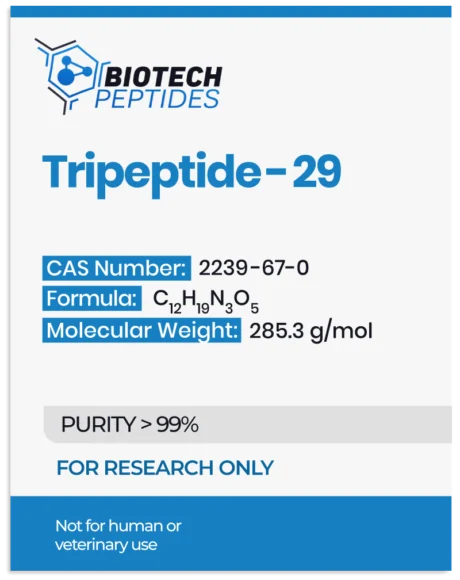
Tripeptide-29 Specifications
| Specification | Details |
|---|---|
| Product Name | Tripeptide-29 |
| Available Quantities | 100mg & 200mg |
| Peptide Type | Synthetic collagen-associated tripeptide |
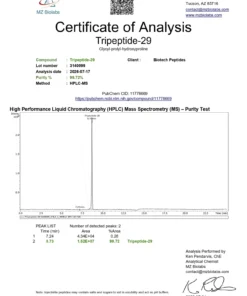
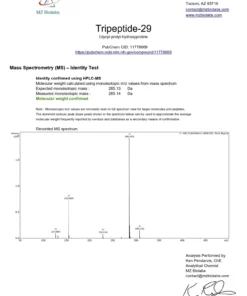
| Molecular Formula | C12H19N3O5 |
| Molecular Weight | 285.3 g/mol |
| Sequence | Gly-Pro-Hyp |
| Research Classification | Research Use Only (RUO) |
What Is Tripeptide-29?
Tripeptide-29 is a short synthetic peptide containing the amino acid sequence Gly-Pro-Hyp. The supplied research material describes this sequence as a collagen building-block motif and a synthetic analog of collagen-associated tripeptide structures.
Collagen molecules contain recurring sequences involving glycine, proline, and hydroxyproline (Hyp). These sequences contribute to the structural organization and stability of collagen. Tripeptide-29 has therefore been investigated as a small molecular model for studying collagen-related molecular interactions.
Beyond collagen research, the supplied material describes experimental interest in Tripeptide-29 involving oxidative stress, glycation, extracellular matrix remodeling, dermal-cell models, coagulation-related pathways, and fibrosis research.
Tripeptide-29 and Collagen Stability Research
One area of Tripeptide-29 research involves the relationship between short collagen-associated peptides and collagen stability. The supplied research describes experiments examining how the amino acid at the C-terminal position of a tripeptide monomer may influence the resulting properties of collagen structures.
Tripeptide-29 contains hydroxyproline (Hyp) as its third amino acid. The supplied material proposes that the hydroxyl group of Hyp may contribute to favorable interatomic interactions involved in collagen stability.
Researchers have also investigated whether the presence of Tripeptide-29-associated sequences within collagen may influence susceptibility to ultraviolet-related damage and collagen degradation under specific experimental conditions.
These studies provide a laboratory framework for examining how small changes in collagen-associated peptide sequences can influence the structural characteristics and stability of larger collagen assemblies.
Tripeptide-29 and Coagulation Research
In-vitro research described in the supplied material has investigated the unpolymerized form of Tripeptide-29 in relation to the glycoprotein VI (GPVI) collagen receptor expressed on platelets.
GPVI is an important research target in platelet biology because collagen-receptor interactions participate in platelet activation and aggregation. Researchers have investigated whether collagen-derived peptide motifs can influence GPVI-associated signaling.
The supplied research describes observations in which Tripeptide-29-containing motifs were associated with tyrosine phosphorylation of Syk and PLCγ2 in platelets. These signaling events were investigated in connection with platelet aggregation.
The source material also describes monomeric collagen-derived peptides as partial agonists of the GPVI receptor and reports that cross-linking of Tripeptide-29 appeared to promote GPVI activation in the experimental setting.
These findings make Tripeptide-29 relevant to laboratory research examining collagen-receptor interactions, platelet signaling, aggregation, and coagulation-related cellular mechanisms. Such research should remain within appropriately controlled laboratory systems.
Tripeptide-29 and Cellular Aging Research
Tripeptide-29 has been investigated in experimental models involving oxidative stress and cellular aging. Free radicals and reactive oxygen species (ROS) are commonly studied because excessive oxidative stress can influence cellular components and extracellular matrix structures.
The supplied research describes collagen hydrolysates containing short peptides such as Tripeptide-29 as potential radical-scavenging systems. Researchers have also investigated whether these peptide-rich hydrolysates may influence the accumulation of advanced glycation end products (AGEs).
AGEs are compounds formed through reactions between sugar molecules and proteins or lipids. Their accumulation has been investigated in relation to changes in the mechanical properties and stability of biological tissues.
The supplied material describes experimental observations suggesting that Tripeptide-29 may influence AGE formation, denatured collagen, reactive oxygen species, and matrix metalloproteinase (MMP) activity. These observations provide research models for examining the relationship between collagen-associated peptides, oxidative stress, glycation, and cellular aging.
Tripeptide-29 and Dermal Cell Research
Laboratory research involving Tripeptide-29 has also examined dermal cells and extracellular matrix behavior. The supplied research describes investigations into collagen type I, MMP activity, oxidative stress, and cellular characteristics associated with dermal tissue.
Researchers have proposed that short collagen-associated peptides may influence the extracellular environment surrounding dermal cells. Experimental models have examined parameters such as hydration, flexibility, tissue structure, and cellular aging.
The supplied material reports that one particular research model observed increased hydration and flexibility in approximately 90% of the research models compared with controls. This reported observation belongs to the specific experimental model described in the source material and should not be interpreted as a demonstrated human outcome.
Tripeptide-29 and Fibrosis Research
Tripeptide-29 has been investigated in laboratory models involving dipeptidyl peptidase IV (DPP4) and fibrosis-related cellular mechanisms.
The supplied research describes experiments involving pigskin, cow skin, fish scales, and chicken feet in which Tripeptide-29 was investigated as a potential inhibitor of DPP4 activity. DPP4 is an enzyme involved in the processing of multiple peptide signaling molecules and has been studied in several areas of cellular and metabolic research.
Experimental research has examined relationships between DPP4 activity and fibrosis-related pathways in different cellular models. The supplied material proposes that Tripeptide-29 may provide an interesting research system for studying the relationship between DPP4-associated signaling, glucose-related cellular processes, and extracellular matrix remodeling.
These findings remain experimental and model-dependent. They provide potential avenues for laboratory investigation rather than established therapeutic conclusions.
Tripeptide-29 and Extracellular Matrix Research
The extracellular matrix contains structural proteins such as collagen and provides an important framework for surrounding cells. Because Tripeptide-29 is composed of a collagen-associated sequence, it has been investigated as a research tool for studying extracellular matrix biology.
Research involving Tripeptide-29 can examine collagen synthesis, collagen stability, MMP activity, oxidative stress, glycation, and other molecular processes that influence extracellular matrix structure.
The small molecular size of Tripeptide-29 has also generated research interest concerning peptide mobility and interactions within experimental biological systems. The supplied material proposes that this characteristic may contribute to its experimental bioavailability, although the exact behavior depends on the research model and experimental conditions.
Tripeptide-29 Research Areas
- Collagen research: Investigation of collagen-associated sequences, structure, and stability.
- GPVI research: Study of collagen-receptor interactions and platelet signaling.
- Coagulation research: Investigation of platelet activation and aggregation pathways in controlled models.
- Oxidative-stress research: Examination of reactive oxygen species and radical-scavenging mechanisms.
- Glycation research: Study of advanced glycation end products and their relationship to collagen stability.
- Dermal cell research: Investigation of collagen type I and extracellular matrix activity.
- MMP research: Examination of matrix metalloproteinase activity and ECM remodeling.
- Fibrosis research: Investigation of DPP4-associated pathways and fibrotic cellular models.
- Cellular aging research: Study of oxidative stress, collagen degradation, and age-associated cellular changes.
Why Choose Tripeptide-29 100mg & 200mg for Research?
Tripeptide-29 provides researchers with a defined synthetic Gly-Pro-Hyp tripeptide model for investigating collagen-related molecular processes. Its short sequence makes it useful for controlled studies examining peptide structure, collagen stability, extracellular matrix interactions, and cellular signaling.
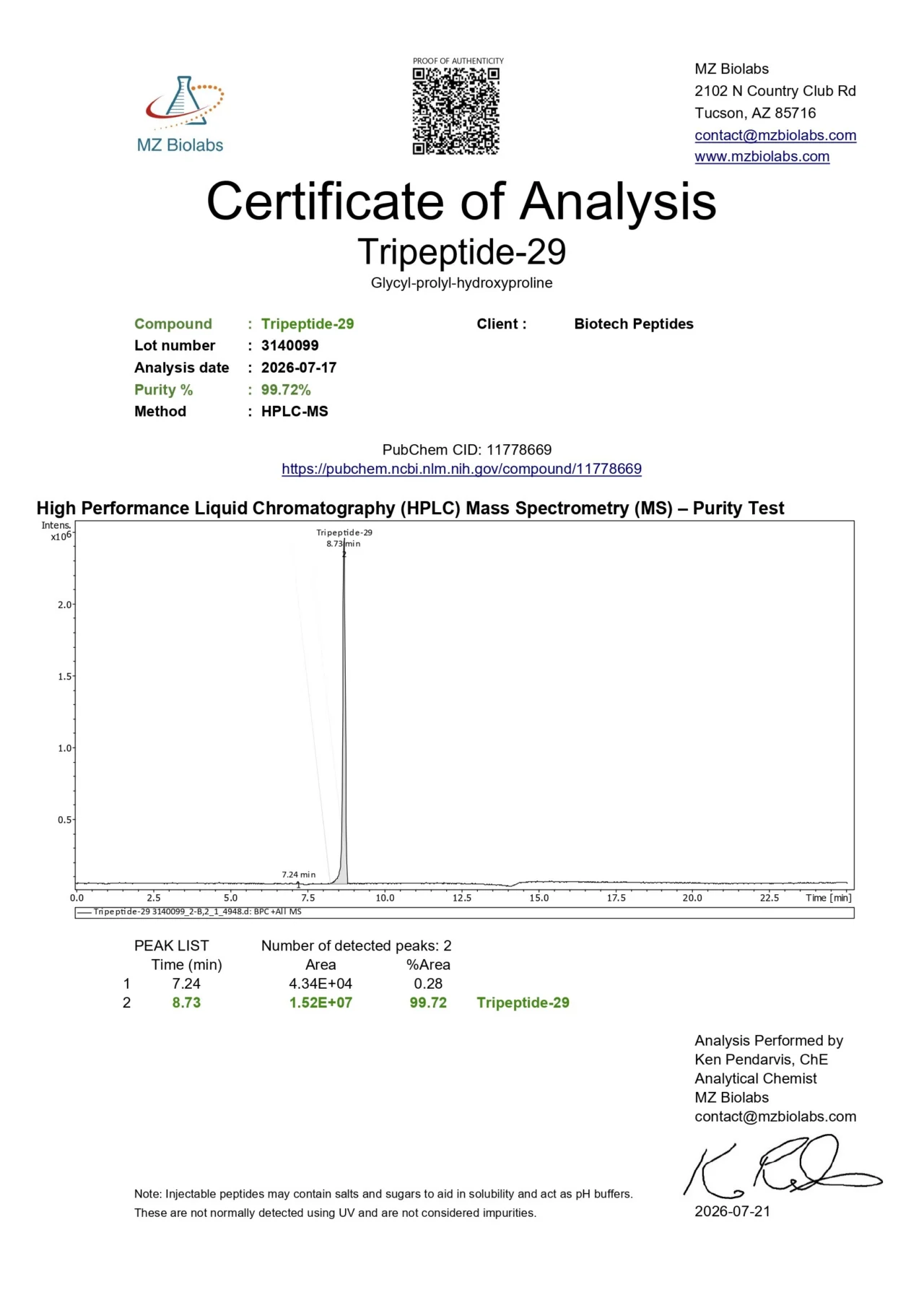
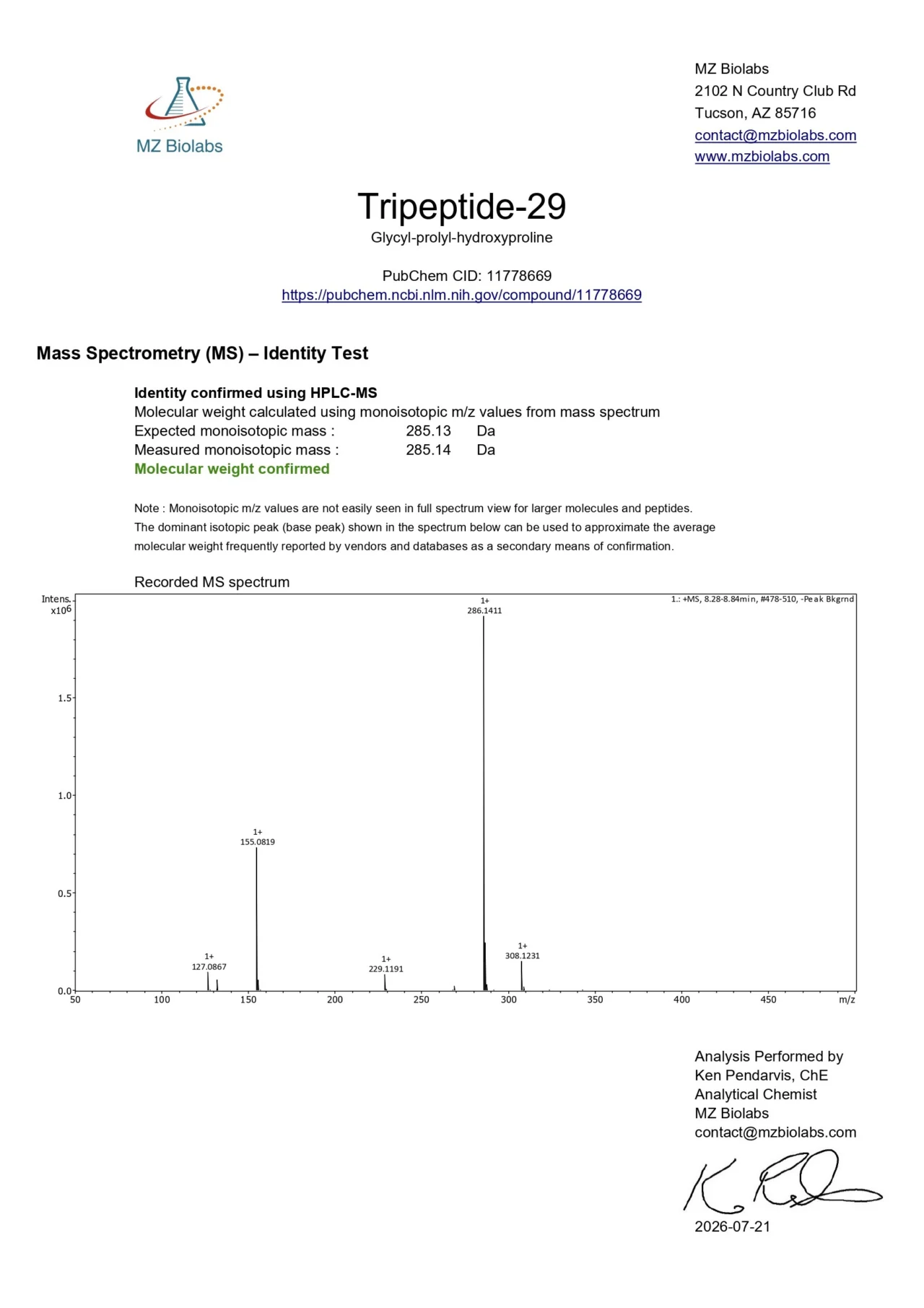
The 100mg and 200mg Tripeptide-29 options provide different quantities for laboratory workflows. Researchers should refer to the applicable batch documentation and analytical records for product-specific information not included in the specifications above.
Tripeptide-29 FAQ
What is Tripeptide-29?
Tripeptide-29 is a synthetic tripeptide with the sequence Gly-Pro-Hyp. It has been investigated in laboratory research involving collagen stability, extracellular matrix biology, oxidative stress, cellular aging, coagulation-related pathways, and fibrosis research.
What is the molecular weight of Tripeptide-29?
The molecular weight provided in the supplied specifications is 285.3 g/mol.
What is the Tripeptide-29 sequence?
The supplied sequence is Gly-Pro-Hyp, consisting of glycine, proline, and hydroxyproline.
What is Tripeptide-29 studied for?
Tripeptide-29 has been studied in laboratory models involving collagen stability, GPVI and platelet signaling, oxidative stress, advanced glycation end products, matrix metalloproteinases, dermal cells, extracellular matrix remodeling, and DPP4-associated fibrosis research.
What quantities of Tripeptide-29 are available?
This product is available in 100mg and 200mg quantities.
Is Tripeptide-29 intended for human use?
No. Tripeptide-29 is supplied strictly for Research Use Only (RUO). It is intended for qualified laboratory research and is not intended for human or veterinary use, consumption, diagnosis, treatment, or prevention of any disease or medical condition.
Research Use Only Disclaimer
IMPORTANT — RESEARCH USE ONLY: Tripeptide-29 100mg & 200mg is supplied strictly as a laboratory research material. This product is not intended for human consumption, human administration, veterinary use, diagnosis, treatment, cure, mitigation, or prevention of any disease or medical condition.
This material is intended only for qualified researchers conducting appropriate in-vitro, cellular, biochemical, or other controlled scientific research. Researchers are responsible for determining appropriate handling, storage, experimental procedures, safety measures, and regulatory requirements applicable to their work.
All research observations described on this page are derived from specific experimental models and conditions. Laboratory findings should not be interpreted as established clinical effects or evidence of safety or efficacy in humans.
| Miligram | 100, 200 |
|---|
Be the first to review “Tripeptide-29 100mg & 200mg | Research Use Only”
Related products
Biotech Peptides
Biotech Peptides
Biotech Peptides
Biotech Peptides
Biotech Peptides
Biotech Peptides
Biotech Peptides
Biotech Peptides
Reviews
There are no reviews yet.