Description
Buy TB-500 Peptide 5mg & 10mg – Thymosin Beta-4 Research
TB-500 research peptide, commonly described as a synthetic Thymosin Beta-4 (Tβ4)-related peptide, is studied in laboratory models involving actin binding, cytoskeletal organization, cell migration, angiogenesis, cellular signaling, and tissue biology. Thymosin Beta-4-related research has examined mechanisms involving globular actin (G-actin), filamentous actin (F-actin), endothelial cells, keratinocytes, extracellular-matrix signaling, and inflammatory pathways.
This TB-500 peptide 5mg & 10mg is supplied strictly for laboratory research, in-vitro experimentation, analytical investigation, and scientific studies. It is not presented for human or veterinary use.
TB-500 Peptide Specifications
| Specification | Details |
|---|---|
| Product Name | TB-500 Peptide |
| Other Known Title | Thymosin Beta-4 |
| Available Sizes | 5mg & 10mg |
| Peptide Classification | Thymosin Beta-4-related research peptide |
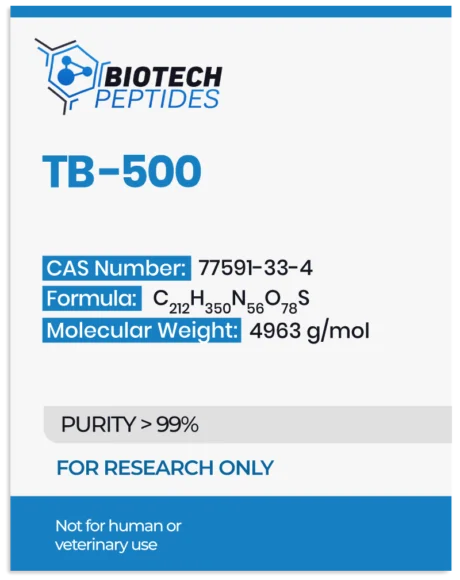
| Molecular Formula | C212H350N56O78S |
| Molecular Weight | 4963 g/mol |
| Supplied Sequence | Ac-Ser-Asp-Lys-Pro-Asp-Met-Ala-Glu-Ile-Glu-Lys-Phe-Asp-Lys-Ser-Lys-Leu-Lys-Lys-Thr-Glu-Thr-Gln-Glu-Lys-Asn-Pro-Leu-Pro-Ser-Lys-Glu-Thy-Ile-Glu-Gln-Glu-Lys-Gln-Ala-Gly-Glu-Ser |
| Research Classification | Research Use Only (RUO) |
Sequence note: The sequence above has been normalized for obvious transcription/formatting artifacts in the supplied source text. Researchers performing analytical or structural work should use the lot-specific certificate of analysis and accompanying documentation as the controlling reference for identity and molecular characterization.
TB-500 and Actin Binding Research
One of the most important areas of TB-500 laboratory research concerns the relationship between Thymosin Beta-4-related peptides and actin dynamics. Actin is a fundamental cytoskeletal protein involved in cell structure, intracellular organization, and cellular movement.
Thymosin Beta-4 contains a conserved actin-binding region commonly associated with the sequence LKKTETQ. Experimental research has investigated how this region interacts with globular actin (G-actin), the monomeric form of actin that can subsequently polymerize into filamentous actin (F-actin).
By studying interactions between peptide sequences and G-actin, researchers can investigate mechanisms regulating actin availability and polymerization. These processes are particularly relevant to experiments involving cytoskeletal organization, cell morphology, cellular motility, and structural remodeling.
TB-500 and Cytoskeletal Signaling
Actin polymerization is an essential component of many cellular processes. Changes in the balance between G-actin and F-actin can influence cell shape, membrane dynamics, migration, and intracellular organization.
TB-500-related research therefore provides an experimental framework for examining how peptide-mediated actin interactions may affect cytoskeletal behavior. Cellular models can be used to evaluate changes in morphology, migration, actin organization, and associated intracellular signaling.
TB-500 and Cell Migration Research
Cell migration is an important process in developmental biology, vascular research, epithelial-cell biology, and tissue-model studies. Research involving Thymosin Beta-4-related peptides has examined cellular movement in endothelial and epithelial cell systems.
Researchers can investigate whether experimental exposure is associated with changes in cellular migration, cytoskeletal rearrangement, extracellular signaling, and related molecular markers. These studies may provide insight into the relationship between actin dynamics and cell movement.
TB-500 and Angiogenesis Research
TB-500 research peptide is also associated with experimental investigations into angiogenesis, the biological process involving the formation and remodeling of vascular networks.
Research models have examined Thymosin Beta-4 expression during early stages of vascular development and have investigated potential relationships between Tβ4-associated signaling, endothelial-cell migration, vascular remodeling, and extracellular-matrix processes.
Laboratory studies can evaluate these mechanisms using endothelial-cell cultures, vascular tissue models, molecular assays, and other controlled experimental systems.
TB-500 and Inflammatory Signaling
Another area of interest involves the interaction between Thymosin Beta-4-related signaling and inflammatory pathways. Experimental research has investigated potential relationships between Tβ4-associated activity and molecular regulators involved in cytokine signaling.
One pathway examined in experimental studies involves microRNA-146a (miR-146a), which participates in the regulation of cellular communication networks associated with inflammatory signaling. Related research has examined proteins such as interleukin-1 receptor-associated kinase 1 (IRAK1) and tumor necrosis factor receptor-associated factor 6 (TRAF6).
These investigations can help characterize how peptide-associated signaling may interact with intracellular regulatory networks. Findings from individual cellular or animal models should remain within the experimental context in which they were observed.
TB-500 and Tissue Model Research
Thymosin Beta-4-related peptides have been investigated in several experimental tissue models, including epithelial and corneal systems. Researchers have examined molecular markers associated with cellular migration, inflammatory signaling, apoptosis, and tissue remodeling.
Experimental work has explored pathways involving interleukins, chemokines, NF-κB signaling, and other molecular regulators. Such models allow researchers to examine relationships between peptide exposure and changes in cellular responses following experimentally induced tissue stress.
These studies are useful for understanding cellular mechanisms but should not be interpreted as evidence of established outcomes outside the specific research model.
TB-500 and Apoptosis Research
Apoptosis is a regulated form of cellular death that plays an important role in tissue development, homeostasis, and response to cellular stress. Research involving Thymosin Beta-4-related systems has examined potential relationships between Tβ4 expression and apoptosis-associated pathways.
Experimental investigations have included caspase-associated signaling, mitochondrial pathways, Akt activation, integrin-linked kinase (ILK), and PINCH-related cellular signaling. These pathways provide researchers with multiple molecular endpoints for evaluating cell-survival mechanisms in controlled laboratory models.
TB-500 and Cardiac Cell Research
Cardiac research represents another experimental area involving Thymosin Beta-4-related signaling. Laboratory studies have examined cardiac fibroblasts, cardiomyocyte-associated pathways, integrin-linked kinase, Akt signaling, and cellular responses following experimentally induced cardiac injury.
Some experimental models have investigated whether Tβ4-associated signaling can influence cardiac-cell survival, cellular reprogramming, tissue remodeling, and regeneration-associated pathways. Murine models and cell-based systems have provided experimental platforms for studying these mechanisms.
These findings are model-specific and should be interpreted as preclinical or laboratory observations rather than established human outcomes.
Key Features of TB-500 Peptide
- Available in 5mg and 10mg research quantities.
- Also known as Thymosin Beta-4 in research literature.
- Molecular weight provided as 4963 g/mol.
- Supplied molecular formula: C212H350N56O78S.
- Relevant to actin-binding and cytoskeletal research.
- Suitable for cell-migration and cellular-morphology studies.
- Applicable to experimental angiogenesis and endothelial-cell research.
- Relevant to inflammatory and microRNA-associated signaling studies.
- Useful for apoptosis and cellular-survival pathway investigations.
- Applicable to experimental tissue and cardiac-cell research models.
- Supplied strictly for Research Use Only.
Potential TB-500 Laboratory Research Applications
Researchers may investigate TB-500 and Thymosin Beta-4-related signaling in controlled experimental systems involving:
- Actin-binding and actin-polymerization studies
- G-actin and F-actin research
- Cytoskeletal organization and cellular morphology
- Cell-migration assays
- Endothelial-cell research
- Angiogenesis and vascular remodeling models
- Keratinocyte and epithelial-cell studies
- Inflammatory signaling research
- miR-146a, IRAK1, and TRAF6 pathway studies
- NF-κB signaling investigations
- Apoptosis and cell-survival research
- Akt and integrin-linked kinase pathway studies
- Cardiac-cell and tissue-remodeling models
- Peptide structure-function investigations
Handling and Storage of TB-500 Research Peptide
TB-500 should be handled by qualified laboratory personnel using appropriate laboratory safety procedures. Researchers should follow the storage conditions and handling instructions supplied with the specific product and lot.
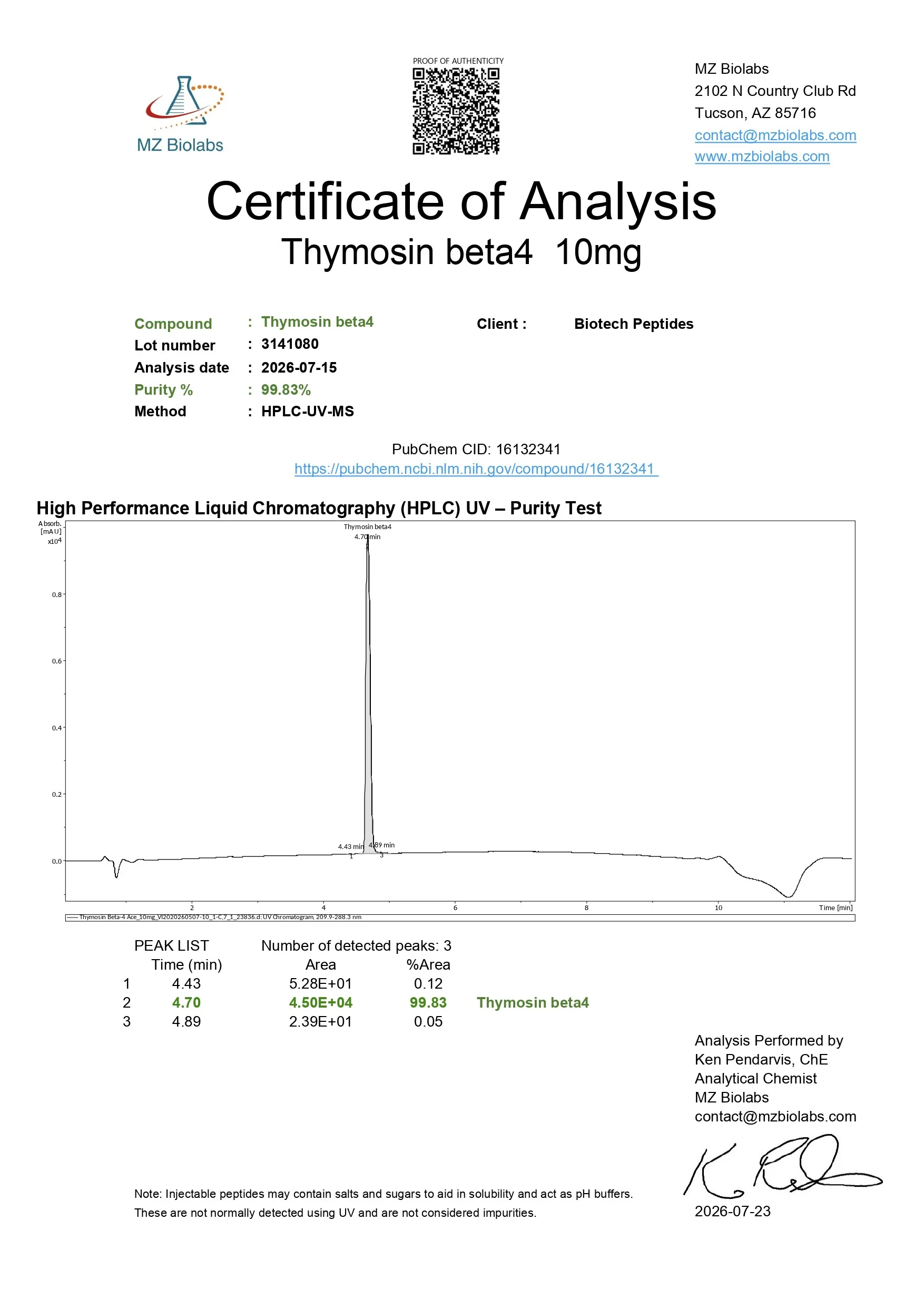
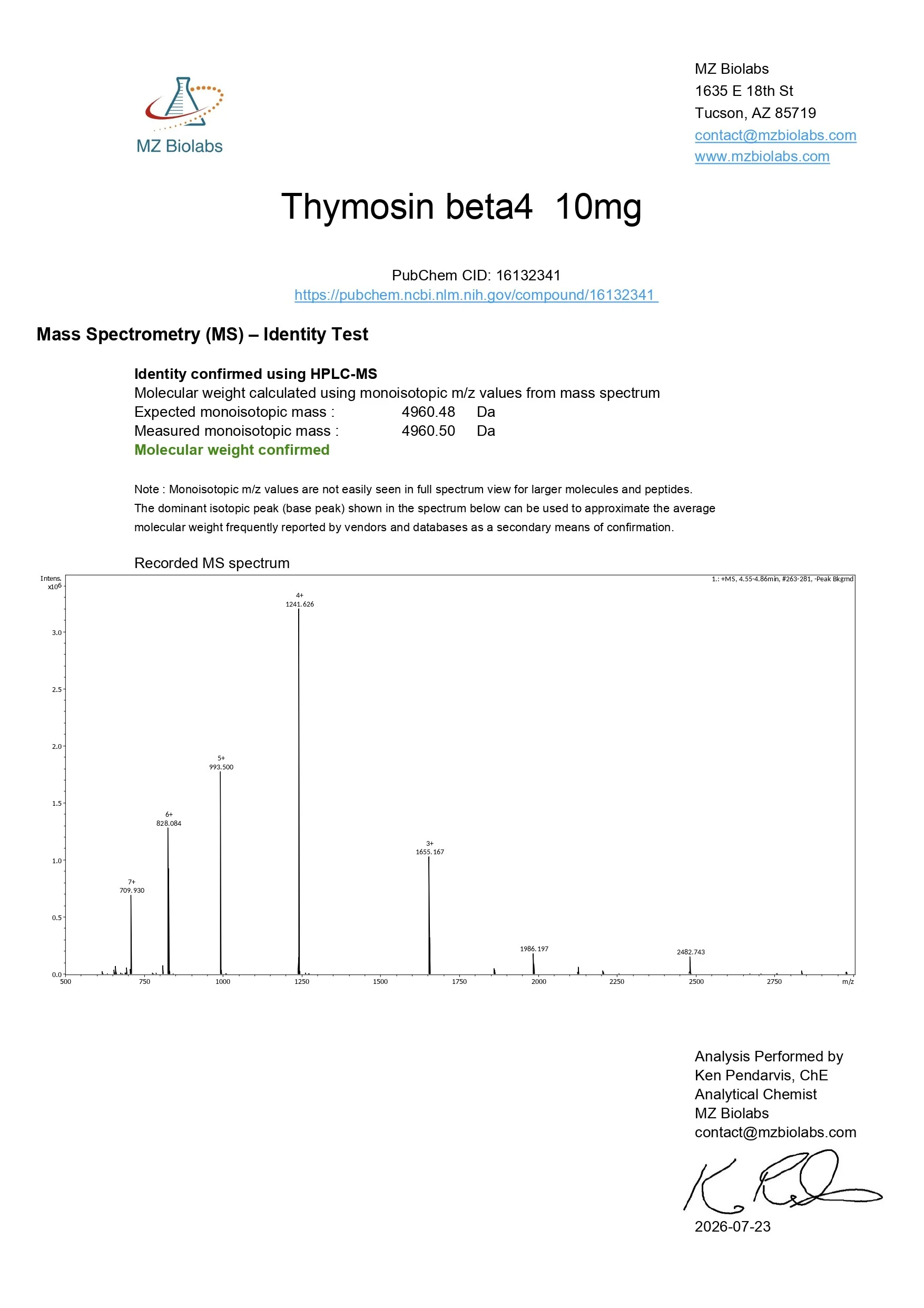
For analytical and experimental applications, researchers should rely on lot-specific documentation for identity, purity, molecular characterization, and other batch-dependent specifications. Appropriate laboratory procedures should be established according to the intended experimental system.
Frequently Asked Questions About TB-500
What is TB-500?
TB-500 is commonly described as a synthetic Thymosin Beta-4-related peptide used in laboratory research involving actin binding, cytoskeletal organization, cellular migration, angiogenesis, and intracellular signaling.
What sizes of TB-500 are available?
This research product is available in 5mg and 10mg quantities.
What is the molecular weight of TB-500?
The molecular weight provided for this product is 4963 g/mol. Researchers performing analytical work should verify molecular characterization against the applicable lot-specific documentation.
What is TB-500 studied for?
TB-500-related research includes investigations into actin dynamics, cytoskeletal organization, cellular migration, angiogenesis, inflammatory signaling, apoptosis, tissue models, and cardiac-cell signaling.
What is the relationship between TB-500 and Thymosin Beta-4?
TB-500 is commonly described as a synthetic Thymosin Beta-4-related peptide. Researchers should distinguish the exact molecular material under investigation and verify identity using the product’s lot-specific analytical documentation.
Is TB-500 intended for human use?
No. This product is supplied strictly as a Research Use Only (RUO) material for qualified laboratory research, in-vitro experimentation, and scientific investigation.
Research Use Only Disclaimer
FOR RESEARCH USE ONLY (RUO). TB-500 Peptide is supplied exclusively for laboratory research, in-vitro testing, analytical research, and scientific investigation. It is not intended for human consumption, veterinary use, diagnosis, disease management, or use as a food, dietary supplement, cosmetic, or approved drug. This material is intended for qualified laboratory personnel using appropriate safety procedures and following applicable institutional requirements and laws. Findings from cellular or animal research models should not be interpreted as established outcomes in humans. The purchaser is responsible for determining appropriate laboratory use, handling, storage, and regulatory compliance.

Reviews
There are no reviews yet.