Description
BPC-157 Peptide – Research Use Only
BPC-157 peptide is a synthetic pentadecapeptide consisting of 15 amino acids and associated with the endogenous Body Protection Compound (BPC) sequence described in the supplied research material. BPC-157 has been investigated extensively in preclinical experimental models involving cellular signaling, tissue biology, vascular processes, gastrointestinal research, oxidative stress, and connective-tissue studies.
For laboratory researchers, BPC-157 research peptide provides a defined peptide sequence for controlled experimental investigations. Published experimental work has examined its interaction with fibroblasts, endothelial cells, vascular signaling pathways, inflammatory markers, oxidative-stress models, and tissue-repair mechanisms.
This product is intended strictly for research use only (RUO). It is not intended for human or veterinary use, diagnosis, treatment, prevention, or mitigation of disease.
BPC-157 Peptide Specifications
| Specification | Details |
|---|---|
| Product Name | BPC-157 Peptide |
| Alternative Name | Body Protection Compound-157 |
| Peptide Class | Pentadecapeptide |
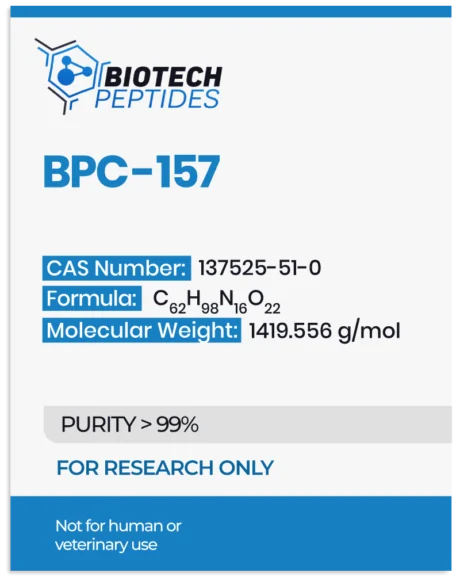
| Molecular Formula | C62H98N16O22 |
| Molecular Weight | 1419.556 g/mol |
| Sequence | L-Valine,glycyl-L-alpha-glutamyl-L-prolyl-L-prolyl-Lprolylglycyl-L-lysyl-L-prolyl-L-alanyl-L-alpha-aspartyl-L-alpha-aspartyl-L-alanylglycyl-L-leucyl-;glycyl-L-alpha-glutamyl-L-prolyl-L-prolyl-L-prolylglycyllysyl-L-prolyl-L-alanyl-L- alpha-aspartylL-alpha-aspartyl-L-alanylglycyl-L-leucyl-L-valine |
| Research Classification | Research Use Only |
Note: The sequence above is reproduced from the supplied source material. Researchers should verify sequence notation and batch-specific analytical information against the applicable certificate of analysis or technical documentation before experimental use.
BPC-157 Research Peptide
Research involving BPC-157 has explored several biological systems and experimental pathways. The following sections summarize the research areas described in the supplied material without presenting the findings as established clinical effects.
BPC-157 and Wound-Healing Research
Experimental research has investigated BPC-157 in models examining fibroblast activity, extracellular-matrix processes, cellular migration, and wound closure.
Fibroblasts are important cells involved in extracellular-matrix production, including proteins associated with connective-tissue structure. Experimental observations described in the supplied material suggest that BPC-157 may influence fibroblast proliferation and migration in a concentration-dependent manner.
Additional laboratory research has examined processes associated with granulation tissue formation, reepithelialization, dermal remodeling, and collagen deposition. Studies have also investigated potential relationships between BPC-157 and vascular endothelial growth factor (VEGF) expression.
Cell-based experiments involving human umbilical vein endothelial cells (HUVECs) have examined endothelial-cell proliferation, migration, VEGF-related signaling, and vascular-tube formation. Additional pathway research has investigated ERK1/2 phosphorylation and downstream signaling involving c-Fos, c-Jun, and Egr-1.
These findings make BPC-157 a subject of continued investigation in experimental cell-biology and tissue-repair models.
BPC-157 and Vascular Growth Research
Another area of BPC-157 research involves vascular biology and experimental angiogenesis models.
The supplied research describes investigations into endothelial-cell growth and proliferation as well as collateral blood-vessel development in animal models. Experimental observations have included vascular responses in gastrointestinal, muscular, neurological, and cardiovascular tissues.
Research involving chicken embryos has also examined potential relationships between BPC-157 and the VEGFR2 pathway. VEGFR2 is an endothelial-cell receptor involved in vascular signaling and cellular responses.
In cultured-cell models, researchers have investigated vascular growth toward areas associated with injury or altered cellular environments. These experiments provide a basis for studying BPC-157 in controlled vascular-biology systems.
BPC-157 and Tendon-Cell Research
BPC-157 has also been investigated in experimental models involving tendon and connective-tissue biology.
Studies described in the supplied material examined tendon fibroblast outgrowth, cellular migration, adhesion, cytoskeletal organization, and responses to oxidative stress. Experimental work involving rat tendon models has investigated fibroblast density and cellular responses at sites of experimental injury.
Cell-culture experiments have further examined BPC-157 exposure in tendon fibroblasts, including migration through transwell assays and cellular spreading on culture surfaces.
Additional laboratory analysis has investigated F-actin formation and signaling involving focal adhesion kinase (FAK) and paxillin. Changes in phosphorylation of these proteins have been studied in relation to fibroblast migration and adhesion.
These experiments make BPC-157 relevant to researchers investigating fibroblast biology, cell migration, cytoskeletal organization, and connective-tissue signaling.
BPC-157 and Oxidative-Stress Research
Experimental models have investigated the relationship between BPC-157 and oxidative-stress markers.
The supplied research describes studies examining nitric oxide, malondialdehyde (MDA), and reactive oxygen species in experimental gastrointestinal models. Other experimental work has evaluated cellular responses to oxidative stress in tendon-related systems.
Research has also examined inflammatory and vascular markers, including myeloperoxidase (MPO) activity and vascular-index measurements, in experimental models.
These investigations provide research directions for studying the interaction between peptide exposure, oxidative-stress markers, cellular signaling, and vascular responses.
BPC-157 and Central Nervous System Research
BPC-157 has been investigated in experimental central-nervous-system models, including a murine traumatic-brain-injury research model.
The supplied material describes experiments examining neurological injury outcomes, brain edema, hemorrhagic lesions, and other indicators following experimentally induced traumatic brain injury.
Such studies provide an experimental framework for investigating peptide-associated cellular and vascular responses in neurological research. These findings are preclinical and should not be interpreted as evidence of clinical efficacy.
BPC-157 Research in Invertebrate Models
Research involving BPC-157 has also extended beyond mammalian models.
The supplied material describes experimental work involving bees and investigations into gastrointestinal processes associated with Nosema ceranae and colony health. BPC-157 exposure through experimental bee-food formulations was investigated in relation to gastrointestinal and colony-survival observations.
This provides an additional example of how BPC-157 has been studied across different biological models and research environments.
Key Research Areas for BPC-157
Researchers investigating BPC-157 research peptide may encounter experimental literature involving:
- Fibroblast proliferation and migration
- Endothelial-cell research
- VEGF-related signaling
- VEGFR2 pathway investigations
- ERK1/2 signaling
- FAK and paxillin phosphorylation
- F-actin and cytoskeletal organization
- Collagen and extracellular-matrix research
- Vascular-growth models
- Oxidative-stress experiments
- Nitric oxide and MDA measurements
- Myeloperoxidase activity
- Gastrointestinal experimental models
- Tendon and connective-tissue research
- Neurological injury models
- Invertebrate research models
BPC-157 Molecular Weight and Sequence
The supplied specifications identify the molecular formula of BPC-157 as C62H98N16O22 and the molecular weight as 1419.556 g/mol.
The supplied source identifies BPC-157 as a 15-amino-acid peptide and provides the sequence listed in the specifications table above. Because peptide sequence notation in the supplied material contains repeated and non-standard formatting, researchers should use the applicable batch documentation or certificate of analysis to confirm the exact sequence representation associated with a specific research material.
Laboratory Research and Documentation
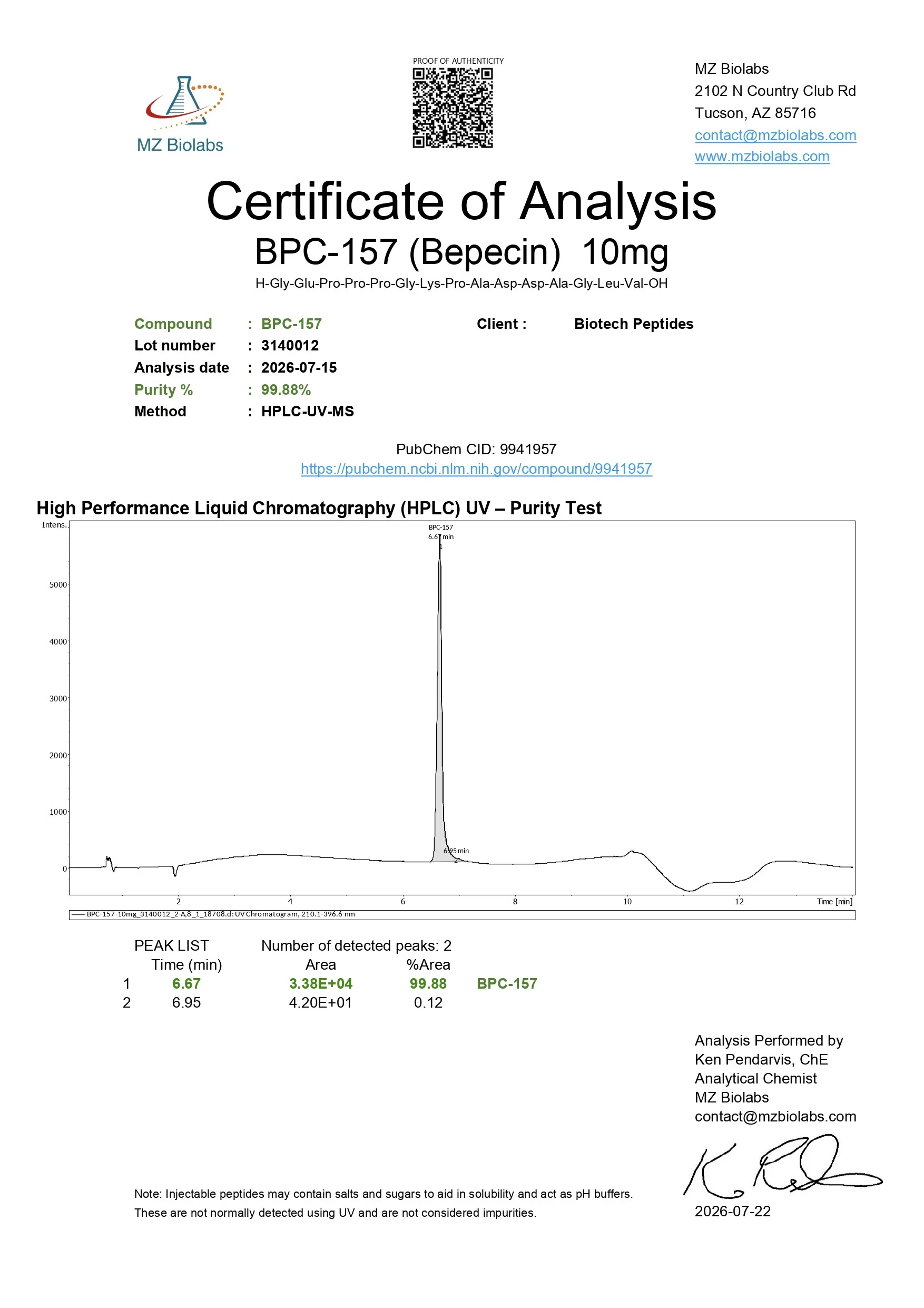
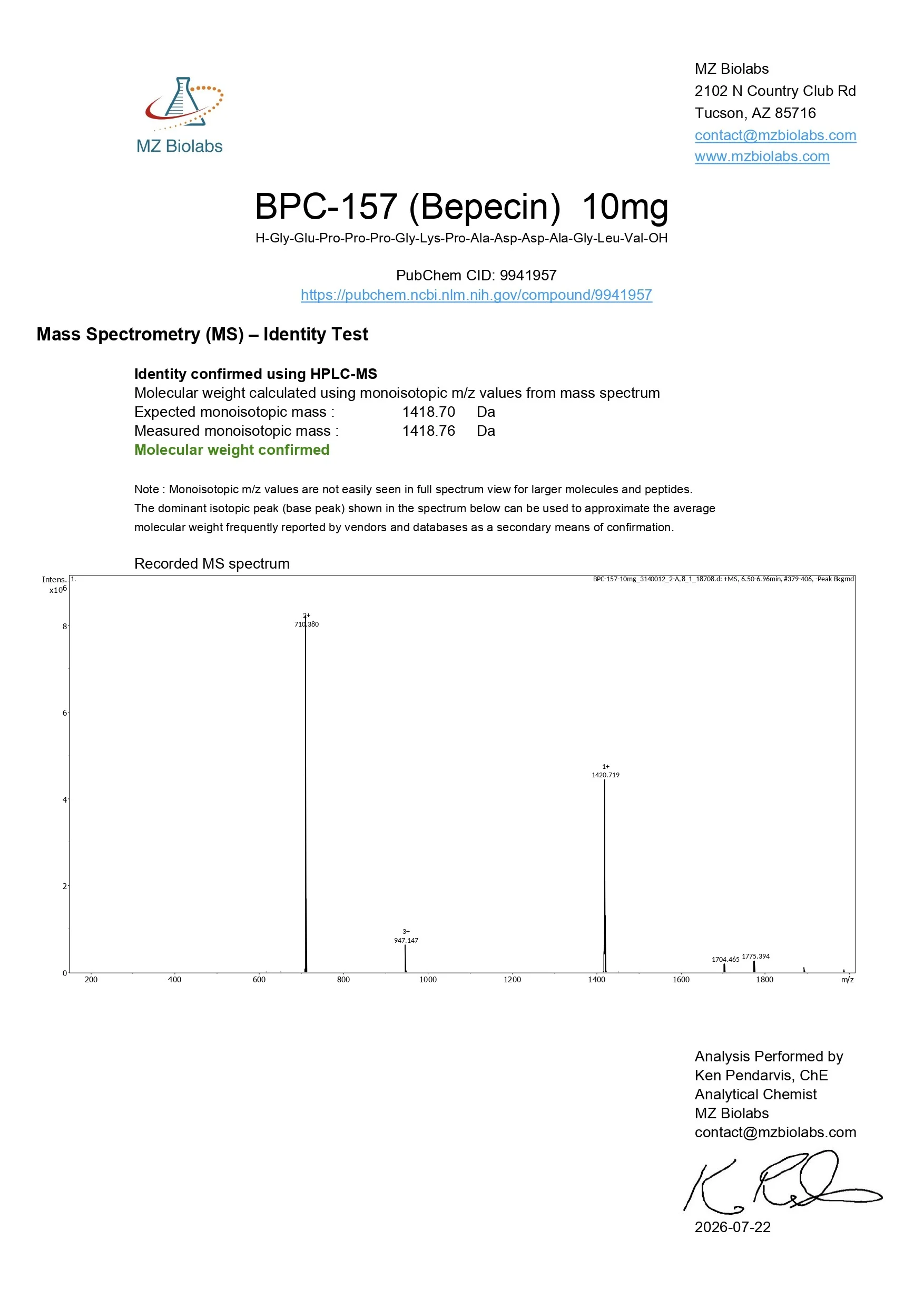
For experimental work, researchers should review the available product documentation before incorporating BPC-157 into a study. Relevant documentation may include batch identification, analytical characterization, peptide sequence confirmation, purity information, and other manufacturer-provided specifications.
Where a particular analytical specification is not provided, researchers should refer to the applicable batch-specific documentation rather than assuming a value.
Frequently Asked Questions
What is BPC-157 peptide?
BPC-157 is a 15-amino-acid peptide associated with the Body Protection Compound sequence described in the supplied research material. It has been investigated in a variety of preclinical and laboratory research models.
What is the molecular weight of BPC-157?
The supplied specification identifies the molecular weight of BPC-157 as 1419.556 g/mol with the molecular formula C62H98N16O22.
What is BPC-157 used for in research?
BPC-157 has been investigated experimentally in areas including fibroblast biology, endothelial-cell research, vascular signaling, oxidative-stress models, connective-tissue research, gastrointestinal models, and neurological research.
Is BPC-157 for human use?
No. This product is presented strictly as a Research Use Only (RUO) material. It is not intended for human or veterinary use, diagnosis, treatment, prevention, or mitigation of disease.
Where can researchers find BPC-157 sequence information?
The supplied specification identifies a BPC-157 peptide sequence, which is reproduced above. Researchers should verify sequence notation against the applicable certificate of analysis or technical documentation for the specific research material.
Research Use Only Disclaimer
RESEARCH USE ONLY (RUO): BPC-157 peptide is intended exclusively for qualified laboratory and scientific research. This material is not intended for human consumption, veterinary use, clinical use, diagnosis, treatment, prevention, or mitigation of any disease or medical condition. It must not be marketed or represented as a drug, dietary supplement, therapeutic agent, or medical treatment. Researchers are responsible for handling, storage, experimental design, regulatory compliance, and appropriate laboratory safety procedures applicable to their work.

Reviews
There are no reviews yet.