

Description
Buy Adipotide FTPP 5mg – Research Peptide
Adipotide FTPP, also known as Adipotide, is a synthetic research peptide investigated in laboratory studies involving peptide structure, receptor interactions, cellular pathways, and adipose-tissue biology. Researchers have examined the peptide in experimental models to investigate interactions involving Annexin A2 (ANXA2), prohibitin (PHB), and related molecular pathways.
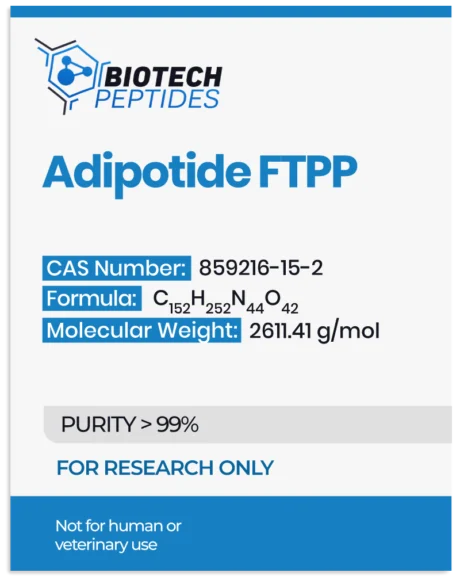
Researchers looking to buy Adipotide FTPP 5mg for qualified laboratory work can use the documented molecular profile and peptide sequence as reference information for analytical and scientific studies. The supplied material identifies Adipotide FTPP with a molecular formula of C152H252N44O42, a reported molecular weight of 2611.41 g/mol, and a sequence described as Cys-Lys-Gly-Gly-Arg-Ala-Lys-Asp-Cys-Gly-Gly-(Lys-Leu-Ala-Lys-Leu-Ala-Lys)2.
This product is intended strictly for laboratory research, in-vitro scientific studies, analytical characterization, and other non-clinical research applications. It is not intended for human or veterinary consumption.
Buy Adipotide FTPP 5mg for Laboratory Research
Buy Adipotide FTPP 5mg for research applications involving synthetic peptide characterization and experimental investigation of peptide-receptor interactions. The supplied research material describes Adipotide as a peptide incorporating a targeting sequence and a proapoptotic peptide component, making its molecular structure relevant to laboratory investigations of cellular signaling and peptide-mediated interactions.
The source material identifies Adipotide under the alternative title Adipotide and provides defined molecular characteristics for laboratory reference. Researchers should use the batch-specific documentation accompanying the material when verifying identity, purity, and other analytical characteristics rather than relying solely on general product information.
Adipotide FTPP Research and Scientific Profile
Adipotide FTPP has been investigated in experimental research concerning molecular interactions associated with ANXA2 and prohibitin. The supplied research material describes an interaction involving ANXA2, PHB, and CD36 in studies examining fatty-acid transport pathways associated with white adipose tissue. These findings provide a scientific context for investigating peptide-receptor interactions and cellular mechanisms in controlled research models.
From a structural perspective, the supplied material describes Adipotide as consisting of the sequence GKGGRAKDC-GG-D(KLAKLAK)2. The source further identifies the CKGGRAKDC component as a peptide sequence investigated for its association with prohibitin-related molecular targets.
The material also describes the KLAKLAK component as a proapoptotic peptide sequence investigated in cellular research. These structural characteristics make Adipotide relevant to laboratory studies examining peptide architecture, molecular targeting, cellular signaling, and related experimental systems.
Adipotide Molecular Weight, Formula & Peptide Sequence
| Specification | Reported Information |
|---|---|
| Product Name | Adipotide FTPP Peptide |
| Other Known Title | Adipotide |
| Peptide Type | Synthetic research peptide |
| Molecular Formula | C152H252N44O42 |
| Molecular Weight | 2611.41 g/mol |
| Reported Sequence | Cys-Lys-Gly-Gly-Arg-Ala-Lys-Asp-Cys-Gly-Gly-(Lys-Leu-Ala-Lys-Leu-Ala-Lys)2 |
| Structural Description | GKGGRAKDC-GG-D(KLAKLAK)2 |
| Intended Application | Laboratory research and in-vitro scientific studies |
The molecular formula, molecular weight, and sequence above are reproduced from the supplied product research material. Researchers should verify the identity and analytical characteristics of the specific lot against its applicable documentation before beginning an experiment.
Adipotide FTPP Structure and Research Applications
The structure of Adipotide FTPP is of particular interest in research because it combines a peptide sequence investigated for molecular targeting with a proapoptotic peptide component. The supplied research material discusses CKGGRAKDC in connection with prohibitin-associated molecular interactions and describes the KLAKLAK sequence as part of the peptide’s structural design.
Laboratory researchers may therefore investigate Adipotide in controlled experimental systems where peptide structure, molecular recognition, cellular signaling, or peptide-mediated biological interactions are being examined. Results from experimental models should be interpreted within the limitations of the particular research system and should not be extrapolated into claims of clinical performance.
Key Research Characteristics
- Defined molecular identity: The supplied material provides a molecular formula and molecular weight for analytical reference.
- Defined peptide sequence: The reported sequence can be used for research documentation and peptide characterization.
- Targeting-related research: Experimental literature has investigated the CKGGRAKDC component in relation to prohibitin-associated molecular interactions.
- Proapoptotic peptide research: The KLAKLAK component has been investigated in cellular research involving programmed cell-death pathways.
- Cellular pathway studies: Research has examined relationships involving ANXA2, prohibitin, and CD36.
- Non-clinical application: The product is positioned strictly for laboratory research and in-vitro scientific investigation.
Adipotide FTPP Research Areas
The supplied research material describes several areas in which Adipotide FTPP has been investigated, including molecular targeting, adipose-tissue biology, cellular signaling, and peptide structure. Research concerning ANXA2 and prohibitin has examined how these proteins may participate in molecular interactions associated with white adipose tissue and fatty-acid transport.
Additional experimental work described in the supplied material has investigated Adipotide in relation to cellular pathways and experimental models. These studies provide background for scientific investigation but do not establish the suitability of the material for human or veterinary use.
Quality Documentation and Analytical Verification
Researchers evaluating Adipotide FTPP should review the documentation supplied with the applicable batch. Analytical verification should be based on actual lot-specific records rather than assumed specifications.
Where analytical testing is supplied, researchers should review the applicable documentation for information such as peptide identity and purity. This product description does not independently establish a particular purity percentage, HPLC result, mass-spectrometry result, or third-party certification because those details were not included in the supplied source material.
Frequently Asked Questions About Adipotide FTPP
What is Adipotide FTPP?
Adipotide FTPP is a synthetic research peptide also identified as Adipotide. The supplied research material describes investigations involving its molecular structure, peptide-receptor interactions, and cellular pathways.
What is the molecular weight of Adipotide?
The reported molecular weight of Adipotide FTPP is 2611.41 g/mol. The reported molecular formula is C152H252N44O42.
What is the Adipotide FTPP peptide sequence?
The supplied specification lists the sequence as Cys-Lys-Gly-Gly-Arg-Ala-Lys-Asp-Cys-Gly-Gly-(Lys-Leu-Ala-Lys-Leu-Ala-Lys)2. The research section also describes the structural sequence as GKGGRAKDC-GG-D(KLAKLAK)2.
What is Adipotide FTPP used for?
This product is supplied strictly for qualified laboratory research, in-vitro scientific investigation, analytical characterization, and other non-clinical research applications. It is not intended for human or veterinary use.

Reviews
There are no reviews yet.