
Description
GHRP-2 Peptide 5mg & 10mg– Research Use Only
GHRP-2 peptide, also known as Pralmorelin, is a synthetic peptide that has been extensively investigated in experimental research involving growth hormone secretagogue receptors (GHS-Rs), pituitary signaling, cellular pathways, muscle biology, appetite regulation, sleep research, cardiovascular models, and immune-system studies.
GHRP-2 is described in the supplied research material as a pentapeptide associated with the ghrelin/growth hormone secretagogue receptor system. Laboratory research has examined how GHRP-2 interacts with receptor-mediated signaling pathways and how experimental exposure may influence downstream cellular processes involving G-proteins, phospholipase C (PLC), intracellular calcium, protein kinase C (PKC), and cyclic AMP (cAMP).
For researchers, GHRP-2 research peptide provides a defined peptide material for controlled laboratory investigations involving receptor biology and related cellular signaling systems.
This product is intended strictly for Research Use Only (RUO). It is not intended for human or veterinary use, diagnosis, treatment, prevention, or mitigation of disease.
GHRP-2 Peptide Specifications
| Specification | Details |
|---|---|
| Product Name | GHRP-2 Peptide |
| Other Known Name | Pralmorelin |
| Other Known Title Provided | Thymosin Beta 4 |
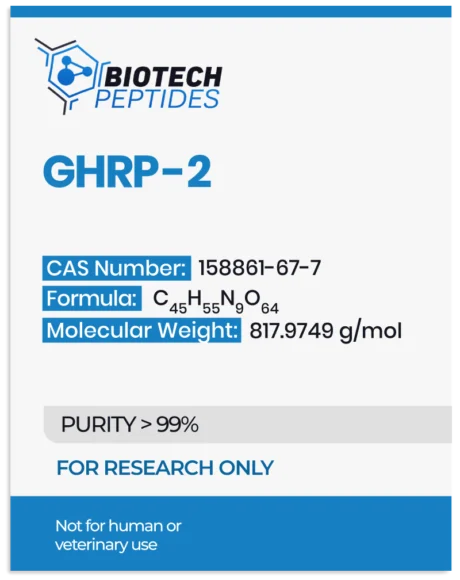
| Molecular Formula | C45H55N9O6 |
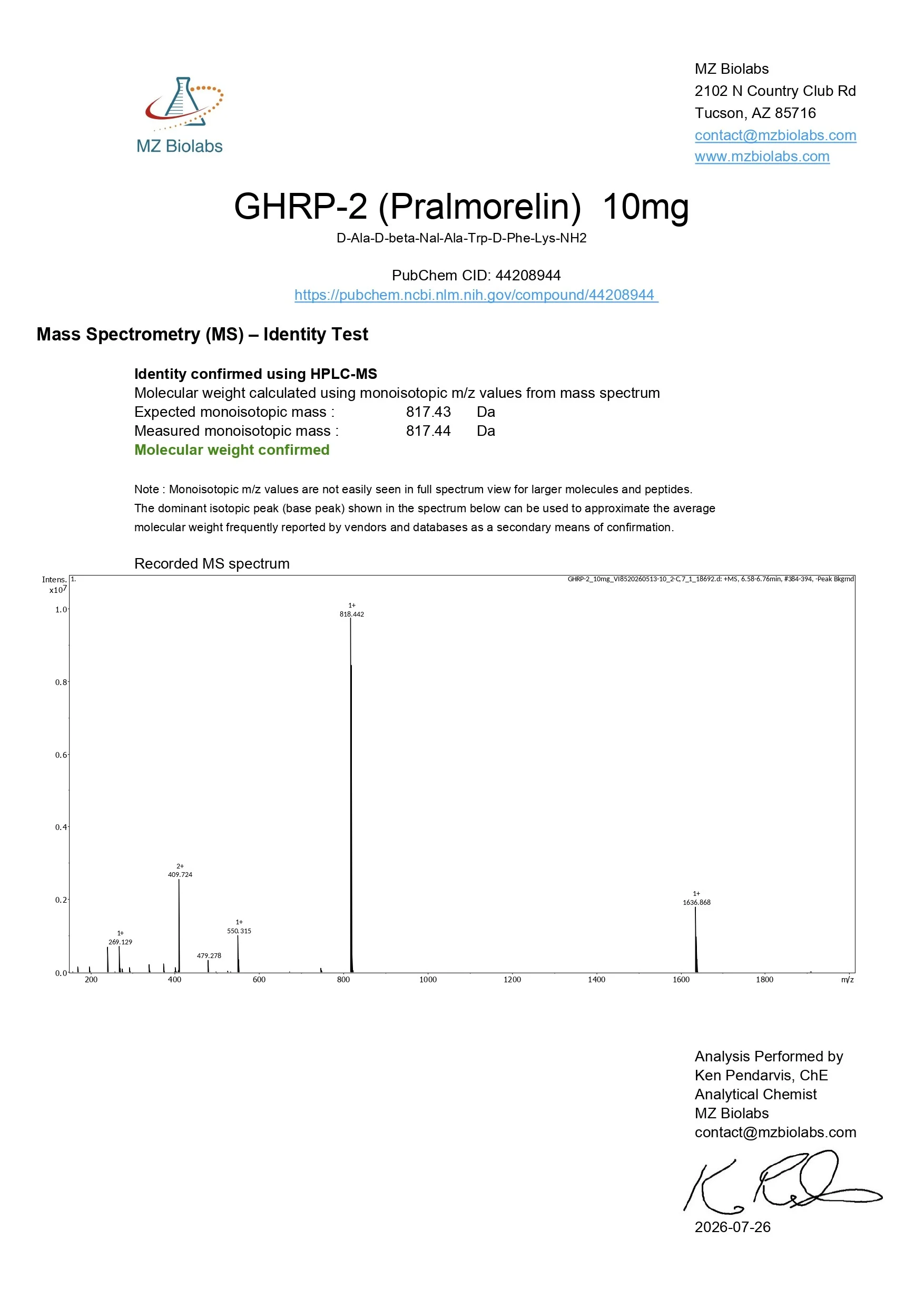
| Molecular Weight | 817.9 g/mol |
| Sequence | H-D-Ala-D-2-Nal-Ala-Trp-D-Phe-Lys-NH2 |
| Research Classification | Research Use Only |
Sequence note: The sequence and alternate-title information above are reproduced from the supplied source material. Researchers should verify sequence nomenclature and batch-specific analytical information against the applicable certificate of analysis or technical documentation.
GHRP-2 Research Peptide
GHRP-2 has been the subject of experimental research across several biological systems. Much of the research described in the supplied material centers on its interaction with growth hormone secretagogue receptors and the downstream signaling pathways associated with these receptors.
The following sections summarize the supplied research material in a laboratory and preclinical context.
GHRP-2 and Pituitary-Gland Research
One of the major research areas involving GHRP-2 research peptide is pituitary signaling.
Growth hormone secretagogue receptors (GHS-Rs) are associated with the ghrelin signaling system and are found in tissues including the hypothalamus and pituitary gland. Experimental research has investigated whether GHRP-2 binding to these receptors can initiate intracellular signaling through G-protein-associated pathways.
The supplied research describes a proposed signaling sequence involving Gαq/11, phospholipase C (PLC), phosphatidylinositol 4,5-bisphosphate (PIP2), inositol trisphosphate (IP3), diacylglycerol (DAG), intracellular calcium, and protein kinase C (PKC).
Researchers have also examined potential involvement of cyclic AMP (cAMP) in downstream signaling.
These pathways provide an experimental framework for studying how peptide-receptor interactions can influence signaling activity in pituitary-cell models.
Research has additionally examined potential receptor desensitization following GHRP-2 exposure. The supplied material describes an experimental observation in which receptor sensitivity may temporarily decline following exposure before subsequently recovering.
GHRP-2 and Growth-Hormone Signaling Research
GHRP-2 has been investigated extensively in experimental studies examining growth-hormone secretion from pituitary cells.
The supplied research describes laboratory observations involving somatotroph cells and pulsatile growth-hormone secretion. Experimental investigations have compared GHRP-2-associated signaling with pathways stimulated by growth hormone-releasing hormone (GHRH).
Research has also examined potential relationships between GHRP-2 exposure and other endocrine signaling markers, including ACTH, cortisol, and insulin-like growth factor-1 (IGF-1).
Some experimental studies described in the source reported substantial changes in measured growth-hormone secretion under specific laboratory conditions. These findings are experimental observations and should be interpreted according to the model, experimental design, concentration, exposure conditions, and analytical methodology used in each individual study.
GHRP-2 and Muscle-Cell Research
Another research area involves muscle structure and protein metabolism.
Experimental research in yak models investigated whether GHRP-2 exposure was associated with changes in muscle protein synthesis and protein degradation pathways. The supplied material describes observations involving increased protein deposition and potential changes in pathways associated with muscle-protein turnover.
Particular attention was given to proteins including atrogin-1 and MuRF1, which are involved in experimental studies of muscle protein degradation.
These findings provide a research basis for investigating GHRP-2 in models of muscle-cell signaling, protein synthesis, protein degradation, and skeletal-muscle biology.
GHRP-2 and Cardiac-Cell Research
GHRP-2 and related growth hormone-releasing peptide analogs have also been investigated in experimental cardiac-cell models.
Research using fetal cardiac-cell culture systems has examined whether GHRP compounds may influence apoptosis and cellular responses under experimental stress conditions.
The supplied material additionally discusses research involving oxidized low-density lipoprotein (OxLDL), CD36, interferon-gamma, superoxide production, and 12/15-lipoxygenase expression.
Experimental studies in cultured aortic smooth-muscle cells and macrophages have investigated whether GHRP-2 exposure alters oxidative and inflammatory signaling associated with OxLDL exposure.
These experiments provide potential research models for examining peptide interactions with cardiovascular cellular pathways.
GHRP-2 and Immune-System Research
GHRP-2 has also been investigated in experimental studies involving the thymus and immune-system biology.
The supplied research discusses the thymus as an important site associated with T-lymphocyte development and examines experimental questions concerning peptide exposure and thymic function.
Research in this area may involve studying cellular populations, thymic biology, T-cell development, and age-associated changes in immune-system models.
These findings remain within the scope of experimental research and should not be interpreted as evidence of clinical immune-system effects.
GHRP-2 and Opioid-Receptor Research
Another area described in the supplied material concerns pain-perception pathways and opioid-receptor research.
Experimental researchers have investigated whether GHRP-2 may interact with opioid-related signaling systems. The supplied material discusses the four major opioid receptor classes and proposes that receptor-selective interactions may contribute to observed experimental responses.
Research in this area can involve receptor-binding assays, cellular signaling experiments, and animal models designed to investigate interactions between peptide exposure and opioid-receptor pathways.
The precise mechanisms and biological significance of these observations require interpretation within the context of individual experimental studies.
GHRP-2 and Sleep-Cycle Research
GHRP-2 has also been investigated in experimental sleep research.
Studies described in the supplied material examined changes in sleep architecture, including experimental measurements of stages 3 and 4 and rapid-eye-movement (REM) sleep.
Researchers have used such models to investigate potential relationships between growth hormone secretagogue signaling and sleep-cycle regulation.
Because sleep architecture is influenced by numerous neurological and physiological factors, experimental observations should be interpreted according to the specific model and methodology used.
GHRP-2 and Appetite Research
GHRP-2 has been investigated in experimental models involving appetite and feeding behavior.
The supplied research describes potential involvement of GHS-R signaling in pathways associated with neuropeptide Y (NPY), agouti-related peptide (AgRP), and α-melanocyte-stimulating hormone (α-MSH).
Researchers have also investigated potential relationships between GHS-R1a activation, cyclic AMP signaling, and the mesolimbic reward system.
Animal-model experiments described in the source reported changes in food intake and energy intake following GHRP-2 exposure, alongside changes in measured growth-hormone levels.
These studies provide experimental models for investigating the relationship between growth hormone secretagogue signaling, feeding behavior, energy balance, and neuroendocrine pathways.
Key GHRP-2 Research Areas
Researchers studying GHRP-2 laboratory research may encounter experimental literature involving:
- Growth hormone secretagogue receptor (GHS-R) signaling
- Ghrelin receptor research
- Pituitary-cell signaling
- Somatotroph-cell models
- Gαq/11 signaling
- Phospholipase C and PIP2 pathways
- IP3 and intracellular calcium signaling
- Protein kinase C (PKC)
- Cyclic AMP signaling
- Growth-hormone secretion research
- IGF-1-related experimental studies
- Muscle-protein synthesis and degradation
- Atrogin-1 and MuRF1 research
- Cardiac-cell apoptosis models
- OxLDL and CD36 research
- Oxidative-stress experiments
- Immune and thymus research
- Opioid-receptor investigations
- Sleep-architecture research
- Appetite and feeding-behavior models
GHRP-2 Molecular Weight and Peptide Sequence
The supplied specifications identify the molecular formula of GHRP-2 as C45H55N9O6 and the molecular weight as 817.9 g/mol.
The sequence supplied for the material is:
H-D-Ala-D-2-Nal-Ala-Trp-D-Phe-Lys-NH2
Researchers should verify the sequence representation, nomenclature, molecular characterization, and batch-specific specifications against the applicable certificate of analysis before beginning experimental work.
Laboratory Research and Analytical Documentation
Researchers should review the documentation supplied for the specific GHRP-2 research material before incorporating it into an experimental protocol.
Depending on the available documentation, relevant information may include:
- Batch identification
- Molecular characterization
- Peptide sequence
- Purity specification
- Analytical testing
- Certificate of analysis
- Manufacturer specifications
Where a specification is not provided, researchers should refer to the applicable batch documentation rather than assuming a value.
Frequently Asked Questions
What is GHRP-2 peptide?
GHRP-2 is a synthetic peptide also known as Pralmorelin. It has been investigated extensively in experimental research involving growth hormone secretagogue receptors, pituitary signaling, neuroendocrine pathways, muscle biology, appetite, sleep, and other biological systems.
What is the molecular weight of GHRP-2?
The supplied product specification lists the molecular weight of GHRP-2 as 817.9 g/mol.
What is the molecular formula of GHRP-2?
The supplied specification identifies the molecular formula as C45H55N9O6.
What is the GHRP-2 peptide sequence?
The sequence provided in the supplied material is H-D-Ala-D-2-Nal-Ala-Trp-D-Phe-Lys-NH2. Researchers should verify the sequence against the relevant batch documentation.
What is GHRP-2 studied for in laboratory research?
GHRP-2 has been investigated experimentally in areas including GHS-R signaling, pituitary-cell research, growth-hormone secretion, muscle protein metabolism, cardiac-cell models, immune-system research, sleep studies, opioid-receptor research, and appetite regulation.
Is GHRP-2 intended for human or animal use?
No. This product is presented strictly as a Research Use Only (RUO) material. It is not intended for human or animal consumption, clinical use, diagnosis, treatment, prevention, or mitigation of disease.
Research Use Only Disclaimer
RESEARCH USE ONLY (RUO): GHRP-2 peptide is intended exclusively for qualified laboratory and scientific research, including appropriate in-vitro and experimental applications. This material is not intended for human consumption, animal consumption, clinical use, diagnosis, treatment, prevention, or mitigation of any disease or medical condition. It must not be represented or marketed as a drug, dietary supplement, therapeutic agent, or medical treatment. Researchers are responsible for appropriate laboratory handling, storage, experimental design, regulatory compliance, and applicable safety procedures.

Reviews
There are no reviews yet.