
Description
Buy MGF Mechano-Growth Factor 5mg – Research Use Only
MGF (Mechano-Growth Factor) 5mg is a research peptide associated with the IGF-1 splice-variant family and has been investigated in experimental models involving cellular signaling, skeletal muscle biology, tissue remodeling, and cell survival pathways. MGF research has focused particularly on the relationship between mechanical stimuli, local growth-factor signaling, satellite-cell activity, and cellular responses following experimental stress.
For researchers looking to buy MGF Mechano-Growth Factor 5mg, this peptide is supplied strictly for laboratory research, in-vitro investigation, analytical studies, and scientific experimentation. Its defined molecular composition and peptide sequence make it suitable for controlled research workflows examining growth-factor-associated signaling and cellular processes.
MGF Mechano-Growth Factor Research Overview
Mechano-Growth Factor, commonly abbreviated as MGF, is a research term associated with an IGF-1 splice-variant system. Experimental studies have investigated MGF in connection with skeletal muscle cells, satellite cells, macrophage-associated signaling, cellular stress responses, and tissue remodeling.
Research involving MGF is particularly relevant to investigators studying how growth-factor signaling changes in response to mechanical or cellular stress. Experimental systems have examined pathways associated with cell proliferation, cellular survival, differentiation, extracellular-matrix remodeling, and tissue-specific responses.
Because splice-variant biology can vary according to tissue, developmental stage, experimental conditions, and molecular processing, researchers should distinguish between specific IGF-1 isoforms when designing analytical or cellular studies.
MGF Molecular Specifications
| Specification | Details |
|---|---|
| Product Name | MGF (Mechano-Growth Factor) 5mg |
| Alternative Name | Mechano-Growth Factor |
| Research Classification | Research Use Only (RUO) |
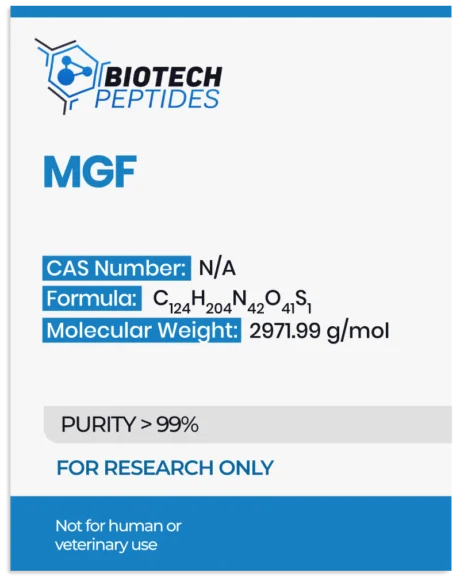
| Molecular Formula | C124H204N42O41S1 |
| Molecular Weight | 2971.99 g/mol |
| Supplied Sequence | Tyr-Gln-Pro-Pro-Ser-Thr-Asn-Lys-Asn-Thr-Lys-Ser-Gln-Arg-Arg-Lys-Gly-Ser-Thr-Phe-Glu-Glu-Arg-Lys-Cys |
| Available Quantity | 5mg |
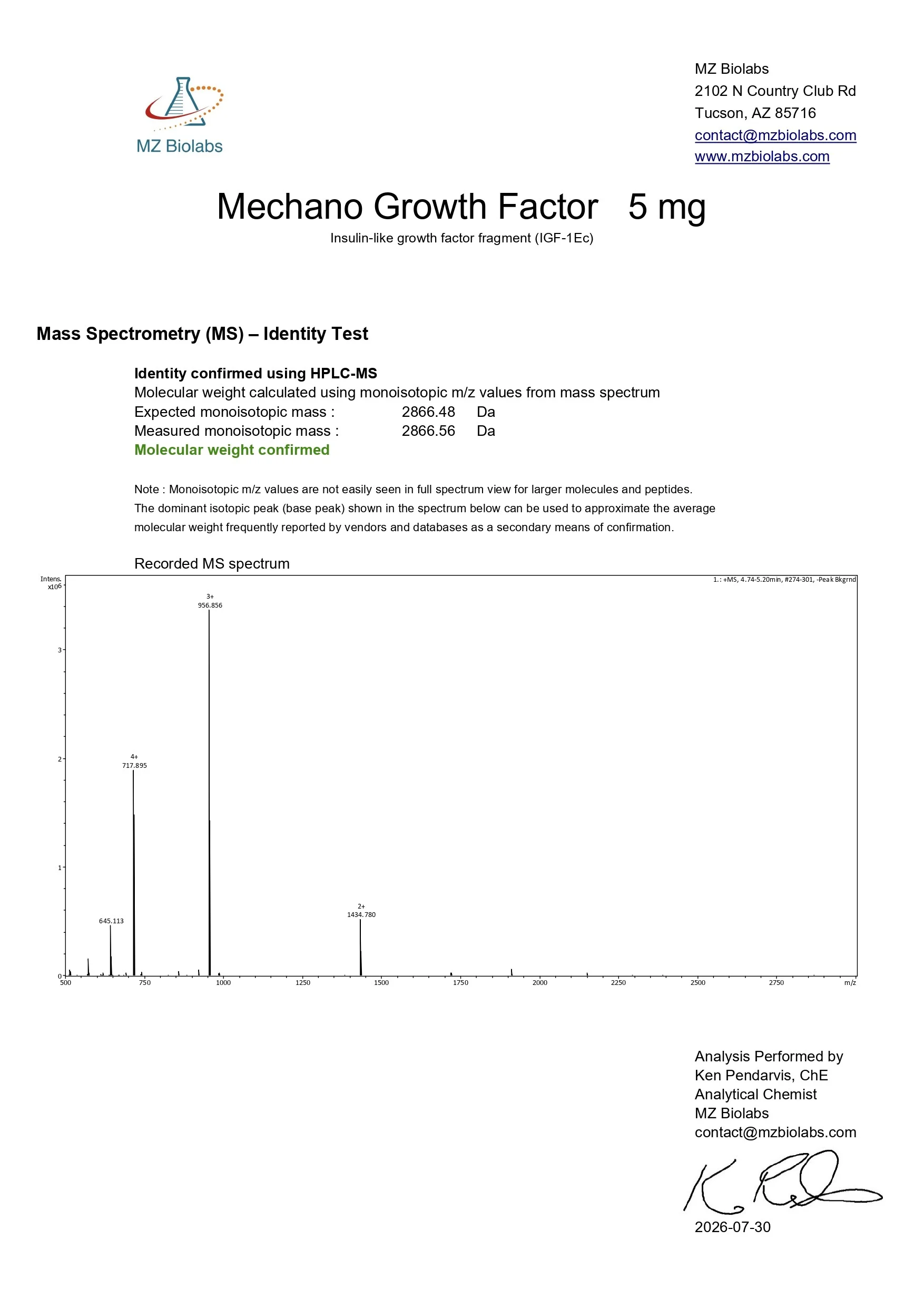
| Purity / Analytical Data | Refer to the lot-specific Certificate of Analysis (CoA) |
MGF and Skeletal Muscle Cell Research
One of the major areas of MGF research involves skeletal muscle biology. Experimental models have examined how local growth-factor signaling interacts with satellite cells, muscle precursor cells, myoblasts, and differentiated muscle cells.
Satellite cells are specialized muscle-associated progenitor cells that participate in skeletal muscle remodeling in experimental systems. Researchers investigating MGF have examined whether changes in MGF-associated signaling correlate with satellite-cell activation, proliferation, differentiation, and formation of multinucleated myotubes.
MGF research can therefore provide an experimental framework for studying the molecular relationship between mechanical stimuli and local growth-factor signaling within skeletal muscle models.
MGF and Cellular Proliferation
Experimental cell-culture studies have investigated MGF in relation to cellular proliferation and differentiation. Depending on the model, researchers may examine changes in cell-cycle activity, myoblast behavior, myotube formation, and expression of muscle-associated proteins.
These experiments can help characterize how growth-factor signaling interacts with cellular development and remodeling under defined laboratory conditions.
MGF and Inflammation Research
Inflammatory signaling is another area investigated in MGF research. Experimental muscle-injury models have examined interactions between macrophages, inflammatory mediators, and local growth-factor signaling.
Macrophages can participate in tissue remodeling and cellular responses following experimental injury. Researchers studying MGF may therefore examine relationships between macrophage activity, cytokine expression, chemokine signaling, oxidative-stress markers, and muscle-cell behavior.
Reported experimental endpoints have included TNF-α, IFN-γ, IL-1β, TGF-β, CCL2, CCL5, CXCR4, and oxidative-stress-associated markers. These measurements can help researchers characterize molecular changes within controlled tissue and cellular models.
MGF and Cellular Aging Research
IGF-1 splice-variant biology has also been investigated in relation to cellular aging and changes in muscle-cell behavior. Different developmental stages and cellular states can influence the expression and processing of IGF-1-related variants.
Experimental research has examined MGF-associated signaling in muscle-cell cultures representing different cellular age states. Researchers may assess endpoints such as cellular proliferation, senescence-associated characteristics, myotube formation, reserve-cell populations, and expression of contractile proteins.
These models provide an experimental approach for examining how growth-factor signaling changes across cellular development and aging.
MGF and Cardiac Cell Research
MGF has also been investigated in experimental cardiac-cell models involving cellular stress and reduced oxygen availability. Research systems have examined how MGF-associated signaling may interact with cardiomyocyte survival pathways under controlled hypoxic or ischemic conditions.
Experimental studies have investigated cellular endpoints including apoptosis, migration of mesenchymal stem cells, and expression of survival-associated proteins such as Bcl-2. These models can help researchers investigate relationships between growth-factor signaling, cellular stress, and cardiac tissue biology.
Results obtained from animal and cellular research models remain dependent on the experimental design, model species, tissue type, assay conditions, and molecular endpoints selected by the investigator.
MGF and Neurobiology Research
MGF has been investigated in experimental neuroscience models because growth-factor signaling plays an important role in cellular development and neural tissue responses. Research has examined MGF-associated activity in developing neural tissues and experimental models involving cellular stress.
Investigators may study MGF in relation to neuronal survival pathways, cellular regeneration, neural signaling, and growth-factor expression. Experimental observations involving hypoxic neural tissue have also contributed to interest in the relationship between MGF-associated signaling and cellular responses to reduced oxygen conditions.
These research applications make MGF relevant to laboratory investigations of growth-factor signaling in both muscle and neural systems.
MGF and Cartilage Cell Research
Cartilage research provides another experimental application for investigating MGF-associated cellular pathways. Chondrocytes respond to mechanical stimuli, extracellular-matrix changes, and cellular stress, making them useful models for studying tissue-remodeling mechanisms.
Experimental research has examined growth-factor signaling in relation to chondrocyte survival, migration, mechanical stress, and intracellular pathways such as YAP-associated signaling. Researchers can use these models to investigate how cellular signaling responds to controlled mechanical loading or experimental tissue damage.
MGF and Muscle Fibrosis Research
Muscle fibrosis is characterized experimentally by changes in extracellular-matrix composition and the accumulation of fibrotic proteins. MGF research has investigated whether growth-factor-associated signaling interacts with molecular pathways involved in collagen expression, inflammatory signaling, oxidative stress, and extracellular-matrix remodeling.
Experimental muscle-contusion models have been used to examine markers including type I and type III collagen, matrix metalloproteinases (MMPs), inflammatory cytokines, chemokines, and oxidative-stress-associated proteins.
Researchers may use these endpoints to investigate the relationship between MGF-associated signaling and post-injury cellular remodeling. Such studies can also examine satellite-cell markers including MyoD and myogenin to characterize muscle-cell differentiation and regeneration pathways.
MGF and Bone Cell Research
MGF has additionally been investigated in experimental bone-cell and tissue-remodeling models. Laboratory studies have examined cellular responses within controlled bone-defect models and compared growth-factor-associated signaling with control conditions.
Research endpoints have included cellular proliferation and activation of signaling pathways such as the MAPK/ERK1/2 pathway. These molecular pathways are widely studied for their relationship to cell proliferation, differentiation, and tissue remodeling.
Further investigation is required to fully characterize how MGF-associated signaling interacts with bone-cell biology under different experimental conditions.
Key Research Features of MGF 5mg
- Defined research peptide: MGF is supplied as a characterized peptide for controlled laboratory investigation.
- IGF-1 splice-variant research: Suitable for studying growth-factor isoform biology and associated signaling mechanisms.
- Muscle-cell research: Applicable to experimental studies involving satellite cells, myoblasts, myotubes, and muscle-cell signaling.
- Cellular signaling studies: Useful for investigating proliferation, differentiation, survival, and stress-response pathways.
- Tissue-model research: Investigated in experimental muscle, cardiac, neural, cartilage, and bone systems.
- Molecular pathway analysis: Research may include MAPK/ERK, apoptosis-associated, inflammatory, extracellular-matrix, and growth-factor signaling pathways.
- Analytical research: Defined molecular weight and sequence support analytical characterization and laboratory assay development.
- RUO classification: Intended exclusively for laboratory research and scientific investigation.
Laboratory Handling and Storage
MGF 5mg should be handled only by qualified laboratory personnel using appropriate laboratory safety practices. Storage conditions, solvent compatibility, reconstitution procedures, concentration ranges, and stability considerations should be determined using the product’s lot-specific documentation and the requirements of the research protocol.
Researchers should review the applicable Certificate of Analysis (CoA) and manufacturer documentation before beginning experimental work. Appropriate laboratory controls should be used to maintain sample integrity and minimize unnecessary exposure to environmental conditions that may affect peptide stability.
Frequently Asked Questions About MGF 5mg
What is MGF?
MGF, or Mechano-Growth Factor, is a research term associated with an IGF-1 splice-variant system. It has been investigated in experimental studies involving muscle-cell biology, cellular signaling, tissue remodeling, and growth-factor-associated pathways.
What is the molecular weight of MGF?
The supplied molecular weight of MGF is 2971.99 g/mol. The supplied molecular formula is C124H204N42O41S1.
What is the MGF amino acid sequence?
The supplied sequence is Tyr-Gln-Pro-Pro-Ser-Thr-Asn-Lys-Asn-Thr-Lys-Ser-Gln-Arg-Arg-Lys-Gly-Ser-Thr-Phe-Glu-Glu-Arg-Lys-Cys.
What is MGF studied for in laboratory research?
MGF has been investigated in experimental systems involving skeletal muscle cells, satellite-cell biology, cellular proliferation, differentiation, inflammatory signaling, tissue remodeling, cardiac-cell models, neural research, cartilage models, and bone-cell signaling.
Is MGF intended for human use?
No. This product is supplied strictly for Research Use Only (RUO) and is intended for laboratory research, in-vitro testing, analytical work, and scientific investigation by qualified personnel.
Research Use Only Disclaimer
FOR RESEARCH USE ONLY (RUO). MGF (Mechano-Growth Factor) 5mg is supplied exclusively for laboratory research, in-vitro testing, analytical research, and scientific investigation. It is not intended for human consumption, veterinary use, diagnosis, disease management, or use as a food, dietary supplement, cosmetic, or approved drug. This material is intended for qualified laboratory personnel using appropriate safety procedures and following applicable institutional requirements and laws. Findings from cellular or animal research models should not be interpreted as established outcomes in humans. The purchaser is responsible for determining appropriate laboratory use, handling, storage, and regulatory compliance.




Reviews
There are no reviews yet.