
Buy PNC-27 Peptide 5mg & 10mg | Research Use Only
PNC-27 Peptide 5mg & 10mg is a synthetic peptide from the PNC family of probe proteins that has been investigated extensively in laboratory cancer research. The peptide contains an HDM2-binding domain and a transmembrane domain corresponding to the supplied p53-derived sequence. Experimental studies have investigated PNC-27 in relation to membrane-associated HDM2, tumor-cell membrane disruption, necrosis, and cancer-cell proliferation.
For researchers looking to buy PNC-27 peptide 5mg or 10mg, this compound provides a defined research material for controlled laboratory and in-vitro investigations. Research supplied for this product has examined leukemia, ovarian cancer, and other cancer-cell models, with particular attention to the proposed interaction between PNC-27 and membrane-associated HDM2.
PNC-27 Peptide Overview
PNC-27 was initially developed as a research probe for investigating mechanisms associated with cancer-cell proliferation and membrane-associated HDM2. The supplied research proposes that PNC-27 may interact with HDM2 located in the plasma membranes of certain tumor cells.
According to the supplied research, this interaction may promote the formation of membrane pores or oligomeric structures. The resulting membrane disruption has been investigated as a possible mechanism for tumor-cell necrosis. Importantly, these observations are derived from experimental research and should not be interpreted as evidence of a proven therapeutic effect in humans.
PNC-27 Peptide Specifications
| Specification | Details |
|---|---|
| Product Name | PNC-27 Peptide 5mg & 10mg |
| Synonym | Membrane Residency Peptide (MRP) |
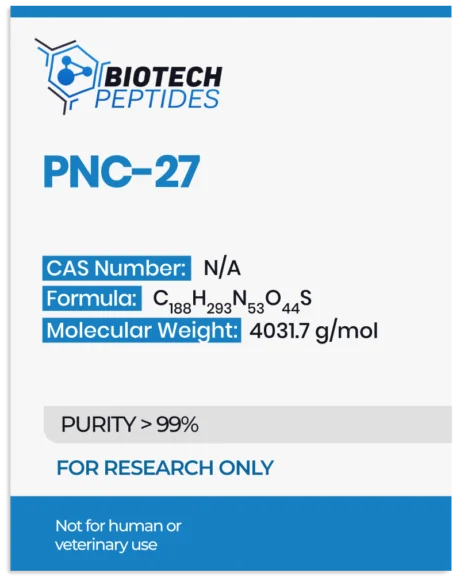
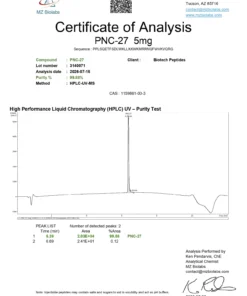
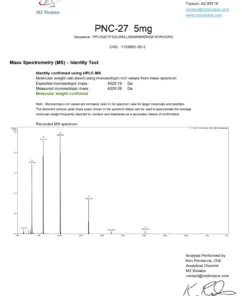
| Molecular Formula | C188H293N53O44S |
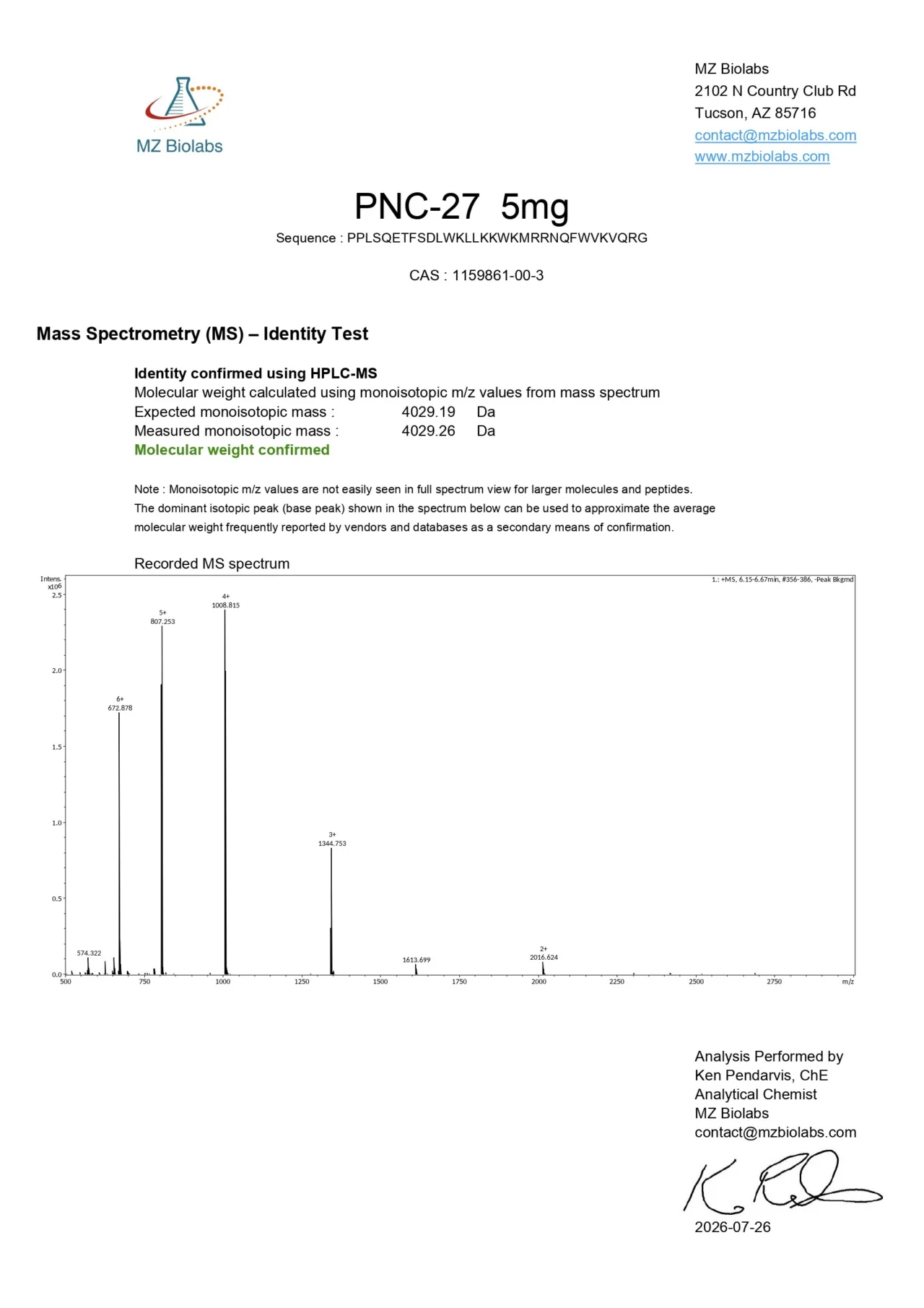
| Molecular Weight | 4031.7 g/mol |
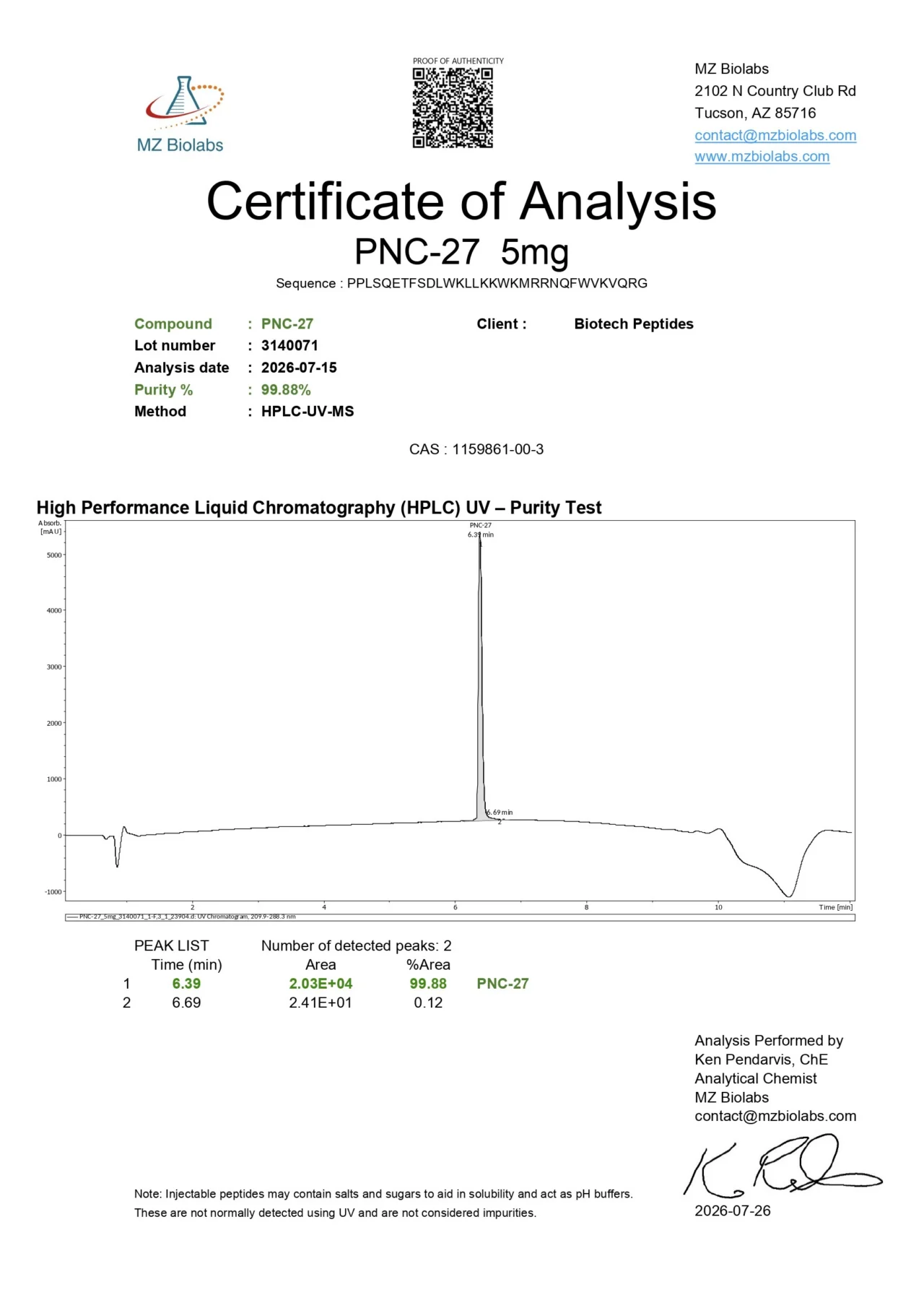
| Sequence | H-Pro-Pro-Leu-Ser-Gln-Glu-Thr-Phe-Ser-Asp-Leu-Trp-Lys-Leu-Leu-Lys-Lys-Trp-Lys-Met-Arg-Arg-Asn-Gln-Phe-Trp-Val-Lys-Val-Gln-Arg-Gly-OH |
| Available Research Quantities | 5mg and 10mg |
| Research Classification | Research Use Only (RUO) |
PNC-27 and HDM2 Binding Research
One of the principal areas of PNC-27 research concerns its proposed interaction with human double minute 2 homolog (HDM2), a protein associated with regulation of the p53 tumor-suppressor pathway.
The supplied research describes experiments investigating whether PNC-27 may form complexes with membrane-associated HDM2 on tumor cells. Researchers have proposed that formation of a PNC-27/HDM2 complex could contribute to the development of transmembrane pores.
Experimental work has investigated this proposed mechanism through theoretical modeling, conformational energy analysis, and microscopy. The research described relatively stable interactions between PNC-27 and HDM2 under the investigated conditions. Immuno-electron microscopy also reportedly identified ring-like structures on cancer-cell surfaces at locations interpreted as potential membrane pores.
Membrane Pore Formation
The proposed mechanism investigated in the supplied studies involves the formation of oligomeric pores within the plasma membrane of certain tumor cells. Researchers reported that similar pore structures were not observed in untransformed cells exposed to PNC-27 under the experimental conditions studied.
This distinction has been investigated as a possible explanation for the apparent selectivity of PNC-27 toward certain cancer-cell models. The research proposes that membrane-localized HDM2 may be an important factor in this selectivity.
Additional experiments involving the introduction of an HDM2 membrane-localization signal into otherwise less-susceptible non-transformed cells appeared to increase their sensitivity to PNC-27. These observations have been used to further investigate the proposed relationship between membrane-associated HDM2 and PNC-27 activity.
PNC-27 and Leukemia Research
PNC-27 has been investigated in several leukemia-cell models, including the acute myelogenous leukemia (AML) cell lines U937, OCI-AML3, and HL60. The supplied research reports elevated levels of membrane-bound HDM2 in these cell lines and investigated whether this characteristic could contribute to their experimental sensitivity to PNC-27.
Confocal microscopy was used to investigate the apparent colocalization of PNC-27 and HDM2 in the leukemia-cell models. In vitro experiments subsequently reported reductions in cell viability following exposure to PNC-27 under the experimental conditions.
The research further investigated the apparent form of cell death. Increased lactate dehydrogenase (LDH) release was observed, while the investigated apoptotic indicators annexin V and caspase-3 activity did not show the same pattern of increase. The findings were therefore interpreted as being consistent with necrosis associated with membrane disruption rather than a conventional apoptotic mechanism.
However, the supplied study also reported differences between the leukemia cell lines. This variation may potentially relate to differences in HDM2 isoform expression or other cellular characteristics. The findings therefore do not establish uniform activity across all leukemia models.
PNC-27 and Ovarian Cancer Cell Research
Additional laboratory research has investigated PNC-27 using freshly isolated primary ovarian cancer cells. The supplied study examined two ovarian cancer subtypes: mucinous cystadenocarcinoma and high-grade papillary serous carcinoma.
Under the experimental conditions, PNC-27 exposure was associated with apparent inhibition of proliferation in the primary ovarian cancer cells. The research also reported apparent cytotoxic effects, with LDH release used as a biochemical indicator associated with cellular membrane disruption.
These observations have contributed to laboratory research examining whether PNC-27-mediated membrane disruption may represent a useful experimental model for studying tumor-cell membrane biology.
PNC-27 Research Areas
- HDM2 and p53 pathway research
- Membrane-associated HDM2 research
- Transmembrane pore formation
- Tumor-cell membrane biology
- Experimental necrosis research
- Acute myelogenous leukemia cell models
- Ovarian cancer cell research
- Cancer-cell proliferation studies
- LDH-based cellular membrane integrity studies
- Confocal microscopy and peptide localization research
- Protein-peptide interaction studies
Why Use PNC-27 Peptide for Laboratory Research?
- Defined synthetic peptide sequence for controlled laboratory research.
- Available in 5mg and 10mg research quantities.
- Useful for experimental studies involving HDM2 and membrane-associated signaling.
- Relevant to in-vitro investigations of tumor-cell membrane integrity.
- Studied in leukemia and primary ovarian cancer cell models.
- Applicable to research involving peptide-membrane interactions and pore formation.
- Suitable for controlled scientific research under appropriate laboratory conditions.
Frequently Asked Questions About PNC-27 Peptide
What is PNC-27 peptide?
PNC-27 is a synthetic peptide from the PNC family of probe proteins. It has been investigated primarily as a laboratory research tool for studying interactions involving membrane-associated HDM2 and tumor-cell membrane integrity.
What is the molecular weight of PNC-27?
The supplied specification lists the molecular weight of PNC-27 as 4031.7 g/mol.
What is the molecular formula of PNC-27?
The supplied molecular formula is C188H293N53O44S.
What is the PNC-27 peptide sequence?
The supplied sequence is H-Pro-Pro-Leu-Ser-Gln-Glu-Thr-Phe-Ser-Asp-Leu-Trp-Lys-Leu-Leu-Lys-Lys-Trp-Lys-Met-Arg-Arg-Asn-Gln-Phe-Trp-Val-Lys-Val-Gln-Arg-Gly-OH.
What is PNC-27 researched for?
PNC-27 has been investigated in laboratory studies involving HDM2 binding, membrane pore formation, tumor-cell membrane disruption, necrosis, cancer-cell proliferation, leukemia models, and ovarian cancer cell models.
Is PNC-27 intended for human use?
No. PNC-27 Peptide is supplied strictly for Research Use Only (RUO). It is intended for qualified laboratory research and experimental applications and is not intended for human consumption, diagnosis, treatment, cure, mitigation, or prevention of disease.
Research Use Only Disclaimer
RESEARCH USE ONLY — NOT FOR HUMAN USE
PNC-27 Peptide 5mg & 10mg is supplied strictly for laboratory research, in-vitro experimentation, analytical testing, and scientific research purposes. This material is not intended for human consumption, veterinary use, diagnosis, treatment, cure, mitigation, or prevention of any disease or medical condition.
The research information presented on this page is based on experimental findings supplied for scientific research purposes. Findings from cancer-cell, tissue, and other experimental models should not be interpreted as established therapeutic effects in humans. Researchers are responsible for appropriate laboratory handling, experimental design, applicable regulatory requirements, and suitable safety procedures.
| Miligram | 10, 5 |
|---|
Be the first to review “PNC-27 Peptide 5mg & 10mg | Research Use Only”
Related products
Biotech Peptides
Biotech Peptides

Biotech Peptides
Biotech Peptides
Biotech Peptides
Biotech Peptides
Biotech Peptides
Biotech Peptides
Reviews
There are no reviews yet.