

Buy Matrixyl Peptide 100mg & 200mg | Research Use Only
Buy Matrixyl Peptide is a lipopeptide that combines a fatty acid component with an amino acid sequence and has been studied extensively in laboratory research involving fibroblasts, collagen synthesis, extracellular matrix (ECM) biology, wound-closure models, and dermal tissue structure. Matrixyl is also referred to as palmitoyl pentapeptide-4 or palmitoyl pentapeptide-3 in research literature and product descriptions.
The supplied research profile describes Matrixyl as a palmitoylated peptide sequence associated with collagen-related signaling. Researchers have investigated its potential interaction with fibroblasts and its relationship to the production of ECM proteins, including collagen. Matrixyl has also been studied as a matrikine, referring to a messenger peptide that may regulate cellular activity through interactions with cellular receptors.
This product is offered in 100mg and 200mg quantities and is intended strictly for Research Use Only (RUO). It is supplied as a laboratory research material for qualified researchers conducting controlled in-vitro, cellular, biochemical, and related scientific studies.
Matrixyl Peptide Specifications
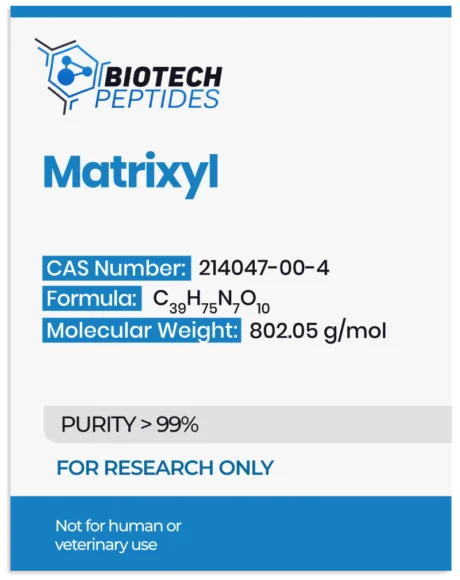
| Specification | Details |
|---|---|
| Product Name | Matrixyl Peptide |
| Available Quantities | 100mg and 200mg |
| Peptide Type | Lipopeptide / signal peptide |
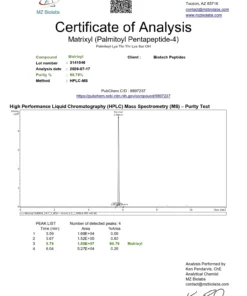
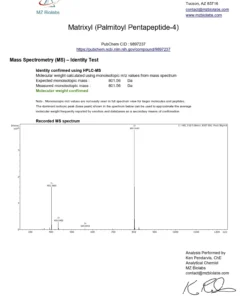
| Molecular Weight | 802.05 g/mol |
| Molecular Formula | C39H75N7O10 |
| Sequence | Pal-Lys-Thr-Thr-Ser-OH or Pal-KTTS-OH |
| Synonym | Palmitoyl pentapeptide-3 |
| Research Classification | Research Use Only (RUO) |
What Is Matrixyl Peptide?
Matrixyl is described as a palmitoylated peptide containing a fatty acid component attached to an amino acid sequence. The palmitoyl modification has been investigated in relation to peptide stability and interactions with biological systems.
The supplied research material describes the palmitoylated peptide as a signal peptide fragment associated with the C-terminal propeptide of type I collagen. Researchers have proposed that the palmitoyl component may influence the peptide’s stability and its ability to interact with cellular systems.
Matrixyl has consequently been investigated as a potential signaling molecule in laboratory models involving fibroblasts and extracellular matrix proteins. Particular attention has been given to collagen synthesis and cellular pathways associated with dermal tissue structure.
Matrixyl and Fibroblast Research
Fibroblasts are central to research involving collagen and extracellular matrix production. Laboratory studies of Matrixyl have examined how different concentrations of the peptide may influence fibroblast activity and collagen synthesis.
The supplied research describes observations of a concentration-dependent increase in collagen synthesis when cells were exposed to varying amounts of Matrixyl, particularly around a concentration referred to as the critical aggregation concentration (CAC).
The CAC represents a concentration at which Matrixyl molecules may begin to self-assemble into larger structures. Researchers have proposed that Matrixyl can form organized nanostructures, including structures described as nanotapes or fibrils. These assemblies may present peptide sequences in an arrangement that affects their interaction with fibroblasts.
One proposed explanation is that the organization of Matrixyl molecules around the CAC may make the peptide sequence more readily recognizable to fibroblasts, potentially influencing collagen deposition.
Interestingly, the supplied research also describes an apparent reduction in fibroblast cell division while collagen production per cell increased. This observation has been discussed as a possible indication that Matrixyl may influence fibroblast activity toward extracellular matrix production rather than simply increasing cellular proliferation.
Matrixyl and Extracellular Matrix Research
The extracellular matrix provides structural support surrounding cells and contains important components such as collagen and other proteins. Matrixyl research has focused on whether the peptide can influence the production and organization of these components in experimental models.
Researchers have investigated Matrixyl in relation to collagen synthesis and the degradation of dermal matrix components associated with experimental models of photoaging. The supplied research proposes that increasing collagen production by fibroblasts may provide a useful model for studying changes in dermal extracellular matrix structure.
These investigations make Matrixyl relevant to laboratory studies examining fibroblast signaling, collagen production, extracellular matrix remodeling, and peptide-mediated cellular responses.
Matrixyl and Wound Closure Research
Matrixyl has also been examined in experimental research involving wound closure and fibroblast-to-myofibroblast differentiation. Myofibroblasts are specialized cells associated with wound contraction and tissue remodeling, while prolonged activity can be associated with fibrotic tissue formation.
The supplied research describes investigations into alpha-smooth muscle actin (α-SMA) and connective tissue growth factor (CTGF), two markers associated with fibroblast differentiation and fibrotic processes.
Experimental observations described in the source material indicate that Matrixyl may reduce α-SMA expression in fibroblasts. This has been interpreted as a possible reduction in myofibroblast formation within the experimental model. Matrixyl has also been investigated for its potential influence on CTGF levels and extracellular matrix remodeling.
The relationship between CTGF and α-SMA is of interest because sustained expression of these proteins has been associated with fibrotic tissue formation. Consequently, Matrixyl has been investigated in laboratory models examining the balance between tissue remodeling, wound closure, and fibrosis-related cellular activity.
Matrixyl Research in Experimental Tissue Models
The supplied research also describes experimental murine models in which Matrixyl was investigated in relation to tissue healing. Researchers proposed that Matrixyl may interact with fibroblasts in the dermis and potentially influence signaling pathways resembling aspects of the TGF-β pathway.
These proposed interactions were investigated in connection with collagen production and collagenase activity. The source material reports observations suggesting increased collagen density and changes in wound closure compared with control groups.
One reported experimental observation described wound-healing measurements increasing from approximately 63.5% to 81.81% in Matrixyl groups compared with a negative control group. This figure represents the specific experimental model described in the supplied material and should not be interpreted as a demonstrated clinical effect.
Matrixyl and Collagen Research
Collagen synthesis is one of the principal areas of Matrixyl research. The supplied research describes investigations involving different collagen types, including collagen I, III, and IV, together with other extracellular matrix components such as elastin, fibronectin, and glycosaminoglycans.
Researchers have examined whether Matrixyl-associated signaling can influence the production of these structural components in laboratory models. Such studies provide experimental systems for investigating peptide-mediated changes in extracellular matrix composition and cellular activity.
The reported findings include observations involving collagen synthesis and changes in tissue properties in experimental settings. These findings remain dependent on the particular research model, formulation, experimental conditions, and measurement methods used.
Matrixyl and Dermal Structure Research
Matrixyl has been investigated in experimental models examining structural characteristics associated with dermal tissue. The supplied material describes research using topometric methods, including Fast Optical Topometry, to evaluate parameters associated with dermal layer roughness.
Reported observations included reductions in mean dermal layer roughness and maximum dermal roughness in research models involving Matrixyl. Additional experimental measurements examined parameters associated with tissue surface structure and wrinkle dimensions.
The supplied research reports reductions in fold depth of approximately 18%, reductions in fold thickness of approximately 37%, and an increase in firmness of approximately 21% in certain settings. These figures are experimental observations from the cited research material and should be interpreted within the specific conditions of those studies.
Matrixyl Research Areas
- Fibroblast research: Investigation of fibroblast activity and collagen synthesis.
- Collagen research: Laboratory study of collagen production and extracellular matrix composition.
- Extracellular matrix research: Investigation of ECM proteins and structural remodeling.
- Wound-closure research: Study of fibroblast and myofibroblast activity in experimental models.
- Fibrosis-related research: Investigation of α-SMA and CTGF-associated pathways.
- Dermal tissue research: Examination of structural and topometric parameters.
- Peptide self-assembly research: Investigation of Matrixyl aggregation and nanostructure formation.
- Cellular signaling research: Study of potential peptide interactions with fibroblast-associated signaling pathways.
Why Choose Matrixyl Peptide 100mg & 200mg for Research?
Matrixyl provides researchers with a defined lipopeptide system for investigating peptide-mediated cellular responses. Its palmitoylated structure and reported association with collagen-related signaling make it relevant to experimental studies involving fibroblasts, extracellular matrix biology, peptide self-assembly, and tissue-model research.
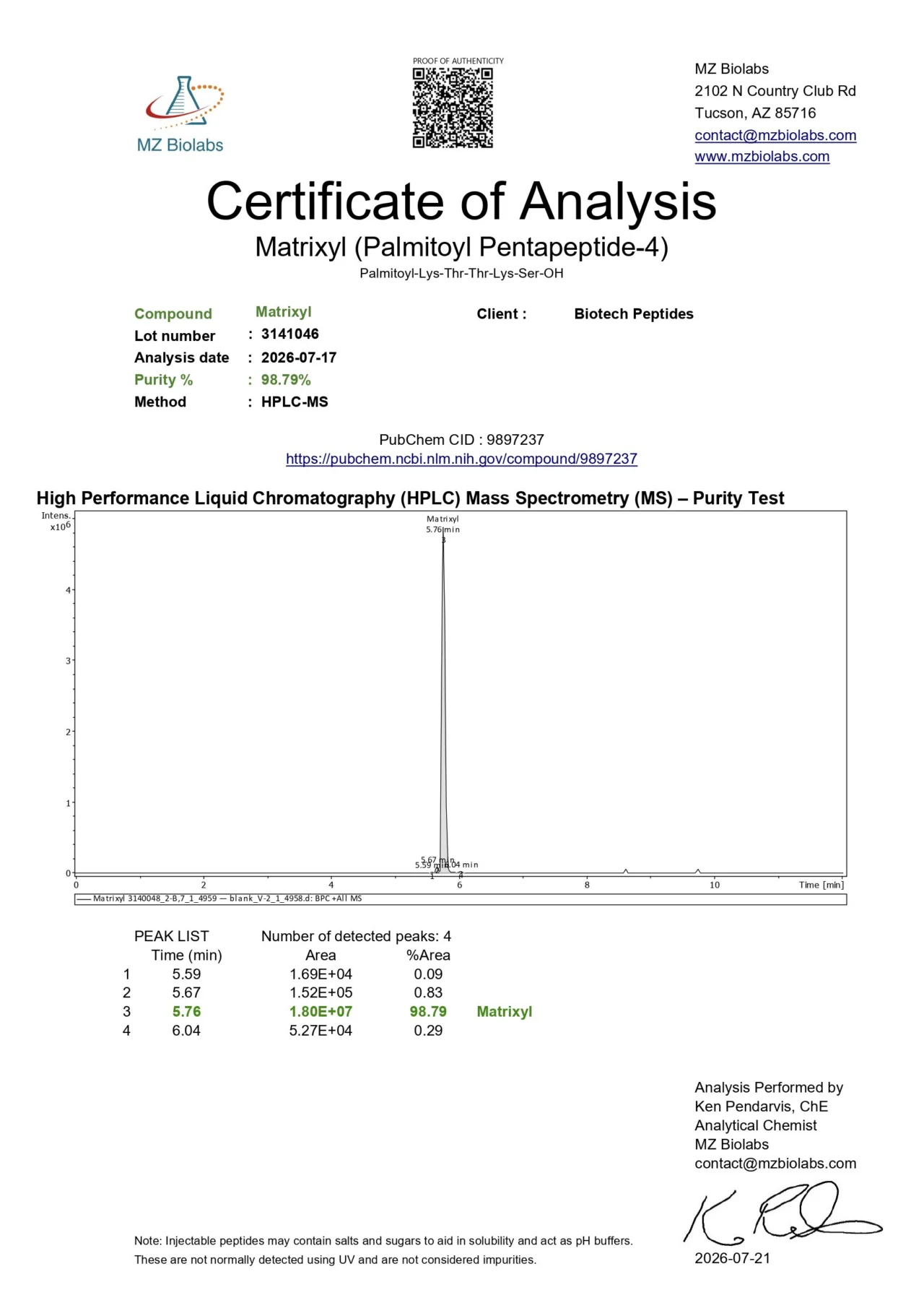
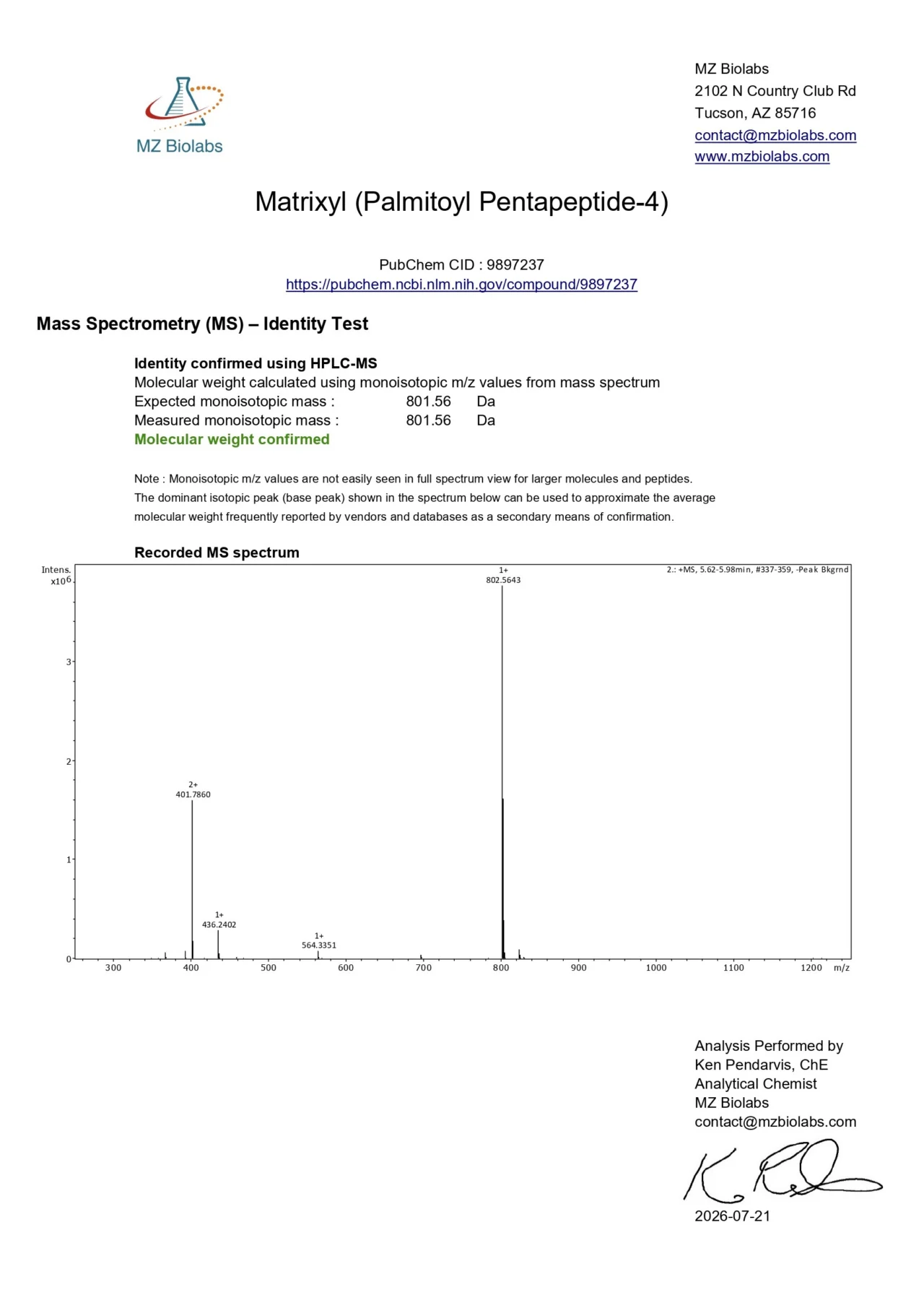
The 100mg and 200mg Matrixyl peptide options provide researchers with different quantities for laboratory workflows. Researchers should consult applicable batch-specific documentation for analytical information not listed in the specifications above.
Matrixyl Peptide FAQ
What is Matrixyl peptide?
Matrixyl is a palmitoylated lipopeptide studied in laboratory research involving fibroblasts, collagen synthesis, extracellular matrix biology, wound-closure models, and dermal tissue structure.
What is the molecular weight of Matrixyl?
The molecular weight provided for Matrixyl in the supplied specifications is 802.05 g/mol.
What is the Matrixyl peptide sequence?
The supplied sequence is Pal-Lys-Thr-Thr-Ser-OH, also written as Pal-KTTS-OH.
What is another name for Matrixyl?
The supplied material identifies palmitoyl pentapeptide-3 as a synonym and also describes Matrixyl as palmitoyl pentapeptide-4 or palmitoyl pentapeptide-3.
What quantities of Matrixyl are available?
This product is available in 100mg and 200mg quantities.
What is Matrixyl studied for?
Matrixyl has been studied in laboratory models involving fibroblasts, collagen synthesis, extracellular matrix proteins, wound closure, myofibroblast activity, α-SMA, CTGF, peptide self-assembly, and dermal tissue structure.
Is Matrixyl intended for human use?
No. This product is supplied strictly for Research Use Only (RUO) and is intended for qualified laboratory research. It is not intended for human or veterinary use, consumption, diagnosis, treatment, or prevention of any disease or medical condition.
Research Use Only Disclaimer
IMPORTANT — RESEARCH USE ONLY: Matrixyl Peptide 100mg & 200mg is supplied strictly as a laboratory research material. This product is not intended for human consumption, human administration, veterinary use, diagnosis, treatment, cure, mitigation, or prevention of any disease or medical condition.
This material is intended only for qualified researchers conducting appropriate in-vitro, cellular, biochemical, or other controlled scientific research. Researchers are responsible for determining appropriate handling, storage, experimental procedures, safety measures, and regulatory requirements applicable to their work.
All research observations described on this page refer to specific experimental models and conditions. Reported laboratory findings should not be interpreted as established clinical effects, therapeutic claims, or evidence of safety or efficacy in humans.
| Miligram | 100, 200 |
|---|
Be the first to review “Matrixyl Peptide 100mg & 200mg | Research Use Only”
Related products
Biotech Peptides
Biotech Peptides
Biotech Peptides
Biotech Peptides
Biotech Peptides
Biotech Peptides
Biotech Peptides
Biotech Peptides
Reviews
There are no reviews yet.