Description
Buy LL-37 Peptide 5mg & 10mg – Research Use Only
Buy LL-37 Peptide 5mg & 10mg for Laboratory Research
Buy LL-37 Peptide 5mg or 10mg as a research material for controlled laboratory, in-vitro, and scientific studies involving antimicrobial peptide biology, innate immune signaling, epithelial-cell responses, and molecular interactions with inflammatory pathways. LL-37, also known as CAP-18, is a human cathelicidin-derived antimicrobial peptide that has been extensively investigated as part of the innate immune system.
LL-37 research encompasses a broad range of experimental areas because the peptide can interact with microbial components, cellular membranes, immune receptors, and signaling molecules. Laboratory studies have examined its interactions with lipopolysaccharide (LPS), Toll-like receptor (TLR) pathways, scavenger receptors, cytokine signaling, and cellular migration. Other experimental models have investigated LL-37 in relation to epithelial biology, vascular-cell responses, and host-defense mechanisms.
With a defined molecular formula, molecular mass, and amino-acid sequence, LL-37 provides researchers with a characterized peptide framework for studying antimicrobial peptide activity and innate immune signaling under controlled experimental conditions. This product is supplied strictly for Research Use Only (RUO) applications.
LL-37 Molecular Structure & Scientific Profile
LL-37 is a member of the cathelicidin family of antimicrobial peptides. Cathelicidins are associated with innate immune defense and are investigated for their ability to interact with microbial membranes and host-cell signaling systems. LL-37 is the mature peptide derived from the human cathelicidin precursor protein commonly referred to as hCAP-18.
One major research interest surrounding LL-37 is its interaction with bacterial lipopolysaccharide (LPS). LPS is an important structural component of the outer membrane of Gram-negative bacteria and is also a recognized activator of innate immune signaling. Experimental research examining LL-37 and LPS can help characterize how antimicrobial peptides interact with microbial components and influence downstream cellular responses.
LL-37 has also been investigated in connection with Toll-like receptors, cytokines, chemotaxis, epithelial-cell behavior, and other components of innate immunity. The outcome of LL-37 activity can vary according to the cell type, experimental environment, concentration, and presence of other molecular signals, making it particularly relevant to mechanistic research.
LL-37 Chemical Specifications & CoA Summary
| Specification | Research Information |
|---|---|
| Product Name | LL-37 Peptide |
| Alternative Name | CAP-18 |
| Available Quantities | 5 mg and 10 mg |
| Peptide Family | Cathelicidin / Antimicrobial Peptide |
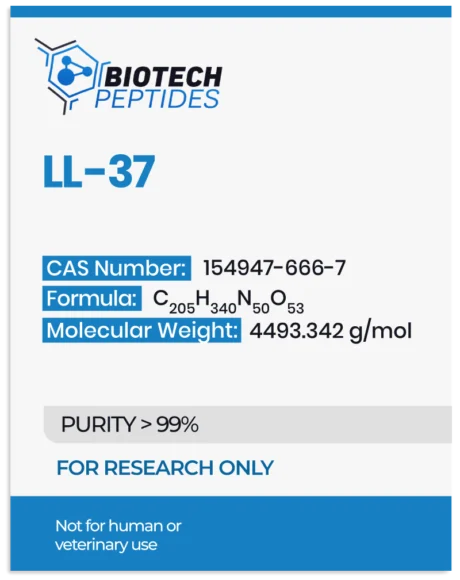
| Molecular Formula | C205H340N50O53 |
| Molecular Weight | 4493.34 g/mol |
| Amino Acid Sequence | Leu-Leu-Gly-Asp-Phe-Phe-Arg-Lys-Ser-Lys-Glu-Lys-Ile-Gly-Lys-Glu-Phe-Lys-Arg-Ile-Val-Gln-Arg-Ile-Lys-Asp-Phe-Leu-Arg-Asn-Leu-Val-Pro-Arg-Thr-Glu-Ser |
| Sequence Length | 37 amino acids |
| Research Classification | Research Use Only (RUO) |
| Purity | Refer to the applicable lot-specific Certificate of Analysis |
| Analytical Testing | Refer to lot-specific product documentation |
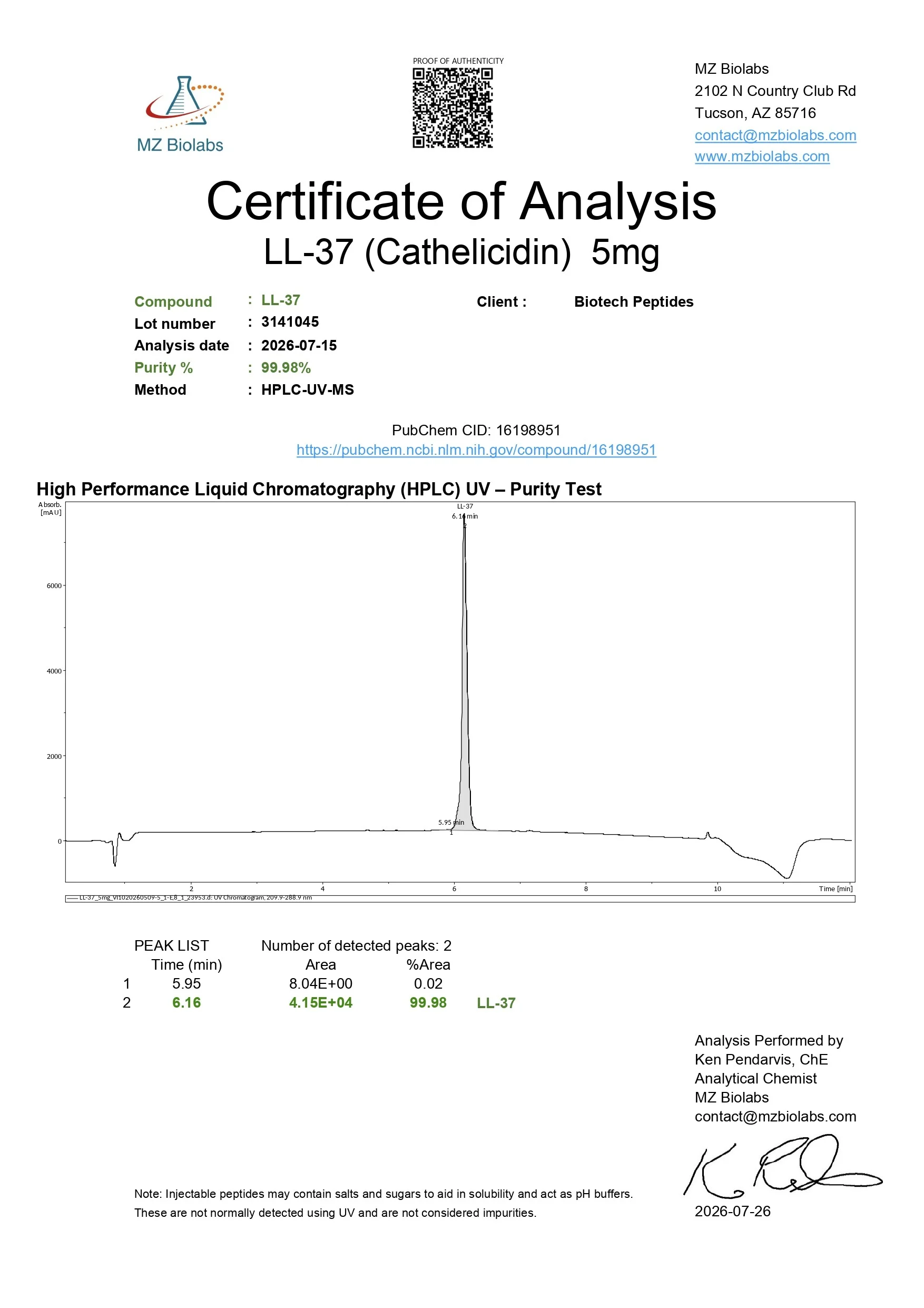
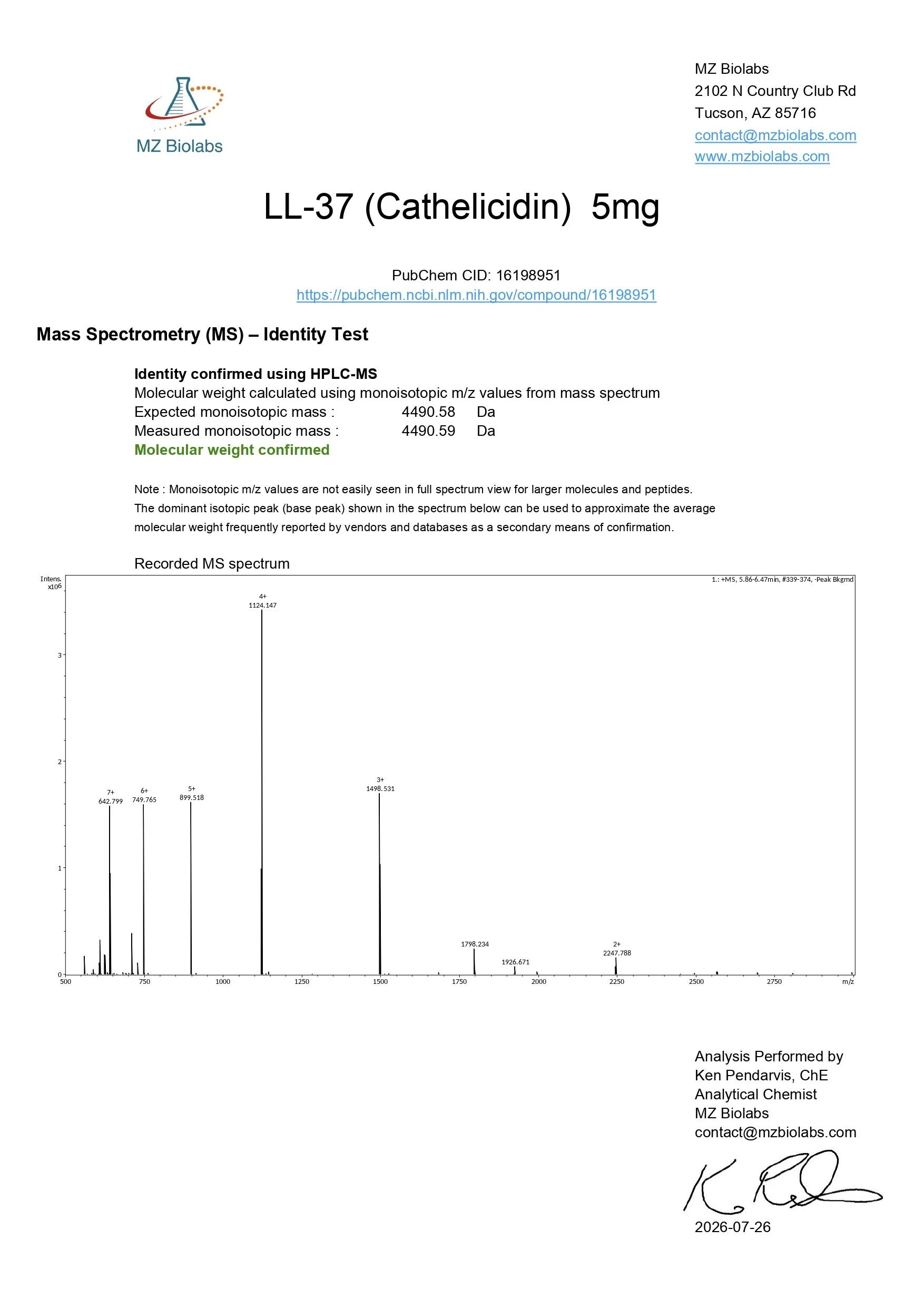
CoA information: Actual purity, identity, chromatographic profile, mass-spectrometry data, physical appearance, and other quality-control results should be verified using the Certificate of Analysis supplied for the specific lot. No unsupported purity percentage or analytical result is stated on this page.
Key Laboratory Features & Quality Benchmarks
- Defined LL-37 sequence: Supplied with the amino-acid sequence provided above for molecular research and analytical reference.
- Cathelicidin research: Suitable for experimental investigations of antimicrobial-peptide and innate-immune biology.
- Microbial-interaction studies: Relevant to laboratory research examining peptide interactions with microbial membrane components such as LPS.
- Innate immune signaling: Useful for studies examining TLR, scavenger-receptor, cytokine, and related signaling pathways.
- Cellular-response research: Applicable to appropriately designed experiments involving epithelial cells, immune cells, endothelial cells, and other relevant model systems.
- Defined molecular characteristics: Molecular formula, molecular mass, sequence, and peptide classification are provided for research reference.
- Lot-specific quality control: Researchers should consult the applicable CoA for actual purity and analytical testing results.
LL-37 Peptide Research Applications
LL-37 and Antimicrobial Peptide Research
LL-37 is extensively studied as a component of innate antimicrobial defense. Laboratory research has investigated interactions between LL-37 and bacterial membrane components, particularly LPS from Gram-negative organisms. These experiments can provide information about peptide-membrane interactions, molecular binding, membrane-associated processes, and antimicrobial-peptide mechanisms.
Research has also examined interactions between LL-37 and other innate immune molecules, including defensins and enzymes involved in microbial defense. Such studies can help researchers characterize how different antimicrobial components interact within experimental systems.
LL-37 and Innate Immune Signaling
LL-37 has been investigated as a modulator of innate immune signaling. Experimental studies have examined interactions involving Toll-like receptors, cytokine production, chemotactic responses, and intracellular signaling pathways.
TLR4 and TLR3-related systems are particularly relevant to LL-37 research. Laboratory models can examine how LL-37 influences receptor-associated signaling in different cellular environments. Because LL-37 can produce different responses depending on the cell type and experimental context, controlled comparative experiments are important when interpreting results.
LL-37 and Epithelial-Cell Research
Epithelial tissues represent another important area of LL-37 research. Experimental models have examined peptide expression and cellular responses in epithelial systems, including studies of cell migration, proliferation, barrier-associated signaling, and interactions between epithelial cells and innate immune molecules.
Researchers can use LL-37 as a molecular tool when investigating how antimicrobial peptides participate in communication between epithelial cells and components of the surrounding immune environment.
LL-37 and Vascular-Cell Research
Laboratory research has investigated LL-37 in endothelial-cell models involving cell migration, proliferation, and formation of vessel-like structures. These experimental systems provide researchers with tools for examining the molecular mechanisms that connect antimicrobial peptide signaling with endothelial-cell behavior.
Studies of LL-37 and endothelial signaling may include analysis of prostaglandin-related pathways and other cellular mediators. Results should be interpreted within the specific experimental system rather than generalized across unrelated biological models.
LL-37 and Immune-Cell Research
LL-37 research also encompasses interactions with immune cells and nucleic-acid sensing pathways. Experimental studies have examined how LL-37 can associate with extracellular DNA or RNA and influence their interaction with cellular receptors.
Scavenger receptors and Toll-like receptors have been investigated as components of these mechanisms. Research models may evaluate endocytosis, receptor activation, interferon-regulatory pathways, and cytokine responses to better understand how antimicrobial peptides participate in innate immune communication.
LL-37 Laboratory Handling, Storage & Preparation
LL-37 should be handled according to the storage and preparation conditions supplied with the specific research lot. Storage requirements can vary according to formulation, container, concentration, and other product-specific factors, so researchers should use the applicable manufacturer documentation and Certificate of Analysis as the controlling reference.
Where the material is supplied in lyophilized form, laboratory personnel should follow their validated in-vitro preparation procedure and use an appropriate research-grade diluent. Researchers should minimize unnecessary exposure to heat, moisture, and repeated environmental changes and should follow established laboratory procedures for any prepared research solution.
No human-use preparation, administration, or dosing instructions are provided. This product is intended exclusively for qualified laboratory research and scientific investigation.
Frequently Asked Questions About LL-37 Peptide
What is LL-37 used for in research?
LL-37 is studied as a cathelicidin antimicrobial peptide in laboratory research involving innate immunity, microbial-peptide interactions, LPS signaling, epithelial-cell biology, immune-cell responses, and receptor-mediated signaling.
What is the molecular weight of LL-37?
The molecular weight supplied for this LL-37 research material is 4493.34 g/mol. The provided molecular formula is C205H340N50O53, and the listed sequence contains 37 amino-acid residues.
How can LL-37 purity be verified?
Purity should be verified using the Certificate of Analysis for the applicable product lot. Depending on the analytical package, chromatographic techniques such as HPLC and molecular-identity techniques such as mass spectrometry may be used. Researchers should rely on actual lot-specific results rather than generalized purity claims.
Is LL-37 intended for human use?
No. LL-37 is supplied strictly as a Research Use Only material for laboratory, in-vitro, analytical, and scientific research. It is not intended for human consumption or administration, veterinary use, diagnosis, treatment, prevention, or mitigation of disease.
Research Use Only Disclaimer
FOR RESEARCH USE ONLY (RUO). This LL-37 peptide product is supplied exclusively as a laboratory research material for in-vitro testing, scientific investigation, analytical research, and other qualified laboratory applications. It is NOT intended for human consumption, human administration, veterinary use, diagnosis, treatment, prevention, mitigation, or cure of any disease or medical condition. This product is not a food, dietary supplement, cosmetic, or approved drug. It must be handled only by appropriately qualified personnel using suitable laboratory safety procedures and in accordance with applicable institutional requirements and laws. No claim is made that this product is suitable for any particular experimental application. The purchaser is responsible for determining appropriate laboratory use, handling, storage, and regulatory compliance.

Reviews
There are no reviews yet.