
Buy AHK-Cu Peptide 200mg | Research Use Only
AHK-Cu Peptide 200mg is a copper-containing tripeptide studied in laboratory research involving fibroblasts, dermal cells, endothelial cells, extracellular matrix processes, collagen synthesis, and hair follicle biology. AHK-Cu consists of the amino acid sequence Ala-His-Lys associated with copper and has been investigated for its interaction with cellular signaling pathways involving vascular endothelial growth factor (VEGF) and transforming growth factor beta (TGF-β).
This AHK-Cu peptide is intended strictly for Research Use Only (RUO). It is provided as a laboratory research material for qualified researchers conducting controlled in-vitro, cellular, biochemical, and related scientific studies. It is not intended for human or veterinary use, diagnosis, treatment, prevention, or consumption.
AHK-Cu Peptide 200mg Specifications
| Specification | Details |
|---|---|
| Product Name | AHK-Cu Peptide |
| Quantity | 200mg |
| Peptide Type | Copper-containing tripeptide |
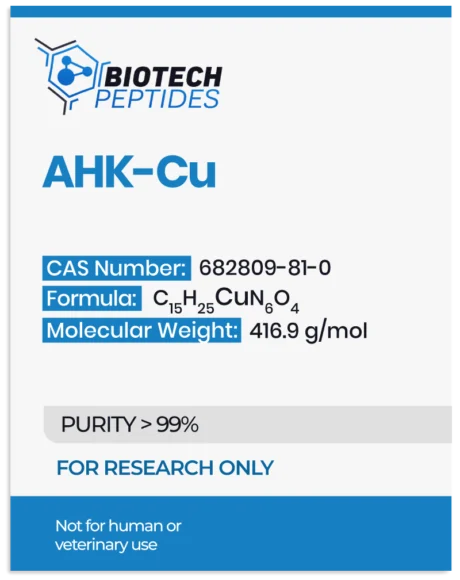
| Molecular Formula | C15H25CuN6O4 |
| Molecular Weight | 416.9 g/mol |
| Sequence | Ala-His-Lys-Cu |
| Research Classification | Research Use Only (RUO) |
AHK-Cu Research Peptide
AHK-Cu has primarily been investigated in laboratory research involving skin cells, fibroblasts, endothelial cells, extracellular matrix (ECM) biology, and hair follicle models. The supplied research material describes AHK-Cu as a short copper-containing peptide that has been studied in relation to cellular growth, regulation, and programmed cell death.
Research discussions surrounding AHK-Cu frequently focus on cellular signaling involving VEGF and TGF-β. VEGF is a signaling protein investigated extensively in angiogenesis research, while TGF-β participates in numerous cellular processes. Laboratory investigations have therefore examined whether AHK-Cu can influence cellular pathways associated with these signaling molecules.
AHK-Cu and Fibroblast Research
Fibroblasts are specialized cells involved in maintaining the extracellular matrix and producing structural components such as collagen and elastin. AHK-Cu research has examined its potential effects on fibroblast activity and collagen-related cellular processes.
In the supplied research description, laboratory experiments involving normal dermal fibroblasts investigated the effects of different quantities of AHK-Cu complex on collagen type I production. Researchers cultured dermal fibroblasts and subsequently analyzed collagen type I using a sandwich ELISA assay with a purified antibody against collagen type I.
The described experiment reported that exposure to the AHK-Cu complex was associated with increased fibroblast proliferation and viability in the experimental model. The research also reported a hypothesized increase in collagen type I production of approximately 300% compared with the control group. These findings represent results from the described laboratory model and should not be interpreted as evidence of an equivalent effect in humans.
AHK-Cu and VEGF Research
One area of AHK-Cu research involves the relationship between fibroblasts, VEGF, and endothelial cells. VEGF signaling is widely investigated in cellular models of angiogenesis and vascular biology.
The supplied research material describes a proposed VEGF/VEGFR interaction involving receptors such as VEGFR-1, VEGFR-2, and VEGFR-3, with VEGFR-2 described as an important mediator of angiogenic signaling. Downstream cellular signaling may involve proteins and pathways including phospholipase C, protein kinase C, and mitogen-activated protein kinases.
These pathways are relevant to laboratory investigations of endothelial-cell proliferation, migration, survival, and differentiation. AHK-Cu has therefore been included in experimental research examining the relationship between copper-containing peptides and these cellular signaling mechanisms.
AHK-Cu Skin Cell Research
AHK-Cu has been studied in laboratory models involving dermal fibroblasts and collagen production. Copper-containing peptide complexes are of interest in research examining extracellular matrix biology and the production of structural proteins by cultured cells.
The supplied research describes an experimental model in which normal dermal fibroblasts were grown in cell culture and subsequently exposed to varying quantities of AHK-Cu complex. After the experimental period, culture media was collected and analyzed for collagen type I content.
The reported observations included potential stimulation of dermal fibroblast proliferation and viability, together with an increase in collagen type I production in the experimental model. The approximately 300% increase described in the source material is a laboratory observation and should be evaluated within the context of the specific experimental conditions.
AHK-Cu Hair Follicle Research
AHK-Cu has also been investigated in laboratory research involving hair follicles and dermal papilla cells (DPCs). DPCs are specialized cells associated with hair follicle biology and have been studied for their role in follicular development and growth.
The supplied research describes experiments in which AHK-Cu was introduced into models involving cultured dermal papilla cells and hair follicles. Researchers observed an increase in hair follicle elongation and investigated whether AHK-Cu could influence DPC proliferation and apoptosis.
Experimental analysis included Annexin V-fluorescein isothiocyanate/propidium iodide labeling and flow cytometry. The described results suggested a possible reduction in apoptotic DPCs, although the source material specifically notes that this reduction was not statistically significant and therefore was not conclusively confirmed.
The research also examined proteins associated with cellular survival and programmed cell death, including the Bcl-2/Bax ratio, cleaved caspase-3, and PARP. The reported observations formed the basis for a proposed mechanism involving DPC proliferation and reduced apoptosis in the experimental model.
AHK-Cu Cellular Signaling Research
The research profile of AHK-Cu includes several cellular pathways that can be investigated using controlled laboratory systems. These include:
- Fibroblast proliferation and viability
- Collagen type I production
- Extracellular matrix research
- VEGF-related cellular signaling
- VEGFR-related pathways
- Endothelial cell research
- Dermal papilla cell models
- Apoptosis-related signaling
- Bcl-2/Bax protein research
- Caspase-3 and PARP research
- Hair follicle biology
These areas provide potential experimental directions for researchers studying the relationship between copper-containing peptides and cellular signaling. Results can vary substantially depending on the experimental model, concentration, culture conditions, assay methodology, and other laboratory variables.
Why Choose AHK-Cu Peptide 200mg for Laboratory Research?
AHK-Cu provides researchers with a defined copper-containing peptide system for controlled experimental investigation. Its short sequence and copper association make it suitable for laboratory studies examining peptide structure, cellular interactions, fibroblast biology, extracellular matrix processes, and signaling pathways.
The 200mg AHK-Cu peptide format is intended for qualified laboratory research where researchers require a defined quantity of material for their experimental workflow. Researchers should consult the applicable batch documentation and analytical records for product-specific information not included in the specifications above.
AHK-Cu Peptide Research Areas
- Fibroblast research: Investigation of fibroblast proliferation, viability, and cellular activity.
- Collagen research: Laboratory examination of collagen type I production in dermal cell models.
- VEGF research: Investigation of VEGF-associated cellular signaling and angiogenesis-related pathways.
- Endothelial cell research: Study of cellular responses associated with vascular biology.
- Hair follicle research: Investigation of hair follicle elongation and related cellular models.
- Dermal papilla cell research: Examination of DPC proliferation and apoptosis-related markers.
- Extracellular matrix research: Study of cellular processes involving ECM components.
AHK-Cu Peptide 200mg FAQ
What is AHK-Cu peptide?
AHK-Cu is a copper-containing tripeptide composed of the sequence Ala-His-Lys-Cu. It has been investigated in laboratory research involving fibroblasts, dermal cells, endothelial cells, collagen-related processes, and hair follicle models.
What is the molecular weight of AHK-Cu?
The molecular weight provided for AHK-Cu in the supplied specifications is 416.9 g/mol.
What is the AHK-Cu peptide sequence?
The supplied sequence for AHK-Cu is Ala-His-Lys-Cu.
What is AHK-Cu used for in research?
AHK-Cu is studied in laboratory research involving fibroblast activity, collagen type I production, VEGF-related signaling, endothelial cells, dermal papilla cells, hair follicle models, extracellular matrix biology, and apoptosis-related cellular pathways.
Is AHK-Cu for human use?
No. This product is supplied strictly for Research Use Only (RUO). It is intended for qualified laboratory research and controlled scientific studies and is not intended for human or veterinary use.
Research Use Only Disclaimer
IMPORTANT — RESEARCH USE ONLY: AHK-Cu Peptide 200mg is supplied strictly as a laboratory research material. This product is not intended for human consumption, human administration, veterinary use, diagnosis, treatment, cure, mitigation, or prevention of any disease or medical condition. It is not a dietary supplement, cosmetic product, or pharmaceutical product.
This material is intended only for qualified researchers conducting appropriate in-vitro, cellular, biochemical, or other controlled scientific research. Researchers are responsible for determining appropriate handling, storage, experimental procedures, safety measures, and regulatory requirements applicable to their work.
Research findings described on this page are provided for scientific and informational purposes and refer to experimental models. Laboratory observations should not be interpreted as established clinical effects or evidence of safety or efficacy in humans.
Be the first to review “AHK-Cu Peptide 200mg | Research Use Only”
Related products
Biotech Peptides
Biotech Peptides
Biotech Peptides
Biotech Peptides
Biotech Peptides
Biotech Peptides
Biotech Peptides
Biotech Peptides
Reviews
There are no reviews yet.