
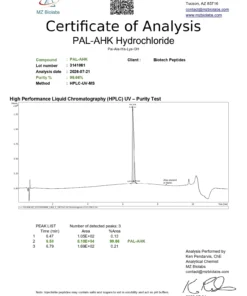
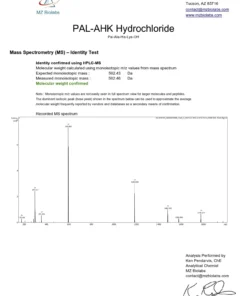
Buy Pal-AHK Peptide 200mg | Palmitoyl Tripeptide-3
Pal-AHK Peptide 200mg, also known as Palmitoyl Tripeptide-3, is a lipid-modified tripeptide consisting of an AHK sequence—alanine, histidine, and lysine—linked to a palmitoyl fatty-acid group. This structural modification gives Pal-AHK a lipophilic character that makes it an interesting molecule for laboratory research involving peptide-cell interactions, membrane-associated processes, fibroblast biology, and extracellular matrix (ECM) signaling.
The underlying AHK sequence has been investigated in experimental models involving dermal fibroblasts, collagen-associated pathways, cellular viability, oxidative-stress mechanisms, dermal papilla cells, and vascular signaling. Pal-AHK research peptide therefore provides researchers with a defined lipid-modified peptide model for studying how structural modifications can influence cellular signaling and extracellular matrix biology.
Our Pal-AHK Peptide 200mg is supplied exclusively for qualified laboratory research, in-vitro experimentation, analytical investigation, and scientific studies. This material is not intended for human or veterinary use.
Pal-AHK (Palmitoyl Tripeptide-3) Research Peptide
Pal-AHK combines the AHK tripeptide sequence with a palmitoyl group. AHK has been studied as a copper-associated peptide sequence, while the palmitoyl modification provides an additional structural feature for research into lipid-modified peptides and cellular interactions.
Researchers investigating Pal-AHK can examine the relationship between peptide structure, lipophilicity, cellular association, and downstream signaling. The molecule is particularly relevant to research involving fibroblasts, extracellular matrix proteins, cell proliferation, oxidative stress, and tissue-associated cellular models.
The supplied product contains a defined synthetic peptide structure and is available as a 200mg research quantity for laboratory workflows requiring a lipid-modified AHK research compound.
Pal-AHK and Extracellular Matrix Research
The extracellular matrix is a dynamic network of proteins and other biomolecules that provides structural and biochemical support to surrounding cells. Dermal fibroblasts are important experimental cells in ECM research because they produce and organize proteins such as collagen and other matrix components.
Research involving AHK and AHK-Cu has examined fibroblast viability, proliferation, and collagen-associated activity. Experimental assays have reported changes in fibroblast growth and collagen production following exposure to AHK-associated peptide systems.
These findings provide a basis for further laboratory investigation into how AHK-containing peptides interact with fibroblast signaling and ECM-associated pathways. Pal-AHK can be used as a lipid-modified research model for examining these mechanisms under controlled experimental conditions.
Fibroblast Proliferation and Viability
Fibroblast proliferation and viability can be evaluated using established laboratory assays. Studies involving AHK-Cu have used techniques such as neutral red uptake and sulforhodamine B assays to investigate cellular viability and proliferation.
Researchers can use these experimental approaches to compare cellular responses between untreated controls and peptide-exposed cultures. Such studies may help characterize concentration-dependent cellular responses, morphology, proliferation markers, and peptide-associated signaling.
Pal-AHK and Collagen Research
Collagen is one of the primary structural proteins investigated in extracellular matrix research. Type I collagen in particular is frequently measured when studying fibroblast activity and ECM-associated signaling.
Experimental research involving AHK-Cu has reported changes in type I collagen production in cultured fibroblasts. These observations have encouraged further investigation into the molecular mechanisms connecting AHK-associated peptide signaling with collagen biosynthetic pathways.
Researchers studying Pal-AHK Peptide 200mg can investigate collagen-related gene expression, protein production, fibroblast activity, and matrix remodeling in controlled in-vitro systems.
Pal-AHK and Oxidative Stress Research
AHK has also attracted research interest because of its metal-binding characteristics. Histidine-containing peptides can participate in metal coordination, making them useful models for studying peptide-metal interactions and oxidative chemistry.
Laboratory investigations can evaluate Pal-AHK in relation to metal-associated reactions, oxidative-stress markers, cellular antioxidant pathways, and peptide structure-function relationships.
Because Pal-AHK includes both the AHK sequence and a palmitoyl modification, researchers can also compare lipid-modified and non-lipid-modified peptide systems when investigating how molecular structure influences experimental behavior.
Pal-AHK and VEGFR2 Research
Vascular endothelial growth factor receptor 2 (VEGFR2) is an important signaling receptor involved in endothelial-cell biology and angiogenesis research. Computational studies have investigated potential interactions between AHK and VEGFR2 using molecular docking approaches.
These in-silico findings provide a basis for additional experimental research into peptide-receptor interactions. Researchers can investigate VEGFR2-associated signaling using appropriate cellular models and evaluate downstream markers associated with endothelial-cell proliferation, migration, and vascular signaling.
It is important to distinguish computational docking results from experimentally established biological effects. Further in-vitro and mechanistic research is necessary to characterize the significance of these predicted interactions.
Pal-AHK and Dermal Papilla Cell Research
Dermal papilla cells (DPCs) are specialized cells located within hair follicles and are frequently used as an experimental model for studying follicular cell signaling, proliferation, apoptosis, and growth-factor pathways.
Research involving AHK and AHK-Cu has investigated DPC proliferation and cellular survival pathways. Experimental studies have examined markers including Bcl-2, Bax, cleaved caspase-3, and PARP to characterize apoptosis-associated responses.
Researchers can also investigate MAPK/ERK1/2 signaling and growth-factor-associated pathways involving VEGF, FGF-2, and FGF-7. These experimental systems provide a framework for studying how peptide structures influence dermal papilla cell biology.
MAPK and ERK Signaling
The mitogen-activated protein kinase (MAPK) pathway and extracellular signal-regulated kinase 1/2 (ERK1/2) are important intracellular signaling pathways involved in cellular proliferation and differentiation.
Laboratory studies can examine whether AHK-associated peptide exposure corresponds with changes in ERK1/2 phosphorylation or downstream signaling markers. These experiments can help researchers characterize relationships between peptide-cell interactions and cellular proliferation pathways.
Pal-AHK and Apoptosis Research
Apoptosis is a tightly regulated form of programmed cell death that can be evaluated using molecular markers such as the Bcl-2/Bax ratio, cleaved caspase-3, and PARP cleavage.
AHK-Cu has been investigated in dermal papilla cell models using these markers. Such studies provide an experimental framework for examining whether AHK-associated peptide systems influence cellular survival and apoptosis-related signaling.
Pal-AHK can therefore serve as a lipid-modified peptide model for comparative laboratory studies involving cell viability, apoptosis markers, and peptide-mediated signaling pathways.
Pal-AHK Peptide Specifications
| Specification | Details |
|---|---|
| Product Name | Pal-AHK Peptide |
| Available Amount | 200mg |
| Peptide Type | Lipid-Modified Tripeptide |
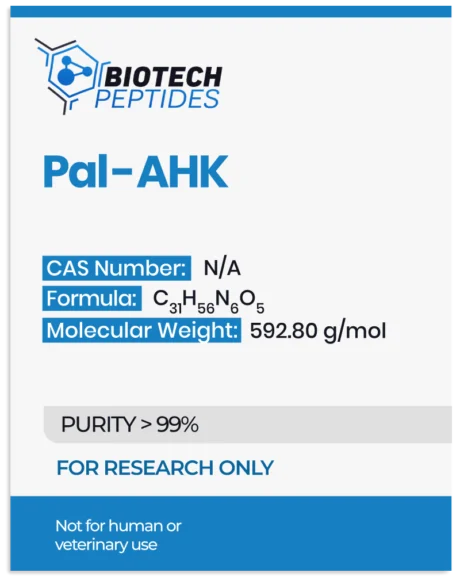
| Sequence | Palmitoyl-Ala-His-Lys |
| Molecular Formula | C31H56N6O5 |
| Molecular Weight | 592.80 g/mol |
| Synonym | Palmitoyl Tripeptide-3 |
| Core Peptide Sequence | AHK (Ala-His-Lys) |
| Research Classification | Research Use Only (RUO) |
Why Buy Pal-AHK Peptide 200mg?
- Defined synthetic Pal-AHK research peptide.
- Available in a convenient 200mg research quantity.
- Contains the AHK tripeptide sequence with a palmitoyl modification.
- Useful for dermal fibroblast and extracellular matrix research.
- Relevant to collagen-associated cellular studies.
- Suitable for peptide-metal interaction and oxidative-stress research.
- Applicable to VEGFR2 and endothelial signaling models.
- Useful for dermal papilla cell and apoptosis research.
- Relevant to MAPK/ERK signaling investigations.
- Suitable for qualified laboratory and scientific research environments.
Buy Pal-AHK Peptide 200mg for Laboratory Research
If your laboratory research focuses on fibroblast biology, extracellular matrix signaling, collagen pathways, peptide-metal interactions, dermal papilla cells, or cellular signaling, Buy Pal-AHK Peptide 200mg for your research inventory.
Pal-AHK provides a defined lipid-modified AHK structure suitable for controlled in-vitro, biochemical, cellular, and analytical research. Select the 200mg research quantity for experimental workflows requiring a Palmitoyl Tripeptide-3 research compound.
Pal-AHK Research FAQ
What is Pal-AHK Peptide?
Pal-AHK is a synthetic lipid-modified tripeptide also known as Palmitoyl Tripeptide-3. It contains the AHK sequence—alanine, histidine, and lysine—linked to a palmitoyl group.
What is the sequence of Pal-AHK?
The supplied sequence is Palmitoyl-Ala-His-Lys, consisting of the AHK tripeptide attached to a palmitoyl fatty-acid group.
What is the molecular weight of Pal-AHK?
The supplied molecular weight is 592.80 g/mol, with the molecular formula C31H56N6O5.
What is Pal-AHK studied for in research?
Pal-AHK can be investigated in experimental models involving dermal fibroblasts, extracellular matrix signaling, collagen-associated pathways, oxidative stress, peptide-metal interactions, VEGFR2 signaling, dermal papilla cells, MAPK/ERK pathways, and apoptosis.
Is Pal-AHK intended for human use?
No. Pal-AHK is supplied strictly for Research Use Only. It is intended for qualified laboratory research, in-vitro testing, analytical investigation, and scientific study and is not intended for human or veterinary use.
Research Use Only Disclaimer
FOR RESEARCH USE ONLY (RUO). Pal-AHK is supplied exclusively for laboratory research, in-vitro testing, analytical research, and scientific investigation. It is not intended for human consumption, veterinary use, diagnosis, disease management, or use as a food, dietary supplement, cosmetic, or approved drug. This material is intended for qualified laboratory personnel using appropriate safety procedures and following applicable institutional requirements and laws. Findings from cellular or animal research models should not be interpreted as established outcomes in humans. The purchaser is responsible for determining appropriate laboratory use, handling, storage, and regulatory compliance.
Be the first to review “Pal-AHK Peptide 200mg | Palmitoyl Tripeptide-3”
Related products
Biotech Peptides
Biotech Peptides

Biotech Peptides
Biotech Peptides

Biotech Peptides

Biotech Peptides

Biotech Peptides
Biotech Peptides
Reviews
There are no reviews yet.