Description
Hexarelin Peptide 5mg & 10mg – Research Use Only
Hexarelin peptide, also known as Examorelin, is a synthetic hexapeptide and research analog associated with the ghrelin/growth hormone secretagogue receptor system. Structurally related to GHRP-6, Hexarelin has been investigated extensively in experimental research involving GHSR-1a signaling, pituitary-cell biology, muscle-cell models, cardiac-cell research, metabolic pathways, and appetite-related signaling.
Hexarelin and GHRP-6 are both six-amino-acid research peptides described in the supplied research material as ghrelin-related compounds. The supplied source distinguishes Hexarelin from GHRP-6 by the presence of a methyl group in its structure.
Experimental studies have examined Hexarelin in relation to growth-hormone secretagogue receptors, cardiac-cell survival, oxidative-stress pathways, mitochondrial function, muscle-cell biology, CD36 receptor signaling, lipid metabolism, and neuroendocrine pathways.
Hexarelin peptide is available in 5 mg and 10 mg research quantities.
This product is intended strictly for Research Use Only (RUO). It is not intended for human or veterinary use, diagnosis, treatment, prevention, or mitigation of disease.
Hexarelin Peptide Specifications
| Specification | Details |
|---|---|
| Product Name | Hexarelin Peptide |
| Other Known Name | Examorelin |
| Available Quantities | 5 mg, 10 mg |
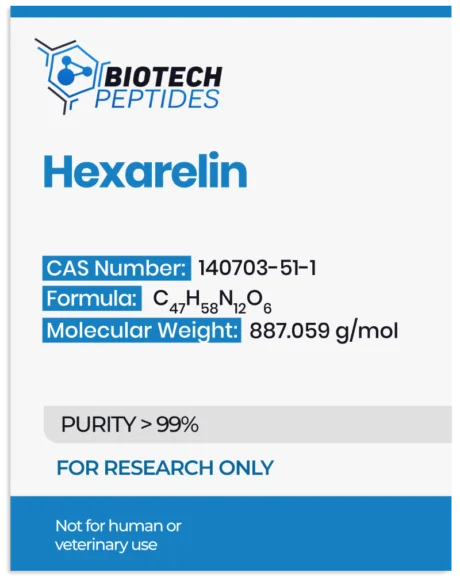
| Molecular Formula | C47H58N12O6 |
| Molecular Weight | 887.05 g/mol |
| Sequence | His-2-Me-D-Trp-Ala-Trp-D-Phe-Lys-NH2 |
| Peptide Type | Synthetic hexapeptide |
| Research Classification | Research Use Only |
Researchers should verify molecular characterization, peptide sequence nomenclature, purity information, and batch-specific analytical specifications against the applicable certificate of analysis.
Hexarelin Research Peptide
Hexarelin research peptide has been investigated across several experimental systems. A significant portion of the available research focuses on the interaction between Hexarelin and growth hormone secretagogue receptors, particularly the GHSR-1a subtype.
Other experimental research areas described in the supplied material include muscle-cell biology, mitochondrial function, cardiac-cell models, oxidative stress, CD36 receptor signaling, metabolic research, and appetite-related pathways.
The following sections summarize the research information provided in the supplied material.
Hexarelin and Growth Hormone Secretagogue Receptors
Experimental research has investigated whether Hexarelin activates growth hormone secretagogue receptors (GHS-Rs), particularly the GHSR-1a subtype.
GHSR-1a is associated with the signaling actions of ghrelin and is distributed in areas including the hypothalamus and pituitary gland as well as other regions of the nervous system and peripheral tissues.
The supplied research proposes that Hexarelin may interact with these receptors and initiate intracellular signaling cascades associated with G-proteins and protein kinase C (PKC).
This provides an experimental framework for studying the relationship between synthetic peptide structures, receptor activation, and downstream pituitary-cell signaling.
Research has also investigated potential receptor desensitization following Hexarelin exposure. The supplied material describes transient changes in receptor responsiveness that may persist for an extended period under certain experimental conditions.
Hexarelin and Pituitary-Cell Research
Hexarelin has been studied as a growth hormone secretagogue in experimental pituitary-cell systems.
Research in this area examines the interaction between GHSR-1a signaling and growth-hormone production in anterior pituitary cells.
This signaling route differs from the pathway associated with endogenous growth hormone-releasing hormone (GHRH), which acts through GHRH receptors.
By investigating these distinct receptor systems, researchers can examine different mechanisms involved in pituitary-cell signaling and growth-hormone secretion.
The supplied material also notes that Hexarelin research has examined associated endocrine markers, including prolactin, adrenocorticotropic hormone (ACTH), and cortisol.
Hexarelin and Muscle-Cell Research
Another major research area involves muscle tissue and cellular metabolism.
Experimental studies involving Hexarelin and GHRP-6 have examined calcium regulation and mitochondrial function in muscle models subjected to catabolic conditions.
Mitochondria play an important role in cellular energy production, and experimental disruption of mitochondrial function can affect muscle-cell viability and metabolism.
The supplied research describes studies investigating whether Hexarelin exposure may influence mitochondrial integrity and calcium regulation.
Additional experimental models have examined muscle-mass changes under catabolic conditions. The source describes an experimental reduction in muscle mass of approximately 12% following exposure to catabolic agents, compared with an approximately 7% reduction in models exposed to Hexarelin.
Related research has also investigated changes in experimental measures of muscle strength.
These observations provide research models for studying peptide-associated effects on mitochondrial biology, calcium signaling, protein metabolism, and muscle-cell integrity.
Hexarelin and Cardiac-Cell Research
Cardiac research represents an important area of Hexarelin investigation.
The supplied material describes experimental studies examining Hexarelin interactions with CD36 receptors and GHS receptors in relation to cardiac-cell responses.
Murine research has investigated cardiac-cell injury and apoptosis under experimental conditions associated with cardiac arrest.
Researchers have examined markers of oxidative stress, cell survival, cardiac function, and tissue remodeling.
The supplied research also describes studies in which Hexarelin exposure was associated with changes in malondialdehyde measurements and other experimental markers of cellular stress.
Additional research has examined cardiac remodeling in rat models. Proposed mechanisms described in the source include changes involving phosphatase and tensin homolog (PTEN) and protein kinase B (Akt).
Other experiments have investigated autonomic nervous-system signaling and potential changes between sympathetic and parasympathetic responses.
Studies involving diabetic rat models have additionally examined potential relationships between Hexarelin exposure and calcium and potassium handling in cardiac muscle cells.
These findings provide several experimental systems for investigating Hexarelin in cardiac-cell signaling and cardiovascular research.
Hexarelin and Oxidative-Stress Research
Hexarelin has been investigated in experimental models involving oxidative stress.
Cardiac-cell studies described in the supplied material have examined free-radical-associated cellular damage and oxidative-stress markers.
Research has also investigated mitochondrial integrity and cellular survival under experimental stress conditions.
These studies can provide laboratory models for examining how peptide exposure interacts with oxidative pathways, mitochondrial function, and cellular stress responses.
Hexarelin and CD36 Receptor Research
CD36 is another receptor investigated in relation to Hexarelin.
The supplied material describes CD36 as a receptor associated with lipid uptake and transport, immune-related signaling, inflammatory processes, and vascular biology.
Experimental research has examined whether Hexarelin may interact with CD36-associated pathways in addition to GHSR-1a signaling.
This provides an additional area of research for investigating peptide-receptor interactions and downstream cellular responses.
Hexarelin and Metabolic Research
The supplied material describes experimental research involving dyslipidemia and insulin-resistance models.
Studies involving GHRP-6 and Hexarelin have investigated lipid-related measurements and metabolic markers in experimental animal models.
Research has examined potential changes in blood lipid levels, glucose-related measurements, and insulin-resistance parameters.
These studies provide experimental models for examining relationships between ghrelin-related signaling, peptide exposure, lipid metabolism, and metabolic pathways.
Because these observations originate from experimental models, the reported findings should be interpreted according to the specific study design and conditions.
Hexarelin and Appetite Research
Hexarelin has also been investigated in experimental appetite and feeding-behavior models.
The supplied material describes potential activation of ghrelin receptors in different regions of the nervous system and possible downstream involvement of appetite-associated neuropeptides.
Particular pathways discussed include:
- Neuropeptide Y (NPY)
- Agouti-related peptide (AgRP)
- α-Melanocyte-stimulating hormone (α-MSH)
- GHSR-1a
- Cyclic AMP (cAMP)
- Mesolimbic reward signaling
NPY and AgRP are involved in experimental studies of energy balance and feeding behavior, while α-MSH is associated with appetite-suppressing signaling.
Research has therefore investigated Hexarelin as a tool for studying the relationship between ghrelin-receptor signaling, neuropeptide pathways, feeding behavior, and reward-related neural circuits.
Hexarelin Molecular Weight and Peptide Sequence
The supplied specification identifies the molecular formula of Hexarelin as C47H58N12O6 and the molecular weight as 887.05 g/mol.
The supplied peptide sequence is:
His-2-Me-D-Trp-Ala-Trp-D-Phe-Lys-NH2
Researchers should verify sequence nomenclature, molecular characterization, purity information, and other analytical specifications against the applicable batch-specific documentation.
Key Hexarelin Research Areas
Researchers studying Hexarelin research peptide may encounter experimental literature involving:
- GHSR-1a receptor signaling
- Ghrelin-receptor research
- Pituitary-cell biology
- Growth hormone secretagogue pathways
- PKC-related signaling
- Receptor desensitization
- Muscle-cell research
- Mitochondrial function
- Calcium signaling
- Muscle protein metabolism
- Cardiac-cell research
- Cardiac apoptosis models
- CD36 receptor research
- Oxidative-stress models
- PTEN and Akt signaling
- Cardiac remodeling
- Lipid metabolism
- Dyslipidemia research
- Insulin-resistance models
- Appetite and feeding behavior
- NPY and AgRP signaling
- α-MSH research
- Mesolimbic reward pathways
Laboratory Research and Documentation
Before incorporating Hexarelin into an experimental protocol, researchers should review the documentation associated with the specific batch.
Depending on the available documentation, researchers may need to review:
- Batch identification
- Molecular formula
- Molecular weight
- Peptide sequence
- Purity specification
- Analytical characterization
- Certificate of analysis
- Manufacturer technical documentation
Where a specific analytical value is not provided, researchers should consult the applicable batch documentation rather than assuming a specification.
Frequently Asked Questions
What is Hexarelin peptide?
Hexarelin, also known as Examorelin, is a synthetic hexapeptide that has been investigated in laboratory research involving growth hormone secretagogue receptors, ghrelin signaling, cardiac-cell biology, muscle-cell research, metabolic pathways, and appetite-related signaling.
What is the molecular weight of Hexarelin?
The supplied specification lists the molecular weight of Hexarelin as 887.05 g/mol.
What is the molecular formula of Hexarelin?
The molecular formula supplied for Hexarelin is C47H58N12O6.
What is the Hexarelin peptide sequence?
The supplied sequence is His-2-Me-D-Trp-Ala-Trp-D-Phe-Lys-NH2.
What quantities of Hexarelin are available?
The supplied product information specifies 5 mg and 10 mg research quantities.
What is Hexarelin studied for?
Hexarelin has been investigated experimentally in areas including GHSR-1a signaling, pituitary-cell research, muscle-cell and mitochondrial models, cardiac-cell research, CD36 receptor pathways, oxidative stress, metabolic research, and appetite-related signaling.
Is Hexarelin intended for human or animal use?
No. This product is presented strictly as a Research Use Only (RUO) material. It is not intended for human or animal consumption, clinical use, diagnosis, treatment, prevention, or mitigation of disease.
Research Use Only Disclaimer
RESEARCH USE ONLY (RUO): Hexarelin peptide is intended exclusively for qualified laboratory and scientific research, including appropriate in-vitro and experimental applications. This material is not intended for human consumption, animal consumption, clinical use, diagnosis, treatment, prevention, or mitigation of any disease or medical condition. It must not be represented or marketed as a drug, dietary supplement, therapeutic agent, or medical treatment. Researchers are responsible for appropriate laboratory handling, storage, experimental design, regulatory compliance, and applicable laboratory safety procedures.

Reviews
There are no reviews yet.