
Description
Buy PEG-MGF Peptide 5mg – Research Use Only
Buy PEG-MGF Peptide 5mg for laboratory research involving mechano-growth factor biology, peptide stability, cellular signaling, skeletal muscle models, and tissue-response pathways. PEG-MGF, also known as pegylated mechano-growth factor, is a modified form of MGF in which a polyethylene glycol (PEG) moiety is associated with the peptide structure. This modification is studied primarily in the context of peptide stability and experimental biological activity.
MGF is associated with alternative splicing of the IGF-1 gene and has been investigated in models of skeletal muscle cells, cellular stress, tissue remodeling, and regenerative signaling. PEG-MGF provides researchers with an experimental peptide format for examining how PEG modification may influence peptide behavior and biological responses compared with non-pegylated MGF-related sequences.
PEG-MGF Research Peptide Overview
Mechano-growth factor (MGF) is associated with the IGF-1 gene and alternative splicing processes that produce different peptide products. The MGF-related E-domain has been investigated in experimental models involving mechanical stress, cellular proliferation, differentiation, and tissue responses.
PEG-MGF research is currently more limited than research involving MGF-E and related MGF constructs. Consequently, many experimental observations discussed in the scientific literature concern MGF or MGF-E rather than PEG-MGF specifically. These studies can provide useful background for investigating the biological pathways associated with the MGF sequence, while PEGylation introduces an additional structural variable for laboratory investigation.
PEGylation and Peptide Stability
PEGylation refers to the attachment or association of a polyethylene glycol moiety with another molecular compound. In peptide research, PEG modification can be investigated as a strategy for altering physicochemical characteristics such as molecular behavior, stability, and clearance in experimental systems.
For PEG-MGF, researchers can examine how PEG modification influences peptide stability compared with non-PEGylated MGF preparations. This makes PEG-MGF laboratory research relevant to studies of peptide structure-function relationships, experimental stability, and the behavior of modified peptide constructs.
PEG-MGF Peptide Specifications
| Specification | Details |
|---|---|
| Product | PEG-MGF Peptide |
| Available Quantity | 5mg |
| Alternative Names | Pegylated MGF, Pegylated Mechano Growth Factor |
| Molecular Formula | C121H200N42O39 |
| Peptide Sequence | Tyr-Gln-Pro-Pro-Ser-Thr-Asn-Lys-Asn-Thr-Lys-Ser-Gln-Arg-Arg-Lys-Gly-Ser-Thr-Phe-Glu-Glu-Arg-Lys |
| Peptide Length | 24 amino acids |
| Modification | PEGylated MGF-related peptide |
| Research Classification | Research Use Only (RUO) |
PEG-MGF and Skeletal Muscle Cell Research
MGF-related signaling has been investigated in experimental skeletal muscle models following mechanical stress and cellular injury. Research has examined changes in MGF-associated messenger RNA following resistance-related mechanical stimuli, providing a model for investigating how muscle cells respond to physical stress at the molecular level.
Experimental studies have also examined MGF-related pathways in muscle-cell proliferation, differentiation, myotube formation, and inflammatory signaling. These models allow researchers to investigate relationships between MGF-associated signaling and cellular responses following experimentally induced stress or injury.
PEG-MGF and Muscle Cell Growth Models
MGF has been investigated in cell-culture systems containing muscle cells at different stages of cellular development. Research observations have included changes in muscle-cell proliferation, myotube size, cellular differentiation, and expression of muscle-associated proteins.
Such experiments can be useful for studying how MGF-related peptides interact with muscle-cell signaling pathways. Differences between younger and older cellular populations have also been investigated, highlighting the importance of cellular context when evaluating peptide-mediated responses.
PEG-MGF and Cardiac Cell Research
MGF-related peptides have been studied in experimental cardiomyocyte and cardiac tissue models involving cellular stress and hypoxia. Researchers have investigated pathways associated with cardiomyocyte survival, cellular signaling, stem-cell recruitment, and tissue remodeling.
Experimental studies have also examined the interaction between MGF-related signaling and mesenchymal stromal cells. These models provide opportunities to investigate chemotactic responses, cellular migration, and molecular pathways associated with cell survival. Findings from animal or cell-based experiments remain specific to those experimental systems and require further validation before broader biological conclusions can be established.
PEG-MGF and Bone Cell Research
MGF-related peptides have also been investigated in osteoblast and bone-defect models. Research areas include osteoblast proliferation, cell-cycle regulation, MAPK signaling, and extracellular signal-regulated kinase 1/2 (ERK1/2) pathways.
These signaling pathways are relevant to laboratory investigations of cell proliferation and tissue remodeling. PEG-MGF can therefore serve as an experimental compound when researchers are examining how MGF-related sequences and PEG modification interact with cellular signaling mechanisms.
PEG-MGF and Cartilage Research
MGF has been investigated in experimental cartilage models involving chondrocyte activity, cellular migration, and cartilage-associated signaling. Researchers have explored the relationship between MGF-related signaling and pathways involved in cellular stress responses and cartilage maintenance.
These experiments provide a framework for investigating peptide-mediated signaling in chondrocytes and other cartilage-associated cell systems. Additional research is required to determine how PEGylated MGF constructs compare with unmodified MGF in these experimental models.
PEG-MGF and Dental Cell Research
Research involving periodontal ligament cell cultures has examined MGF-related peptide activity in osteogenic differentiation and extracellular matrix-associated pathways. Experimental endpoints have included cellular differentiation and expression of matrix metalloproteinases such as MMP-1 and MMP-2.
These findings make periodontal ligament cultures another potential experimental system for studying MGF-associated cellular signaling and tissue-related responses.
PEG-MGF and Neurobiological Research
MGF-related signaling has also been investigated in neural and central nervous system models. Research has explored relationships between MGF expression, neuronal stress, neuronal survival, and age-dependent changes in experimental models.
Studies involving experimental hypoxic injury have reported changes in MGF expression in regions experiencing neuronal stress. These observations provide a basis for further investigation into MGF-associated signaling within neural cells and tissue models.
PEG-MGF and Muscle Remodeling Research
Experimental research has examined MGF in models of muscle injury and tissue remodeling, including inflammatory signaling, extracellular matrix activity, fibrosis-associated pathways, and oxidative stress markers.
Research endpoints have included cytokines such as TNF-α, IFN-γ, IL-1β, and TGF-β, as well as chemokines and oxidative-stress-associated markers. These studies may help researchers characterize how MGF-related signaling interacts with the inflammatory environment following experimentally induced muscle injury.
PEG-MGF Research Applications
- MGF and IGF-1 alternative-splicing research
- PEGylated peptide stability studies
- Skeletal muscle cell and myoblast research
- Myotube formation and cellular differentiation studies
- Cardiomyocyte and cardiac-cell research
- Mesenchymal stromal cell migration studies
- Osteoblast and bone-cell research
- Chondrocyte and cartilage-cell models
- Periodontal ligament cell research
- Neural-cell and neurobiological research
- Inflammatory and oxidative-stress pathway studies
- Peptide structure-function investigations
PEG-MGF Handling and Storage
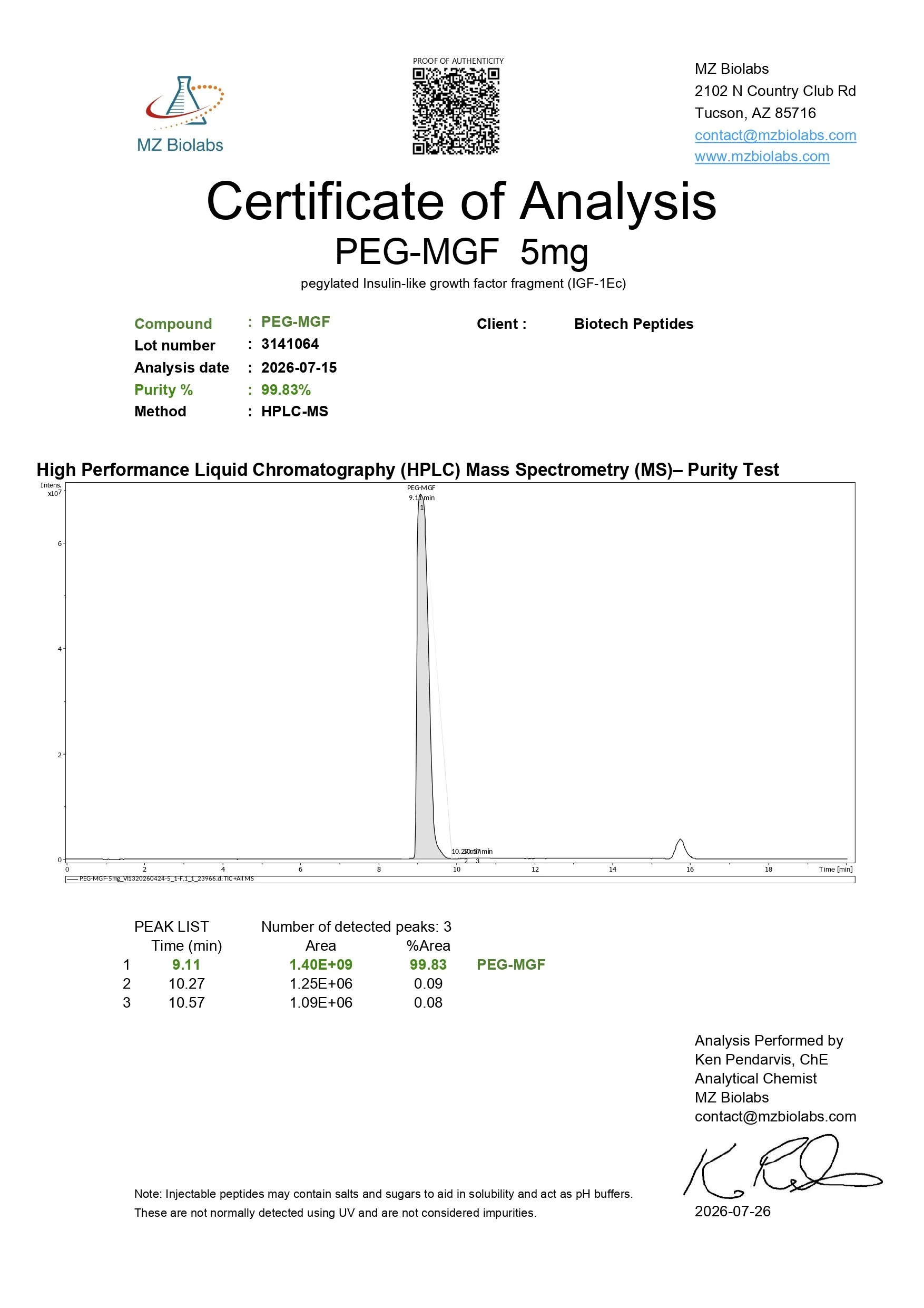
Researchers working with PEG-MGF Peptide 5mg should follow the applicable manufacturer documentation and lot-specific certificate of analysis for storage, handling, and preparation requirements. Qualified laboratory personnel should use appropriate protective equipment and established laboratory procedures when handling peptide materials.
Because PEG-MGF research remains comparatively limited, researchers should distinguish between evidence generated specifically with PEG-MGF and findings obtained using MGF-E, full-length MGF, or other related IGF-1-derived constructs.
Frequently Asked Questions About PEG-MGF
What is PEG-MGF?
PEG-MGF is a PEG-modified MGF-related research peptide. PEGylation introduces a polyethylene glycol moiety that can alter the physicochemical characteristics of a peptide and provides an additional variable for laboratory stability and structure-function studies.
What is the PEG-MGF peptide sequence?
The supplied sequence is Tyr-Gln-Pro-Pro-Ser-Thr-Asn-Lys-Asn-Thr-Lys-Ser-Gln-Arg-Arg-Lys-Gly-Ser-Thr-Phe-Glu-Glu-Arg-Lys.
How many amino acids are in the supplied PEG-MGF sequence?
The supplied sequence contains 24 amino acids.
What is PEG-MGF used for in research?
PEG-MGF can be investigated in laboratory models involving MGF-related signaling, peptide stability, skeletal muscle cells, cardiomyocytes, bone cells, cartilage models, neural systems, and cellular stress pathways.
Is PEG-MGF intended for human use?
No. This product is supplied strictly for qualified laboratory research, in-vitro testing, analytical research, and scientific investigation.
Research Use Only Disclaimer
FOR RESEARCH USE ONLY (RUO). PEG-MGF Peptide is supplied exclusively for laboratory research, in-vitro testing, analytical research, and scientific investigation. It is not intended for human consumption, veterinary use, diagnosis, disease management, or use as a food, dietary supplement, cosmetic, or approved drug. This material is intended for qualified laboratory personnel using appropriate safety procedures and following applicable institutional requirements and laws. Findings from cellular or animal research models should not be interpreted as established outcomes in humans. The purchaser is responsible for determining appropriate laboratory use, handling, storage, and regulatory compliance.


Reviews
There are no reviews yet.