


Description
Buy Sermorelin Peptide 5mg & 10mg – Research Use Only
Sermorelin research peptide is a synthetic growth hormone-releasing hormone (GHRH) analog used in laboratory research involving GHRH receptor signaling, somatotroph-cell biology, intracellular cAMP pathways, and growth-hormone-related experimental models. As a truncated GHRH sequence, Sermorelin provides researchers with a defined peptide system for investigating receptor-mediated signaling and downstream cellular processes.
This Sermorelin peptide 5mg & 10mg is supplied exclusively for laboratory research, in-vitro studies, analytical investigation, and scientific experimentation. The material is not presented for human or veterinary use.
Sermorelin Peptide Specifications
| Specification | Details |
|---|---|
| Product Name | Sermorelin Peptide |
| Available Sizes | 5mg & 10mg |
| Peptide Class | GHRH Analog |
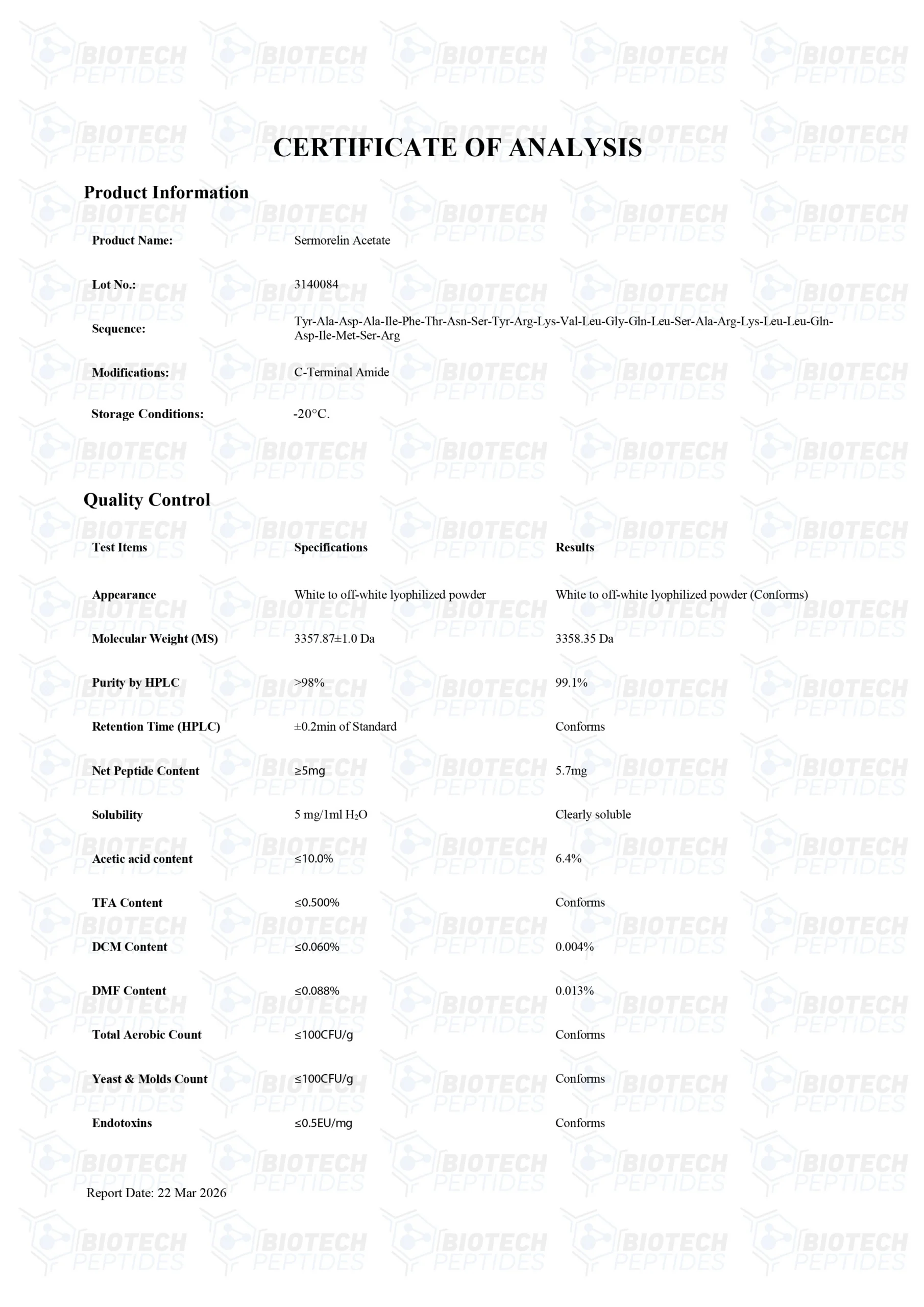
| Molecular Formula | C149H246N44O42S |
| Molecular Weight | 3357.9 g/mol |
| Sequence | Tyr-Ala-Asp-Ala-Ile-Phe-DL-Thr-Asn-Ser-Tyr-Arg-Lys-Val-Leu-Gly-Gln-Leu-Ser-Ala-Arg-Lys-Leu-Leu-Gln-Asp-Ile-Met-Ser-Arg-NH2 |
| Research Classification | Research Use Only (RUO) |
Sermorelin Research and GHRH Receptor Signaling
Sermorelin represents a truncated sequence corresponding to the N-terminal region of growth hormone-releasing hormone (GHRH). This structural characteristic makes the peptide relevant to research examining how GHRH-derived sequences interact with GHRH receptors and influence downstream signaling pathways.
In experimental models, GHRH receptor activation can be investigated through the adenylyl cyclase and cyclic adenosine monophosphate (cAMP) signaling pathway. Changes in intracellular cAMP may subsequently influence protein kinase A (PKA) activity and other signaling events within receptor-expressing cells.
Because somatotroph cells express GHRH receptors, Sermorelin provides a research tool for examining receptor activation, intracellular signal transduction, calcium-dependent cellular processes, and growth-hormone-related secretory mechanisms in controlled experimental systems.
Sermorelin and Somatotroph Cell Research
One important area of Sermorelin laboratory research involves somatotroph cells of the anterior pituitary. These cells provide a useful model for investigating the relationship between GHRH receptor activation and growth-hormone-related signaling.
Experimental studies can examine receptor binding, cAMP generation, PKA-associated signaling, calcium-channel activity, and downstream cellular responses. These models help researchers characterize the molecular events associated with GHRH analog activity without requiring conclusions about human physiological outcomes.
Sermorelin and cAMP Signaling Pathways
The GHRH receptor belongs to the G protein-coupled receptor family. Research involving GHRH analogs commonly examines receptor-associated activation of adenylyl cyclase and subsequent production of cAMP.
In experimental systems, cAMP may function as an important intracellular second messenger. Increased cAMP signaling can influence PKA activity, phosphorylation of cellular proteins, calcium-dependent processes, and other downstream events. Sermorelin therefore provides a useful peptide model for investigating the relationship between receptor activation and intracellular signal transduction.
Sermorelin in Cardiac Research Models
GHRH analogs have also been investigated in experimental cardiovascular models. Research has examined pathways associated with cardiac remodeling, extracellular-matrix regulation, vascular growth, inflammatory signaling, fibrosis, and cellular survival following experimental cardiac injury.
Preclinical studies involving GHRH-related compounds have explored changes in cardiac tissue structure and function following experimentally induced injury. These findings provide a basis for continued laboratory investigation into GHRH signaling, tissue remodeling, and repair-associated pathways.
Such findings should be interpreted strictly within the context of the experimental model in which they were generated and should not be treated as established outcomes in humans.
Sermorelin and Neuroscience Research
Sermorelin has also appeared in experimental neuroscience research involving GHRH signaling, GABAergic pathways, neuronal excitability, and sleep-associated signaling systems.
GABA is a major inhibitory neurotransmitter in the central nervous system, making GABA receptor activity an important subject in neuroscience research. Experimental studies involving GHRH analogs can help researchers investigate possible interactions between neuroendocrine signaling and neuronal activity.
Researchers have also examined relationships between the GHRH axis and neurochemical systems associated with sleep-wake regulation, including orexin-related pathways. These studies provide opportunities to investigate interactions between peptide signaling, neuroendocrine regulation, and neural circuits.
Sermorelin and Growth-Hormone-Related Research
A major application of Sermorelin research peptide is the investigation of the GHRH–growth hormone–IGF-related signaling axis. Rather than functioning as a general-purpose research compound, Sermorelin can be studied as a defined molecular probe for examining GHRH receptor-mediated signaling.
Experimental research may measure downstream markers such as growth-hormone-associated signaling, IGF-related pathways, receptor expression, intracellular second messengers, and changes in cellular responses following peptide exposure.
These studies can be performed using receptor-expressing cell systems, endocrine cell models, tissue preparations, and other controlled laboratory platforms.
Sermorelin Structure and Sequence Research
The molecular structure of Sermorelin makes it particularly relevant to structure-function investigations involving GHRH-derived peptides. The supplied sequence contains 29 amino-acid residues and includes a C-terminal amide group.
Researchers studying peptide structure can evaluate how sequence composition, terminal modification, peptide stability, receptor interaction, and molecular conformation influence experimental signaling characteristics.
For analytical work, researchers should use the lot-specific certificate of analysis and analytical documentation supplied with the material as the controlling reference for identity, purity, and other batch-specific characteristics.
Key Features of Sermorelin Peptide
- Available as 5mg and 10mg research quantities.
- Defined GHRH-derived peptide sequence.
- Molecular weight: 3357.9 g/mol.
- Molecular formula: C149H246N44O42S.
- Suitable for controlled laboratory and in-vitro research.
- Relevant to GHRH receptor and somatotroph-cell research.
- Useful for studying cAMP, PKA, calcium-dependent, and downstream signaling pathways.
- Applicable to experimental neuroscience, cardiovascular, endocrine, and cellular signaling studies.
- Supplied strictly as a Research Use Only (RUO) material.
Potential Laboratory Research Applications
Researchers may investigate Sermorelin in a range of controlled experimental systems, including:
- GHRH receptor signaling studies
- Somatotroph-cell and pituitary research
- cAMP and PKA pathway investigations
- Peptide receptor structure-function studies
- Growth-hormone-related cellular signaling
- IGF-related pathway research
- Neuroscience and neuroendocrine signaling models
- GABAergic signaling investigations
- Sleep and orexin-associated experimental research
- Cardiac remodeling and tissue-signaling models
- Extracellular-matrix and fibrosis-related research
- Peptide stability and analytical characterization
Handling and Storage of Sermorelin Research Peptide
Researchers should follow the storage conditions specified on the product documentation and lot-specific certificate of analysis. Peptide materials should be handled by qualified laboratory personnel using appropriate laboratory procedures.
To maintain material integrity, minimize unnecessary exposure to environmental conditions such as excessive heat, moisture, and repeated handling. Researchers should establish their own validated procedures for preparation, storage, and experimental use according to their laboratory requirements.
Frequently Asked Questions About Sermorelin Peptide
What is Sermorelin peptide?
Sermorelin is a synthetic GHRH-derived peptide used in research involving GHRH receptor signaling, somatotroph-cell biology, intracellular cAMP pathways, and growth-hormone-related experimental systems.
What sizes of Sermorelin are available?
This research product is available in 5mg and 10mg quantities.
What is the molecular weight of Sermorelin?
The molecular weight provided for this Sermorelin research material is 3357.9 g/mol.
What is the amino acid sequence of Sermorelin?
The supplied sequence is Tyr-Ala-Asp-Ala-Ile-Phe-DL-Thr-Asn-Ser-Tyr-Arg-Lys-Val-Leu-Gly-Gln-Leu-Ser-Ala-Arg-Lys-Leu-Leu-Gln-Asp-Ile-Met-Ser-Arg-NH2. For analytical work, researchers should verify the lot-specific documentation supplied with the product.
What is Sermorelin used for in research?
Sermorelin can be investigated as a molecular research tool for studying GHRH receptor activity, cAMP signaling, somatotroph-cell biology, neuroendocrine pathways, peptide structure-function relationships, and other controlled experimental systems.
Is Sermorelin intended for human use?
No. This product is supplied strictly for Research Use Only (RUO) and is intended for qualified laboratory research and scientific investigation.
Research Use Only Disclaimer
FOR RESEARCH USE ONLY (RUO). Sermorelin Peptide is supplied exclusively for laboratory research, in-vitro testing, analytical research, and scientific investigation. It is not intended for human consumption, veterinary use, diagnosis, disease management, or use as a food, dietary supplement, cosmetic, or approved drug. This material is intended for qualified laboratory personnel using appropriate safety procedures and following applicable institutional requirements and laws. Findings from cellular or animal research models should not be interpreted as established outcomes in humans. The purchaser is responsible for determining appropriate laboratory use, handling, storage, and regulatory compliance.

Reviews
There are no reviews yet.