Description
Vasoactive Intestinal Peptide (VIP) 6mg
Buy Vasoactive Intestinal Peptide (VIP) 6mg for laboratory research involving GPCR signaling, VPAC1 and VPAC2 receptor pathways, PAC1 receptor biology, immune-cell signaling, neurobiology, intestinal barrier models, pulmonary cellular research, and cardiac fibrosis pathways.
Vasoactive intestinal peptide, commonly abbreviated VIP and also known as vasoactive intestinal polypeptide or PHM27, is an endogenous peptide studied extensively in molecular and cellular biology. Research has examined VIP interactions with several G-protein-coupled receptors and downstream signaling pathways associated with cyclic AMP, immune-cell communication, neuronal signaling, and cellular responses to inflammatory stimuli.
This VIP 6mg research peptide is intended exclusively for laboratory research, in-vitro experimentation, biochemical studies, and scientific investigation.
Vasoactive Intestinal Peptide (VIP) Specifications
| Property | Specification |
|---|---|
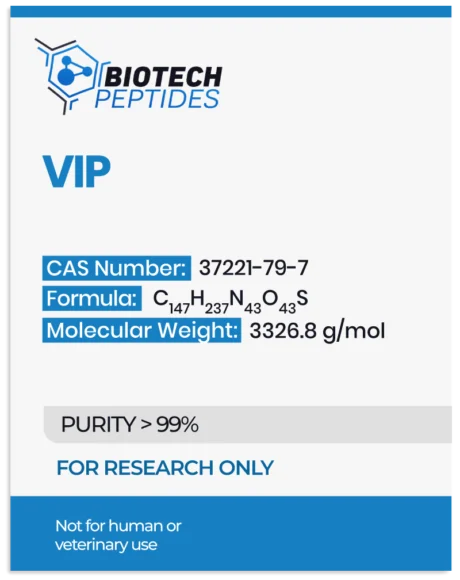
| Product Name | Vasoactive Intestinal Peptide (VIP) |
| Available Size | 6mg |
| Other Known Titles | PHM27, Vasoactive Intestinal Polypeptide |
| Molecular Formula | C147H237N43O43S |
| Molecular Weight | 3326.8 g/mol |
| Sequence | HSDAVFTDNYXRLRKQMAVKKYLNSXLN |
| Research Classification | Research Use Only (RUO) |
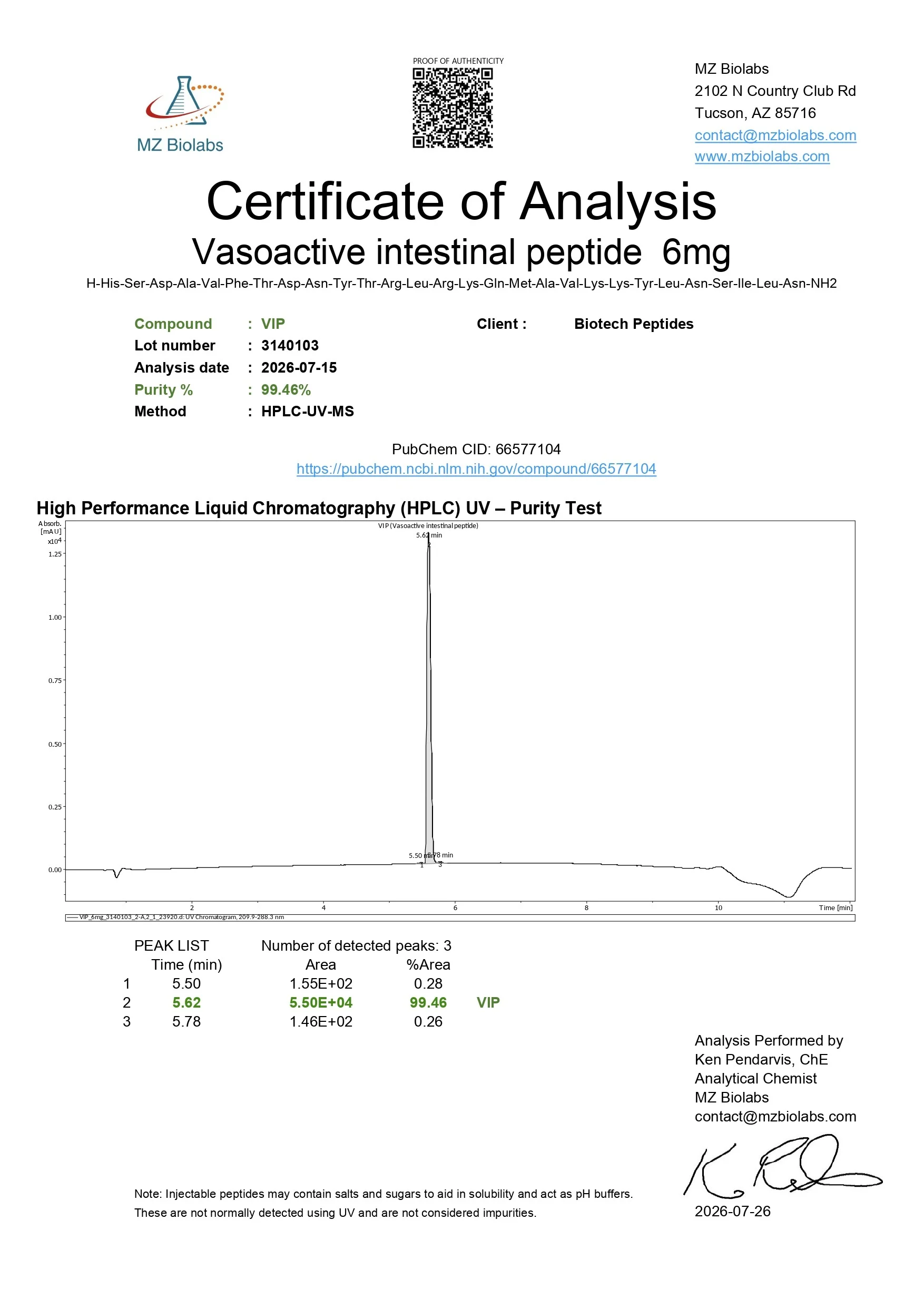
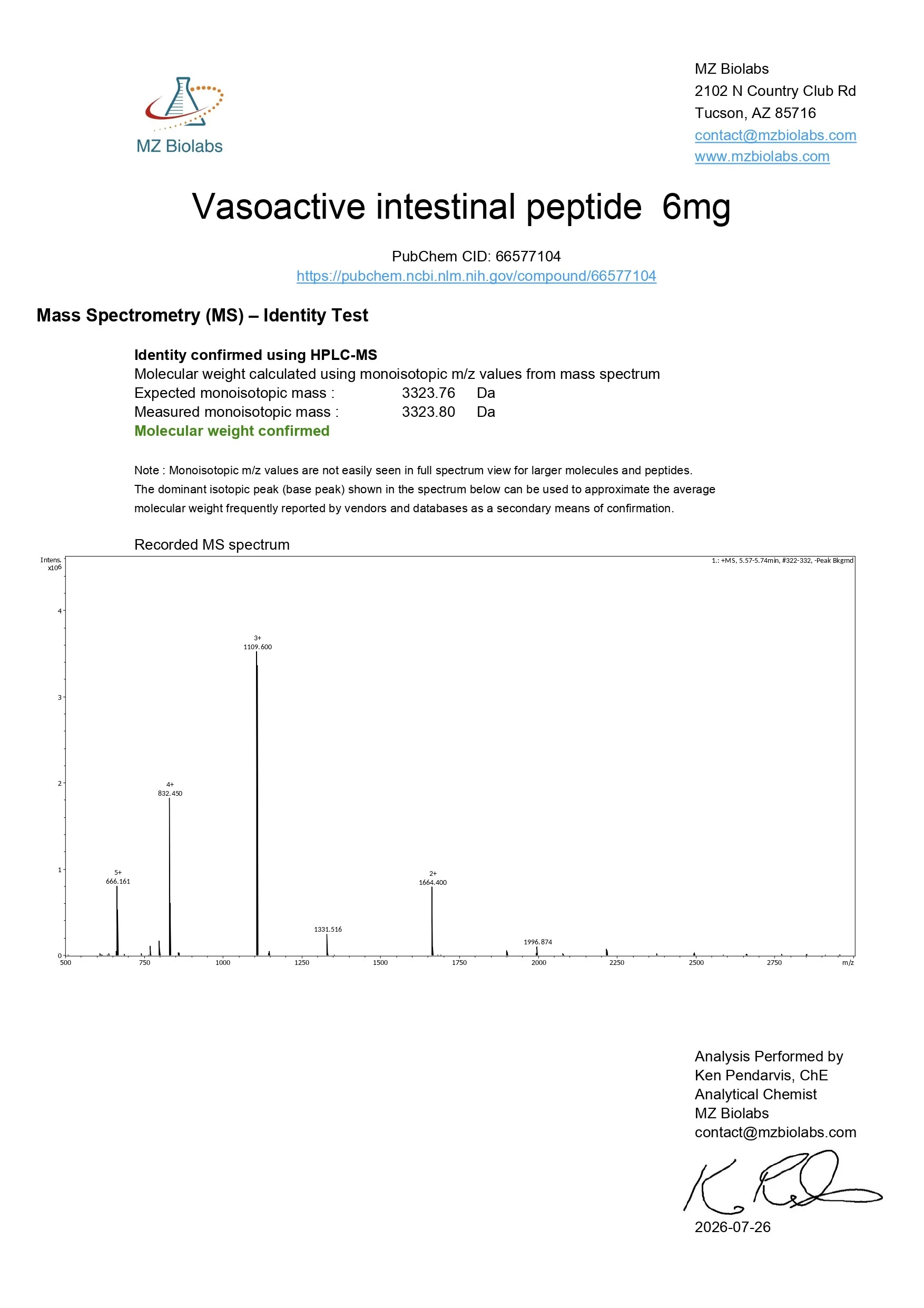
For lot-specific identity, purity, analytical characterization, and handling information, researchers should consult the applicable Certificate of Analysis (CoA) and product documentation.
VIP Peptide and GPCR Signaling Research
One of the most established areas of VIP peptide research involves its interaction with G-protein-coupled receptors. Experimental studies have focused on three receptor families:
- VPAC1
- VPAC2
- PAC1
VPAC1 and VPAC2 are commonly investigated as VIP-responsive receptors, while PAC1 is associated with the broader pituitary adenylate cyclase-activating peptide receptor family.
Receptor distribution across different tissues provides researchers with a useful model for examining how the same peptide can participate in different cellular signaling environments.
VIP-receptor research commonly investigates pathways involving adenylate cyclase and cyclic AMP (cAMP) signaling. These pathways are important intracellular communication systems and can be evaluated through biochemical assays, receptor-expression experiments, phosphorylation studies, and cell-based signaling models.
VIP and Immune-Cell Signaling Research
VIP has attracted significant scientific interest in studies of immune-cell communication and inflammatory signaling. Experimental models have examined interactions between VIP and immune cells including dendritic cells and T-cell populations.
Dendritic cells are particularly important experimental models because they participate in antigen presentation and communication with adaptive immune cells.
Research involving VIP has investigated changes in dendritic-cell markers such as:
- CD40
- CD80
- CD86
- MHC class II
- IL-10
- TGF-β
- Proinflammatory cytokines
- Regulatory T-cell-associated pathways
These studies allow researchers to investigate how neuropeptide signaling can influence immune-cell phenotype and communication.
VIP research is therefore relevant to laboratory investigations of dendritic-cell biology, T-cell signaling, cytokine networks, immune tolerance models, and neuroimmune communication.
VIP Peptide and Intestinal Barrier Research
Another important area of VIP research involves intestinal epithelial and barrier models.
The intestinal barrier relies on specialized cellular junctions that regulate movement of molecules between epithelial cells. Proteins associated with tight-junction structure, including claudins, are commonly examined when studying epithelial barrier integrity.
Experimental studies have investigated VIP in intestinal-cell and inflammatory models alongside measurements of:
- Tight-junction proteins
- Claudin expression
- Epithelial-cell integrity
- Cytokine signaling
- Immune-cell interactions
- Barrier permeability
These models provide researchers with a controlled environment for examining how neuropeptides interact with epithelial and immune signaling.
VIP may therefore be useful as a research material in studies involving intestinal barrier biology, epithelial signaling, cytokine responses, and neuroimmune interactions.
VIP and Pulmonary Cell Research
VIP has also been investigated in pulmonary and vascular cellular models. Research has focused on signaling pathways associated with nuclear factor of activated T cells (NFAT), vascular remodeling, and smooth-muscle-cell proliferation.
NFAT proteins are transcription factors involved in calcium-dependent cellular signaling and immune-cell activation. Studying VIP in conjunction with NFAT-related pathways can provide information about how peptide-receptor signaling influences cellular transcriptional responses.
Potential research areas include:
- Pulmonary vascular-cell signaling
- NFAT activation
- Smooth-muscle-cell proliferation
- Cellular remodeling
- Inflammatory signaling
- GPCR-mediated intracellular pathways
These experimental models can help characterize relationships between VIP receptor activation and cellular responses in pulmonary systems.
VIP and Dendritic-Cell Research
VIP is particularly interesting for researchers studying the interaction between the nervous and immune systems.
Experimental studies have investigated VIP exposure in immature dendritic cells and subsequent changes in costimulatory molecules and cytokine production. Other studies have examined dendritic-cell interactions with regulatory T-cell populations.
Research markers may include:
- CD40
- CD80
- CD86
- MHC class II
- IL-10
- TGF-β
- IFN-γ
- IL-2
- Regulatory T-cell activity
This makes VIP 6mg relevant to immunology research, dendritic-cell differentiation studies, T-cell biology, and neuroimmune signaling experiments.
VIP Peptide and Neurobiology Research
VIP is also studied as a neuropeptide involved in central and peripheral nervous-system signaling. Laboratory research has examined VIP interactions with VPAC1 and VPAC2 receptors in neuronal and glial models.
Research has explored relationships between VIP signaling and:
- Microglial activity
- Neuroinflammatory signaling
- Neuronal survival pathways
- Blood-brain barrier models
- Neurotrophic-factor expression
- PKA signaling
- NF-κB-associated pathways
- Regulatory T-cell activity
Researchers have also investigated potential relationships between VIP signaling and neurotrophic factors such as activity-dependent neurotrophic factor (ADNP) and brain-derived neurotrophic factor (BDNF).
These studies provide experimental models for investigating how neuropeptide signaling intersects with neuronal, glial, and immune-cell pathways.
VIP and Neuroinflammation Research
The interaction between nervous-system signaling and immune-cell activity represents another important field for VIP research.
Experimental systems have examined VIP-mediated signaling in microglial cells and other immune-related cellular populations. Researchers may evaluate cytokine production, transcription-factor activity, receptor expression, and cellular phenotypes following experimental VIP exposure.
VIP studies can therefore contribute to investigations involving:
- Microglial signaling
- Cytokine networks
- Neuroimmune communication
- PKA signaling
- NF-κB pathways
- Neurotrophic signaling
- Regulatory T-cell biology
These applications remain areas of laboratory investigation and should be interpreted according to the specific experimental model used.
VIP and Cardiac Cellular Research
VIP has also been examined in experimental cardiac models involving fibrotic signaling and extracellular-matrix remodeling.
Research has investigated relationships between VIP and components of the renin-angiotensin signaling system, including angiotensinogen (Agt) and angiotensin receptor type 1 pathways.
Researchers studying VIP in cardiac-cell models may investigate:
- Agt expression
- AT1 receptor signaling
- Extracellular-matrix remodeling
- Fibroblast activity
- Cytokine signaling
- Cardiac-cell receptor pathways
- Peptide-mediated intracellular signaling
These experimental systems can help characterize how VIP-associated receptor signaling interacts with pathways involved in cardiac cellular remodeling.
Why Choose Vasoactive Intestinal Peptide (VIP) 6mg?
Vasoactive Intestinal Peptide (VIP) 6mg provides a defined peptide research material for laboratories investigating GPCR signaling, neuroimmune communication, and cellular response pathways.
Potential research applications include:
- VPAC1 receptor research
- VPAC2 receptor research
- PAC1 receptor studies
- GPCR and cAMP signaling
- Dendritic-cell research
- T-cell signaling models
- Intestinal barrier research
- Pulmonary cellular signaling
- Neurobiology research
- Microglial signaling studies
- Neuroimmune research
- Cardiac-cell signaling
- Cytokine pathway studies
Its well-defined molecular characteristics make VIP suitable for controlled biochemical and cell-based research applications.
Frequently Asked Questions
What is Vasoactive Intestinal Peptide?
Vasoactive intestinal peptide, or VIP, is an endogenous neuropeptide also known as vasoactive intestinal polypeptide and PHM27. It is widely studied in molecular biology because of its interactions with VPAC1, VPAC2, and PAC1 receptor systems.
What is VIP used for in research?
VIP is investigated in laboratory models involving GPCR signaling, immune-cell communication, intestinal epithelial biology, neurobiology, pulmonary cellular pathways, cardiac signaling, and neuroimmune interactions.
What receptors interact with VIP?
Research has primarily focused on VPAC1, VPAC2, and PAC1 receptor systems and their associated intracellular signaling pathways.
What is the molecular weight of VIP?
The supplied specification lists the molecular weight of VIP as 3326.8 g/mol, with a molecular formula of C147H237N43O43S.
What size of VIP peptide is available?
This product is available as a 6mg research peptide.
Is VIP peptide intended for human use?
No. Vasoactive Intestinal Peptide (VIP) 6mg is supplied strictly for Research Use Only (RUO) and is not intended for human consumption, administration, diagnosis, treatment, or clinical use.
What should researchers verify before using VIP?
Researchers should review the product’s applicable Certificate of Analysis, lot-specific analytical documentation, storage information, and institutional laboratory procedures before conducting experiments.

Reviews
There are no reviews yet.