
Description
CJC-1295 DAC Peptide
CJC-1295 DAC is a synthetic peptide analog associated with growth hormone-releasing hormone (GHRH) research. The compound is composed of a modified 29-amino-acid GHRH-related sequence incorporating a Drug Affinity Complex (DAC) component. Experimental research has investigated the molecular structure, receptor interactions, pharmacokinetic characteristics, and signaling pathways associated with CJC-1295 DAC.
For researchers looking to buy CJC-1295 DAC peptide for laboratory investigation, this compound provides a defined research material with a documented molecular formula, molecular weight, and sequence. The DAC modification distinguishes CJC-1295 DAC from related GHRH-derived research peptides such as Modified GRF (1-29).
CJC-1295 DAC has been investigated primarily in experimental systems involving pituitary-cell signaling, GHRH receptor interactions, growth-hormone-related pathways, and downstream molecular signaling. These studies provide research context only and should not be interpreted as evidence of clinical efficacy or suitability for human use.
This product is supplied strictly for Research Use Only (RUO).
Buy CJC-1295 DAC Peptide for Laboratory Research
CJC-1295 DAC is a synthetic GHRH-related peptide developed for experimental investigation of GHRH-associated signaling pathways.
The compound is structurally related to other peptides derived from the first 29 amino acids of GHRH. According to the supplied research material, CJC-1295 and Modified GRF (1-29) share several sequence modifications designed to investigate peptide stability and resistance to enzymatic degradation.
The defining structural difference described in the source is the incorporation of the DAC component into CJC-1295. The DAC group is associated with a lysine-linked modification and has been investigated for its interaction with plasma proteins and its effects on the peptide’s pharmacokinetic characteristics.
CJC-1295 DAC Molecular Specifications
| Specification | Details |
|---|---|
| Product Name | CJC-1295 DAC Peptide |
| Other Known Title | CJC-1295 with DAC |
| Molecular Formula | C152H252N44O42 |
| Molecular Weight | 3367.954 g/mol |
| Sequence | H-Tyr-D-Ala-Asp-Ala-Ile-Phe-Thr-Gln-Ser-Tyr-Arg-Lys-Val-Leu-Ala-Gln-Leu-Ser-Ala-Arg-Lys-Leu-Leu-Gln-Asp-Ile-Leu-Ser-Arg-Lys(Mal)-NH2 |
| Peptide Class | Synthetic GHRH-related peptide |
| Research Classification | Research Use Only (RUO) |
The specifications above are taken directly from the supplied product information. Researchers should use current batch-specific documentation to verify any additional analytical specifications.
CJC-1295 DAC Structure
CJC-1295 DAC is described as a synthetic analog associated with the first 29 amino acids of GHRH.
The supplied material identifies several modifications within the peptide sequence. These include substitutions at positions associated with the 2nd, 8th, 15th, and 27th residues. The source describes these changes as being investigated in relation to resistance to enzymatic degradation and peptide stability.
One distinction between CJC-1295 DAC and Modified GRF (1-29) is the presence of the DAC component.
DAC is described in the supplied source as being attached through a lysine-associated linker. The sequence provided for the compound ends with a lysine modification represented as Lys(Mal)-NH2.
Researchers studying CJC-1295 DAC should therefore distinguish between:
- CJC-1295 DAC
- Modified GRF (1-29)
- Other GHRH-derived peptides
- Unmodified GHRH fragments
Although these compounds share structural relationships, they should not automatically be treated as chemically identical.
CJC-1295 DAC and GHRH Receptor Research
One major area of experimental research involving CJC-1295 DAC concerns its interaction with the growth hormone-releasing hormone receptor (GHRHR).
The supplied research describes experimental investigations into receptor binding and downstream signaling. GHRH receptor activation is associated with intracellular signaling mechanisms involving G-proteins and secondary messengers such as cyclic adenosine monophosphate (cAMP) and inositol trisphosphate (IP3).
These signaling molecules participate in intracellular pathways that can subsequently involve protein kinases and transcriptional regulators.
For laboratory researchers, this provides a molecular framework for studying:
- GHRH receptor signaling
- Peptide–receptor interactions
- G-protein-associated signaling
- cAMP pathways
- IP3-associated signaling
- Protein kinase activity
- Transcriptional regulation
The reported experimental observations should be interpreted according to the specific cellular or animal model used.
CJC-1295 DAC and Pituitary Cell Research
CJC-1295 DAC has been investigated in experimental models involving pituitary cells, including somatotroph-related research.
Somatotrophs are specialized pituitary cells associated with growth hormone production. Research examining these cells can provide insight into the molecular pathways associated with GHRH signaling.
The supplied source describes experimental observations involving pituitary RNA and growth-hormone-related messenger RNA. Such measurements can be used as molecular markers when investigating peptide-associated changes in experimental pituitary systems.
Potential laboratory research parameters include:
- Pituitary-cell signaling
- GHRH receptor activity
- GH mRNA expression
- Cellular signaling pathways
- Somatotroph-associated research
- Gene-expression analysis
CJC-1295 DAC and Growth Hormone Research
Experimental studies have investigated CJC-1295 DAC in relation to growth-hormone signaling.
The supplied research describes animal-model experiments examining changes in GH concentrations following exposure to the peptide. It also discusses the temporal characteristics of the observed experimental response.
These studies provide a research framework for examining the relationship between a synthetic GHRH analog and the physiological signaling pathways associated with growth hormone.
Researchers may investigate parameters such as:
- GH concentration
- GH-associated gene expression
- GHRH receptor signaling
- Pituitary response
- Hormonal signaling pathways
- Downstream IGF-related molecular pathways
The experimental observations should not be interpreted as evidence of a clinical or therapeutic effect.
CJC-1295 DAC and IGF-Related Research
The supplied research also discusses the relationship between GHRH signaling and insulin-like growth factor 1 (IGF-1).
Within experimental biological systems, growth-hormone signaling can be investigated in connection with downstream liver-cell signaling and molecular pathways such as the JAK-STAT pathway.
Research into this pathway can involve examining:
- Receptor-associated signaling
- JAK-STAT activity
- STAT protein signaling
- IGF-related gene expression
- Transcriptional responses
- Growth-hormone-associated molecular pathways
These pathways represent areas of experimental molecular biology rather than established applications for human use.
CJC-1295 DAC and Pharmacokinetic Research
The DAC component is an important distinguishing characteristic of CJC-1295 DAC research.
The supplied material describes the DAC modification as being associated with plasma-protein interactions, including interactions involving albumin. Researchers have investigated these interactions in relation to the pharmacokinetic behavior of the modified peptide.
This makes CJC-1295 DAC relevant to experimental studies examining:
- Peptide stability
- Plasma-protein interactions
- Peptide half-life
- Pharmacokinetic behavior
- Structural modifications
- Peptide degradation
- GHRH analog design
The specific pharmacokinetic characteristics of a research material should be verified against the applicable scientific source and batch-specific documentation rather than assumed from the general description.
CJC-1295 DAC and Experimental Growth Models
The supplied research describes CJC-1295 DAC investigations in murine models with altered GHRH physiology.
Researchers examined parameters including GH-associated signaling, pituitary RNA, GH mRNA, lean-mass measurements, and adipose-tissue measurements.
These experimental models provide research context for studying the relationship between GHRH signaling and physiological growth pathways.
Such studies can be useful for investigating:
- GHRH signaling
- Pituitary biology
- GH-associated gene expression
- Experimental body-composition models
- Hormonal signaling
- Mammalian growth pathways
Results from animal models should remain specific to the experimental conditions under which they were obtained.
CJC-1295 DAC and Reproductive Research
The supplied source also describes historical experimental research involving GHRH analogs and reproductive models.
Animal-model research has examined relationships between GH, IGF-1, and reproductive signaling around ovulation. The source also discusses experimental investigations into sperm production.
These findings provide research context for studying interactions between endocrine signaling pathways and reproductive biology. They do not establish a human reproductive application for CJC-1295 DAC.
Key Research Characteristics
CJC-1295 DAC has several characteristics relevant to laboratory peptide research:
- Synthetic GHRH-related peptide: Associated with the first 29 amino acids of GHRH.
- DAC modification: Contains a Drug Affinity Complex associated with the C-terminal region.
- Defined molecular formula: C152H252N44O42.
- Molecular weight: 3367.954 g/mol.
- Defined sequence: The supplied sequence incorporates the specified amino-acid substitutions and Lys(Mal) modification.
- Receptor research: Investigated in relation to GHRH receptor signaling.
- Pharmacokinetic research: DAC-associated plasma-protein interactions have been investigated experimentally.
- RUO classification: Intended exclusively for laboratory and scientific research.
Research Documentation and Analytical Information
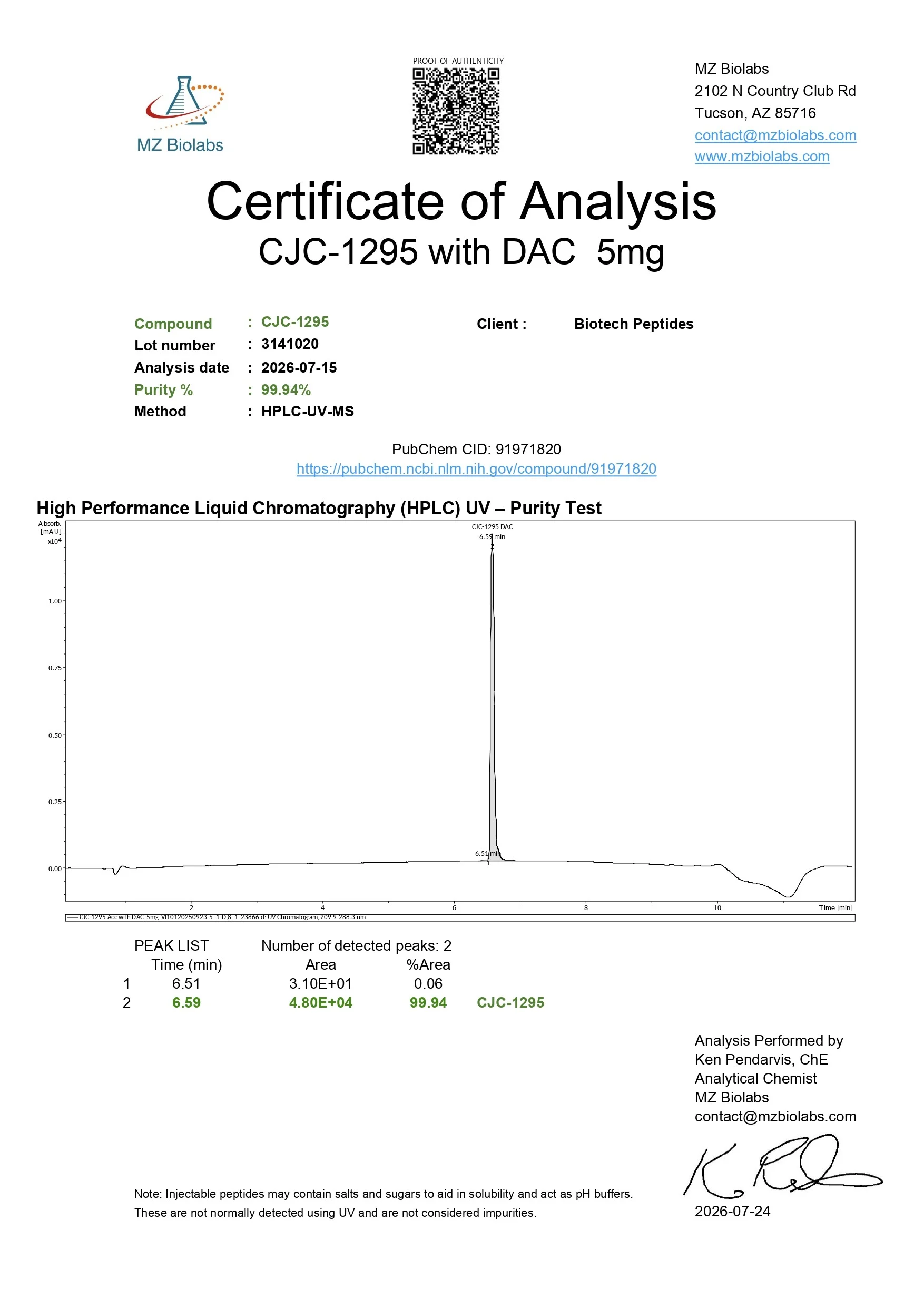
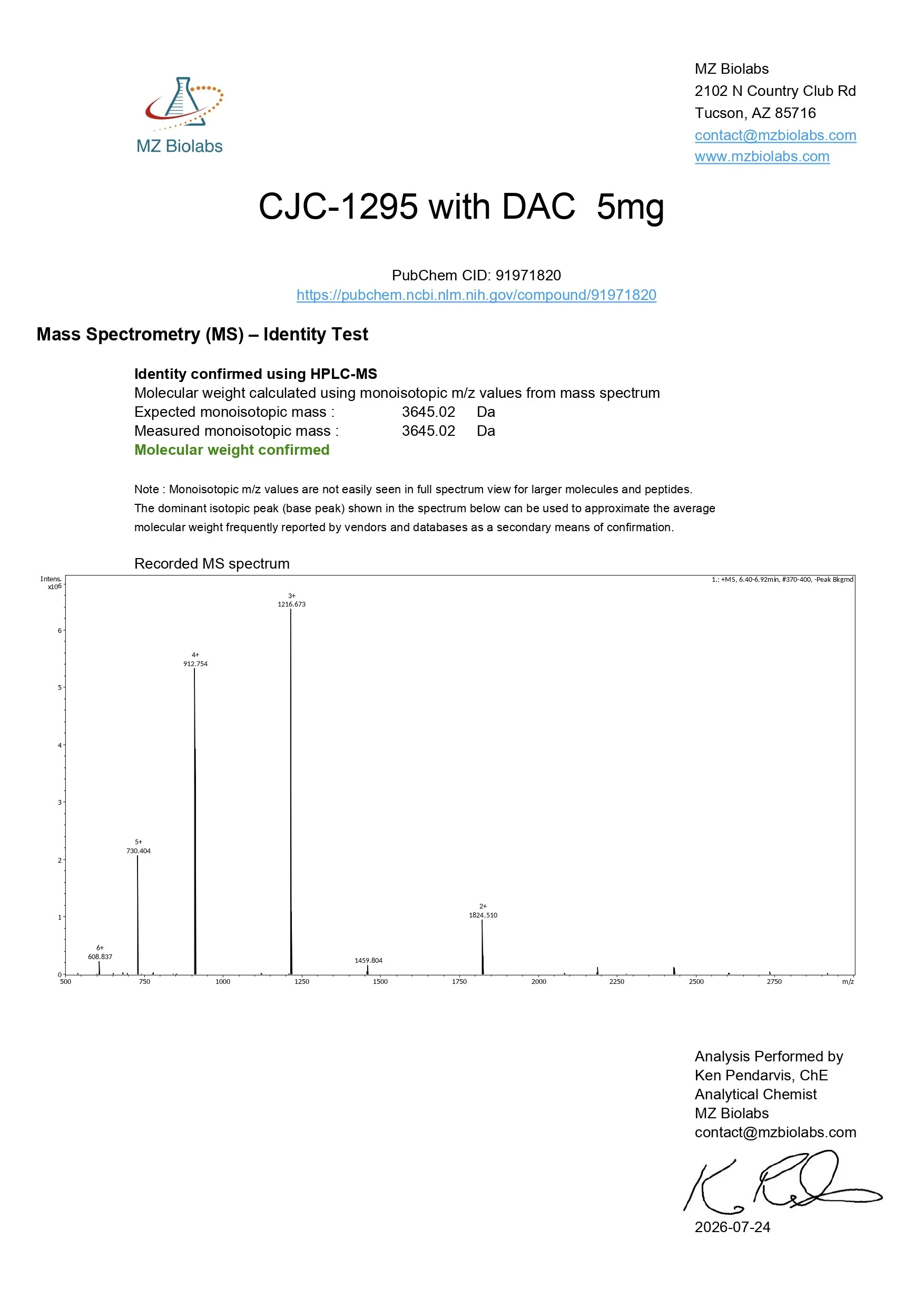
Researchers should verify the analytical characteristics of the specific CJC-1295 DAC batch being evaluated.
This product description does not independently establish additional values for:
- Purity
- HPLC analysis
- Mass spectrometry
- Certificate of Analysis
- Residual solvents
- Stability period
- Storage conditions
- Batch-specific analytical results
Where applicable, researchers should consult the current batch-specific Certificate of Analysis (CoA) and accompanying product documentation.
Frequently Asked Questions
What is CJC-1295 DAC?
CJC-1295 DAC is a synthetic peptide associated with GHRH research. It contains a modified GHRH-related sequence together with a Drug Affinity Complex (DAC) component.
What does DAC mean in CJC-1295 DAC?
DAC refers to the Drug Affinity Complex component incorporated into the peptide structure. The supplied research describes the DAC modification in connection with plasma-protein interactions and experimental pharmacokinetic characteristics.
What is the molecular weight of CJC-1295 DAC?
The supplied specification lists the molecular weight as 3367.954 g/mol.
What is the molecular formula of CJC-1295 DAC?
The supplied molecular formula is:
C152H252N44O42
What is the CJC-1295 DAC sequence?
The supplied sequence is:
H-Tyr-D-Ala-Asp-Ala-Ile-Phe-Thr-Gln-Ser-Tyr-Arg-Lys-Val-Leu-Ala-Gln-Leu-Ser-Ala-Arg-Lys-Leu-Leu-Gln-Asp-Ile-Leu-Ser-Arg-Lys(Mal)-NH2
How is CJC-1295 DAC different from Modified GRF (1-29)?
The supplied material describes both compounds as GHRH-related peptides with sequence modifications. The primary distinction described in the source is the presence of the DAC modification in CJC-1295 DAC.
What research areas involve CJC-1295 DAC?
Research described in the supplied material includes GHRH receptor signaling, pituitary-cell biology, GH-related signaling, IGF-related pathways, pharmacokinetics, reproductive models, and experimental mammalian growth models.
Is CJC-1295 DAC intended for human use?
No. This product is supplied strictly for Research Use Only. It is not intended for human consumption, clinical use, diagnosis, treatment, cure, mitigation, or prevention of disease.
Research Use Only Disclaimer
RESEARCH USE ONLY — NOT FOR HUMAN CONSUMPTION
CJC-1295 DAC peptide is supplied strictly for laboratory research, in-vitro experimentation, analytical investigation, and scientific studies. This product is not intended for human consumption, clinical use, diagnosis, treatment, cure, mitigation, or prevention of any disease or medical condition. The information provided on this page is for scientific research context only and does not constitute medical advice or establish clinical efficacy. Researchers are responsible for complying with applicable institutional, laboratory, regulatory, and safety requirements when working with research materials.

Reviews
There are no reviews yet.