
Description
Buy PE-22-28 Peptide 8mg | Research Use Only
PE-22-28 Peptide 8mg is a synthetic seven-amino-acid analog of Spadin that is being investigated in laboratory and animal-model research involving TREK-1 potassium channels, neuronal signaling, neurogenesis, serotonin pathways, and related mechanisms. Also referred to as PE2228, PE 22 28, PE 2228, Spadin Analog, Sortilin Derivative, and TREK-1 Antagonist, PE-22-28 provides researchers with a shorter synthetic sequence derived from the naturally occurring peptide Spadin.
Research surrounding PE-22-28 remains limited, and several proposed mechanisms are based on findings involving Spadin rather than extensive direct studies of PE-22-28 itself. Accordingly, the information below is presented for laboratory research and scientific investigation only. PE-22-28 is not intended for human or veterinary use.
PE-22-28 Peptide Specifications
| Specification | Details |
|---|---|
| Product Name | PE-22-28 Peptide |
| Quantity | 8mg |
| Other Known Titles | Spadin Analog, PE2228, TREK-1 Antagonist, PE 22 28, Sortilin Derivative, PE 2228 |
| Sequence | GVSWGLR |
| Molecular Formula | C35H55N11O9 |
| Molecular Weight | 773.8947 g/mol |
| Research Classification | Research Use Only (RUO) |
PE-22-28 Research Overview
PE-22-28 is described as a synthetic variant of the naturally occurring peptide Spadin, a secreted peptide associated with Sortilin. Spadin has been investigated for its interaction with the TREK-1 two-pore-domain potassium channel. Because PE-22-28 is a shorter Spadin analog, researchers have proposed that it may share some of the molecular characteristics observed with Spadin.
However, direct research on PE-22-28 is relatively limited. For that reason, findings involving Spadin should not automatically be interpreted as demonstrated effects of PE-22-28. The relationship between the two peptides remains an area for further laboratory investigation.
PE-22-28 and TREK-1 Research
TREK-1 is a two-pore-domain potassium channel associated with the regulation of neuronal excitability. Research described in the supplied source identifies TREK-1 as a cognate receptor for Spadin and proposes that PE-22-28 may interact with the same pathway because of its structural relationship to Spadin.
TREK-1 expression has been investigated in areas of the brain including the prefrontal cortex, amygdala, and hippocampus. Its activity has been associated with regulation of neuronal excitability and protection against excitotoxicity. Research involving Spadin has therefore explored the relationship between TREK-1 signaling, neuronal activity, and neurogenic mechanisms.
For PE-22-28, these mechanisms remain primarily investigational. Laboratory researchers may study the peptide to better understand how shorter Spadin analogs interact with TREK-1-related signaling pathways.
PE-22-28 and BDNF Research
Brain-Derived Neurotrophic Factor (BDNF) is a neurotrophin involved in neuronal survival, growth, maintenance, and synaptic plasticity. Research involving Spadin has suggested possible relationships between Spadin activity and BDNF-associated pathways.
The supplied research material proposes that PE-22-28 may warrant investigation in similar pathways because of its relationship to Spadin. However, direct evidence establishing PE-22-28 effects on BDNF levels, BDNF mRNA, or BDNF protein pathways remains limited.
This makes PE-22-28 particularly relevant as a subject for exploratory laboratory research into the relationship between Spadin analogs, neurotrophic signaling, and neuronal plasticity.
PE-22-28 and Neurogenesis Research
Neurogenesis and synaptogenesis are among the research areas associated with Spadin and related analogs. The supplied material describes animal-model research examining rapid changes in markers associated with neuronal development following Spadin exposure.
One pathway discussed is CREB (cAMP response element-binding protein), a transcription factor associated with neuronal plasticity and memory-related processes. Research described in the source observed increased phosphorylated CREB (pCREB) following short-term Spadin exposure, while total CREB levels remained unchanged.
The source also describes colocalization between pCREB and doublecortin (DCX), a marker associated with neuronal precursor cells. These findings have been interpreted as supporting further investigation into the relationship between CREB activation and neurogenic processes.
BrdU-positive cells have also been examined as an indicator of cellular proliferation. Research involving Spadin reported an increase in BrdU-positive cells within the hippocampus in experimental models. The possibility that PE-22-28 may exhibit related activity remains a hypothesis requiring additional direct investigation.
PE-22-28 and Serotonin Research
Serotonin (5-HT) neurotransmission represents another area of investigation surrounding the Spadin-TREK-1 pathway. The supplied research material describes a proposed mechanism in which inhibition of TREK-1 may influence the firing activity of serotonin neurons within the dorsal raphe nucleus (DRN).
Research has also examined potential relationships between Spadin, serotonin receptor agonists, and mGluR2/3 receptors. Experimental findings involving markers such as Zif268 and intracellular calcium have been used to investigate neuronal activity under different experimental conditions.
Because PE-22-28 is described as a Spadin analog, similar pathways have been proposed as potential areas of investigation. However, these proposed PE-22-28 mechanisms should be treated as hypotheses rather than established biological effects.
PE-22-28 and Muscle Research
TREK-1 channels have also been investigated in relation to mechanical stimulation and muscle physiology. The supplied research describes experiments examining TREK-1 channel activity under mechanical pressure and reports changes in channel opening probability.
Research into TREK-1 blockade has also explored potential relationships with muscle contractility, while channel activation has been associated with muscle relaxation in experimental models. These findings provide another potential research direction for studying compounds that interact with the TREK-1 pathway.
For PE-22-28, investigation of these mechanisms remains preliminary. Researchers may use PE-22-28 as a molecular tool when examining the relationship between TREK-1 signaling, mechanical stimulation, and muscle-cell physiology in controlled laboratory models.
PE-22-28 Sequence and Molecular Profile
The supplied specification identifies PE-22-28 as a seven-amino-acid synthetic peptide with the sequence GVSWGLR. Its reported molecular formula is C35H55N11O9, with a molecular weight of 773.8947 g/mol.
These molecular characteristics can be useful when researchers are designing analytical, biochemical, receptor-binding, or comparative studies involving PE-22-28 and related Spadin-derived peptides.
Potential Laboratory Research Areas
- TREK-1 two-pore-domain potassium channel research
- Spadin analog and Sortilin-related research
- Neuronal excitability studies
- Neurogenesis and synaptogenesis research
- CREB and phosphorylated CREB investigations
- BDNF and neurotrophic signaling research
- Serotonin and 5-HT neuronal signaling studies
- mGluR2/3-related neuronal pathway research
- Hippocampal cellular research
- Muscle physiology and TREK-1 signaling studies
Why Choose PE-22-28 8mg for Research?
PE-22-28 provides researchers with a defined synthetic Spadin analog for controlled laboratory investigation. Its short seven-residue sequence and reported molecular profile make it suitable for comparative research examining relationships between peptide structure and TREK-1-associated biological pathways.
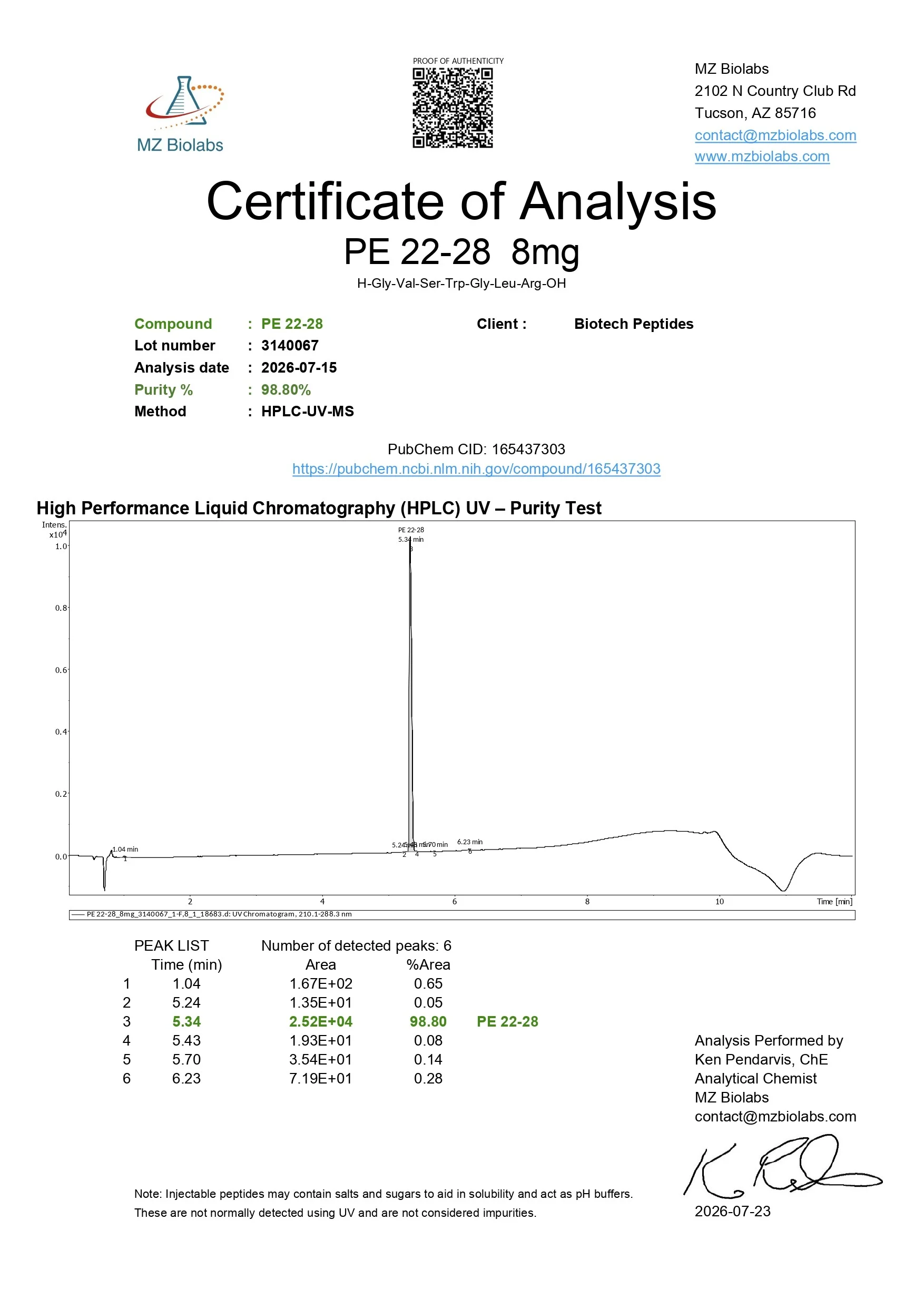
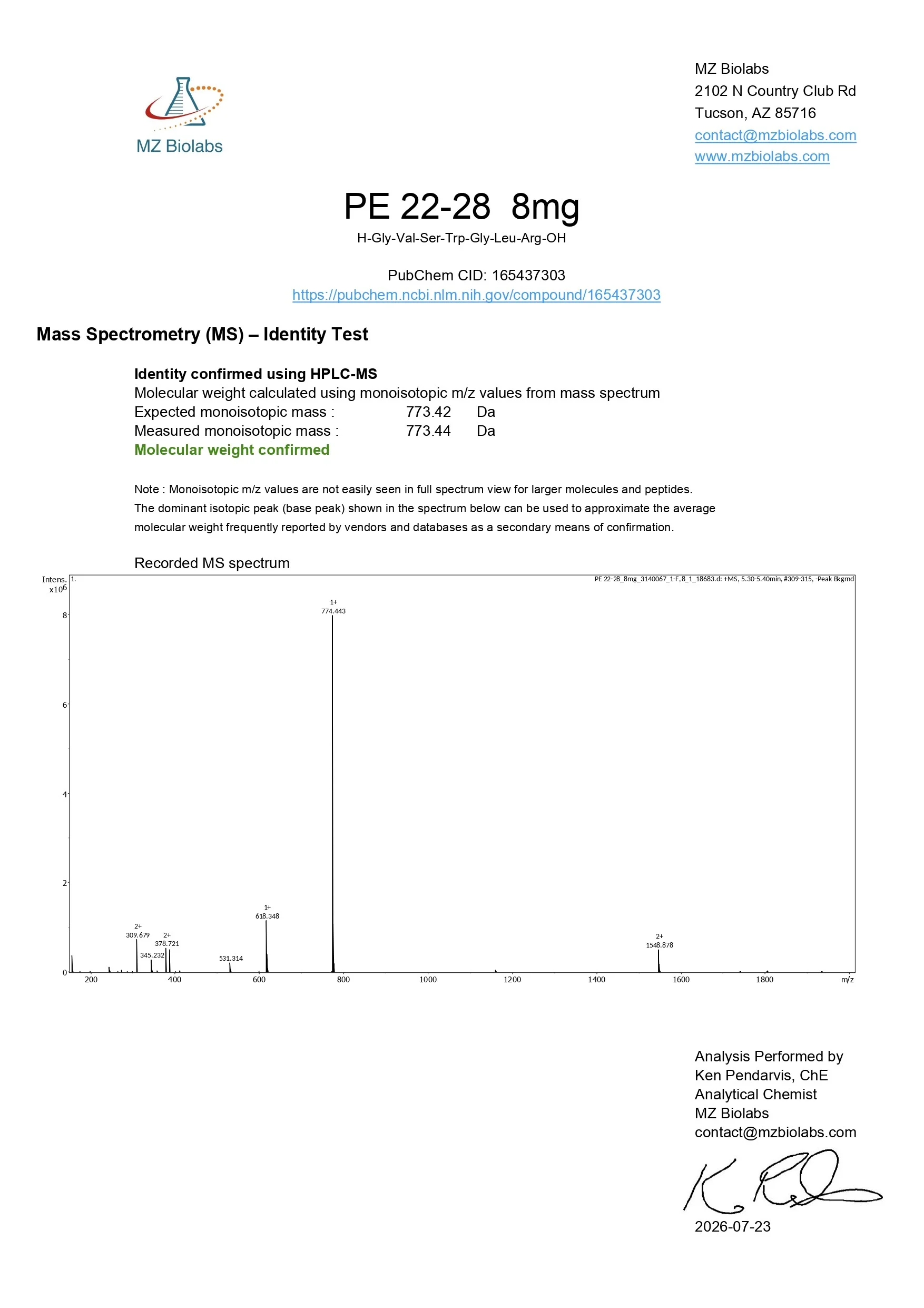
When working with PE-22-28, researchers should rely on the product’s batch-specific documentation and analytical records for exact material characteristics. Where additional analytical information is required, consult the applicable product documentation or batch-specific Certificate of Analysis.
PE-22-28 Peptide FAQ
What is PE-22-28 peptide?
PE-22-28 is a synthetic seven-amino-acid analog of Spadin. It is investigated primarily in research involving TREK-1 potassium channels and related neuronal signaling pathways.
What is the sequence of PE-22-28?
The supplied sequence for PE-22-28 is GVSWGLR.
What is the molecular weight of PE-22-28?
The supplied molecular weight is 773.8947 g/mol, with the reported molecular formula C35H55N11O9.
What is PE-22-28 used for?
PE-22-28 is supplied for laboratory research only. Research areas described for PE-22-28 and its related Spadin pathway include TREK-1 signaling, neuronal excitability, neurogenesis, serotonin signaling, BDNF-related research, and muscle physiology.
Is PE-22-28 for human use?
No. PE-22-28 is designated Research Use Only (RUO) and is not intended for human or veterinary use, consumption, diagnosis, treatment, or administration.
Research Use Only Disclaimer
PE-22-28 Peptide 8mg is intended strictly for research and laboratory use only. This product is not intended for human or veterinary use, consumption, diagnosis, treatment, prevention, or mitigation of any disease or medical condition. It is not a dietary supplement, pharmaceutical product, or therapeutic product. Researchers are responsible for handling, storage, testing, and use of the material in accordance with applicable laboratory procedures, institutional requirements, and local regulations.
The research information presented on this page is provided for scientific and educational purposes. Some proposed PE-22-28 mechanisms are based on research involving Spadin and related experimental models and should not be interpreted as established effects of PE-22-28. Additional research is required to characterize the peptide’s biological properties.



Reviews
There are no reviews yet.