Description
Buy Mod GRF 1-29 Peptide 5mg & 10mg – Research Use Only
Mod GRF 1-29 Peptide, also known as Modified GRF (1-29) and commonly described as CJC-1295 without DAC, is a synthetic research peptide derived from the N-terminal region of growth hormone-releasing hormone (GHRH). Research involving Mod GRF 1-29 has focused on GHRH receptor signaling, somatotroph-cell activity, intracellular messenger pathways, and the molecular biology of growth-factor signaling.
For laboratories looking to buy Mod GRF 1-29 Peptide 5mg or 10mg, this material is supplied strictly for research use. Its defined amino acid sequence and molecular characteristics make it suitable for controlled laboratory studies involving peptide-receptor interactions, cellular signaling, receptor pharmacology, and experimental growth-hormone-related pathways.
Mod GRF 1-29 Research Peptide Overview
Mod GRF 1-29 is a modified fragment based on the first 29 amino acids of GHRH. Early research into GHRH fragments investigated whether the N-terminal 29-amino-acid region retained important receptor-associated activity of the longer endogenous GHRH molecule.
Modifications introduced into the GRF (1-29) sequence are designed to alter peptide characteristics such as enzymatic stability and receptor interaction. The supplied Mod GRF 1-29 sequence incorporates substitutions at positions 2, 8, 15, and 27 compared with the corresponding native GRF sequence.
Structural Modifications in Mod GRF 1-29
- Position 2: Alanine is replaced with D-alanine, a stereochemical modification investigated for its influence on enzymatic stability.
- Position 8: Asparagine is replaced with lysine, introducing a positively charged side chain that may influence receptor interactions.
- Position 15: Histidine is replaced with D-phenylalanine, another stereochemical modification investigated in relation to peptide stability.
- Position 27: The corresponding residue is modified with N-methylglycine (sarcosine), a substitution investigated for its influence on enzymatic cleavage and peptide persistence.
These structural modifications provide researchers with a defined analog for comparative studies of peptide stability, receptor binding, intracellular signaling, and structure-function relationships.
Mod GRF 1-29 Molecular Specifications
| Specification | Details |
|---|---|
| Product Name | Mod GRF 1-29 Peptide |
| Alternative Name | Modified GRF (1-29) |
| Related Description | CJC-1295 without DAC |
| Available Quantities | 5mg & 10mg |
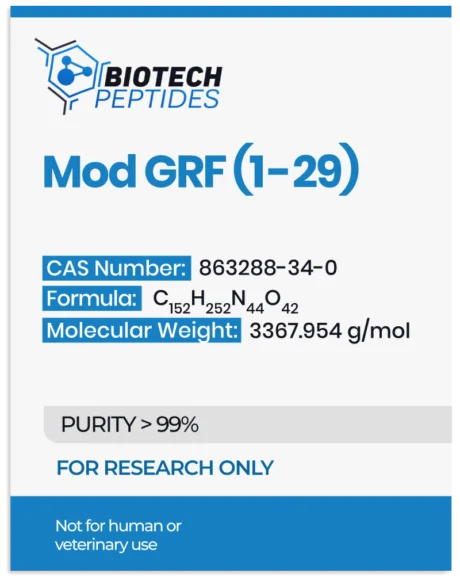
| Molecular Formula | C152H252N44O42 |
| Molecular Weight | 3367.95 g/mol |
| Amino Acid Sequence | H-Tyr-D-Ala-Asp-Ala-Ile-Phe-Thr-Gln-Ser-Tyr-Arg-Lys-Val-Leu-Ala-Gln-Leu-Ser-Ala-Arg-Lys-Leu-Leu-Gln-Asp-Ile-Leu-Ser-Arg-NH2 |
| Research Classification | Research Use Only (RUO) |
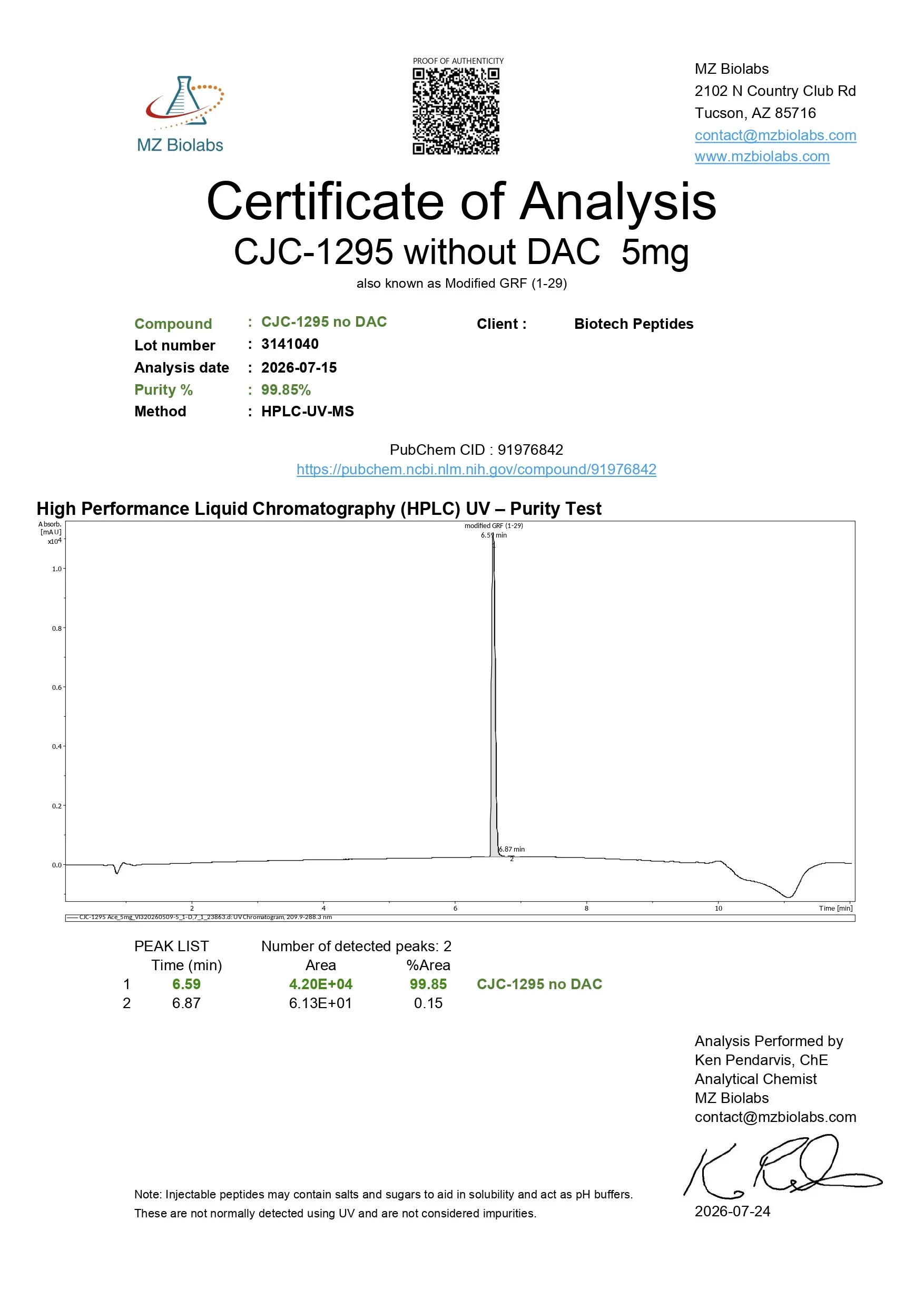
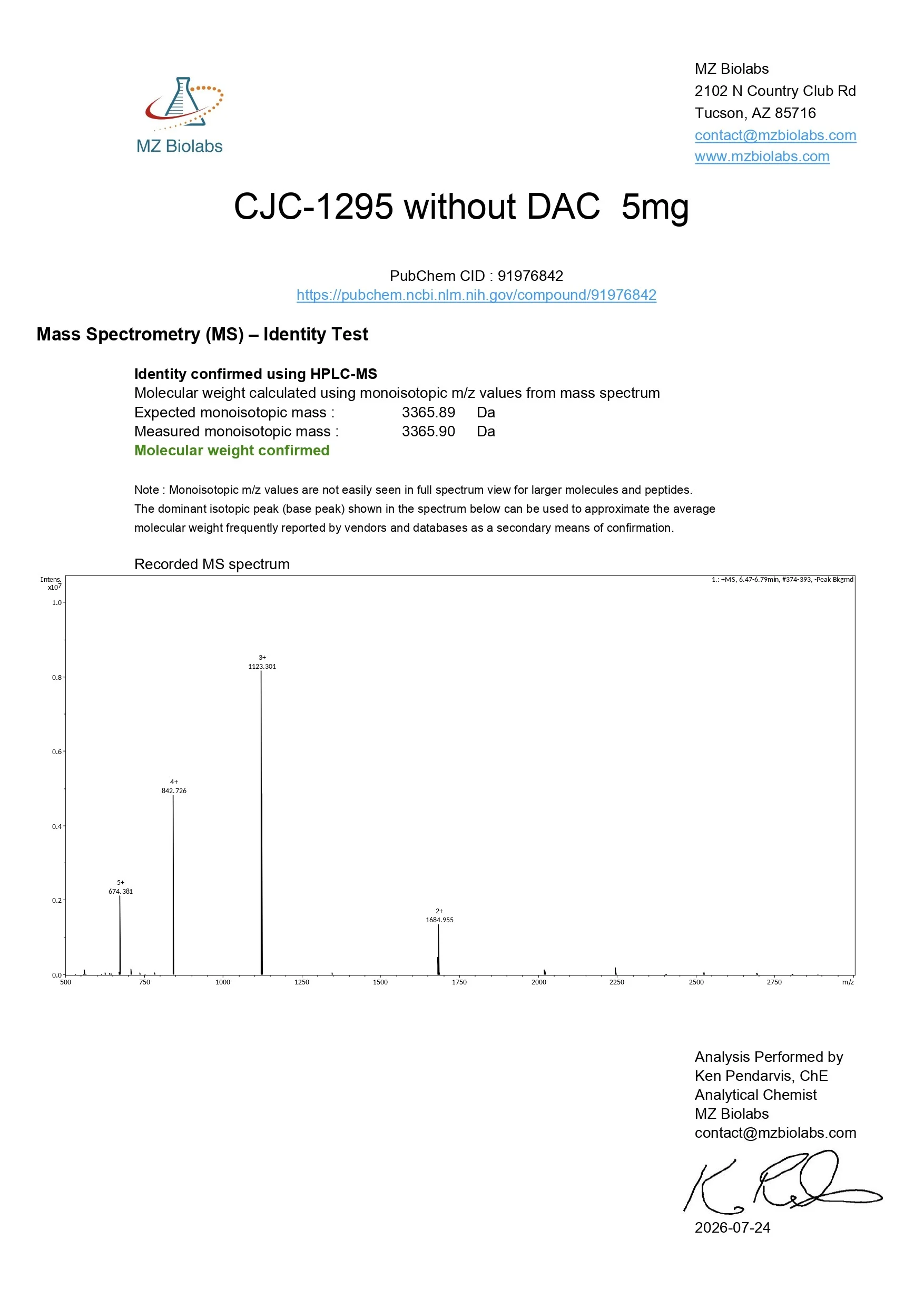
| Purity / Analytical Data | Refer to the lot-specific Certificate of Analysis (CoA) |
Mod GRF 1-29 and GHRH Receptor Research
A primary area of Mod GRF 1-29 research involves the growth hormone-releasing hormone receptor (GHRHR). GHRHR is a membrane-associated receptor expressed on somatotroph cells within experimental pituitary models.
When a GHRH-related peptide interacts with its receptor, researchers can investigate downstream intracellular signaling involving heterotrimeric G-proteins and secondary messenger systems. Experimental studies commonly examine signaling molecules such as cyclic adenosine monophosphate (cAMP), protein kinase A (PKA), and other intracellular pathways.
These signaling mechanisms provide a useful experimental framework for studying how peptide-receptor interactions translate into cellular responses.
cAMP and Intracellular Signaling
GHRH receptor signaling can involve activation of adenylyl cyclase and subsequent changes in intracellular cAMP concentrations. Increased cAMP can activate protein kinases and influence phosphorylation of downstream proteins involved in cellular signaling and gene transcription.
Researchers studying Mod GRF 1-29 can therefore examine receptor activation, second-messenger production, kinase activity, transcriptional responses, and other molecular endpoints in controlled cellular systems.
Mod GRF 1-29 and Somatotroph Cell Research
Somatotroph cells provide an important experimental model for investigating GHRH-associated signaling. These specialized pituitary cells contain GHRH receptors and participate in growth-hormone-related cellular processes.
Research models can evaluate how Mod GRF 1-29 interacts with GHRH receptors and how this interaction influences intracellular signaling. Experimental endpoints may include cAMP production, kinase activation, gene transcription, growth-hormone-associated mRNA expression, and cellular secretion pathways.
Such experiments allow researchers to characterize the molecular activity of Mod GRF 1-29 without assuming that observations from cellular or animal models translate directly to humans.
Mod GRF 1-29 and Growth-Factor Signaling Research
Growth-factor signaling is closely connected to the GHRH/GH/IGF-1 axis, making Mod GRF 1-29 relevant to experimental studies of interconnected endocrine signaling pathways.
Laboratory investigations can examine changes in growth-hormone-associated signaling and downstream IGF-1-related pathways. Researchers may measure gene expression, messenger RNA, protein levels, receptor activity, and other molecular endpoints to characterize signaling responses.
Reported experimental findings have included changes in growth-hormone-associated secretion and IGF-1 measurements in particular research models. However, the magnitude and duration of any response can vary according to species, assay design, peptide preparation, receptor expression, and experimental conditions.
Mod GRF 1-29 and Cardiac Cell Research
GHRH receptor signaling has also been investigated in experimental cardiac systems. Research involving GHRH-related analogs has examined pathways associated with cardiomyocyte survival, cellular stress, cardiac remodeling, and intracellular signaling.
Experimental pathways of interest include the Gαs/cAMP/PKA pathway, MAPK/ERK1/2 signaling, and phosphatidylinositol 3-kinase/Akt pathways. Researchers have also examined apoptosis-associated signaling and molecular markers associated with cardiomyocyte hypertrophy.
Although these investigations provide useful information about GHRH-related signaling, findings involving other GHRH analogs should not automatically be attributed to Mod GRF 1-29. Direct experimental characterization is required to establish the activity of a specific peptide.
Mod GRF 1-29 and Thyroid-Growth-Factor Research
Interactions between thyroid hormone signaling and GHRH-associated pathways have been investigated in experimental endocrine models. Research has examined whether thyroid status can alter the responsiveness of somatotroph cells to GHRH-related peptides.
These studies provide an experimental framework for investigating cross-talk between endocrine signaling systems and determining how cellular receptor responsiveness changes under different experimental conditions.
Mod GRF 1-29 and Gastrointestinal Research
GHRH-related peptides have also been investigated in experimental gastrointestinal systems. Some research has examined potential interactions between GHRH-associated signaling and receptors belonging to related peptide-receptor families.
Vasoactive intestinal peptide (VIP) receptors are another area of interest in gastrointestinal research because these receptors participate in signaling pathways within smooth-muscle and other gastrointestinal cell systems. Experimental studies can investigate receptor binding, intracellular signaling, and cellular responses using isolated tissues or controlled cell-based models.
These research observations should be interpreted specifically within the experimental model in which they were generated.
Mod GRF 1-29 Structure-Function Research
The sequence modifications present in Mod GRF 1-29 make it particularly relevant to structure-function research. Substituting D-amino acids, charged residues, and N-methylated residues can alter peptide conformation, enzymatic susceptibility, receptor interactions, and molecular stability.
Researchers can compare Mod GRF 1-29 with related GRF fragments to investigate how individual residue substitutions influence peptide behavior. Analytical techniques may include chromatographic characterization, mass spectrometry, receptor-binding assays, cellular signaling assays, and other validated laboratory methodologies.
Key Research Features of Mod GRF 1-29
- Defined synthetic sequence: Supplied with a specific modified GRF (1-29) amino acid sequence for controlled laboratory research.
- GHRH receptor research: Suitable for experimental investigation of GHRH receptor-associated signaling.
- Peptide structure-function studies: Useful for evaluating the effects of specific amino acid substitutions.
- Cellular signaling research: Supports investigation of cAMP, PKA, MAPK/ERK, PI3K/Akt, and related signaling pathways.
- Somatotroph-cell models: Relevant to controlled studies involving GHRH receptor-expressing pituitary cell systems.
- Growth-factor research: Can be investigated within experimental GHRH-associated growth-factor signaling models.
- Analytical research: Defined molecular weight and sequence support analytical characterization workflows.
- Multiple research quantities: Available in 5mg and 10mg quantities.
- RUO classification: Supplied exclusively for laboratory research and scientific investigation.
Laboratory Handling and Storage
Mod GRF 1-29 should be handled by qualified laboratory personnel using appropriate laboratory safety procedures. Storage conditions, reconstitution requirements, solvent compatibility, concentration ranges, and stability considerations should be established using the applicable product documentation and the requirements of the intended experimental protocol.
Researchers should consult the lot-specific Certificate of Analysis (CoA) and manufacturer documentation before beginning experimental work. Appropriate laboratory controls should be maintained throughout sample preparation, storage, and analysis to preserve sample integrity.
Frequently Asked Questions About Mod GRF 1-29
What is Mod GRF 1-29?
Mod GRF 1-29 is a synthetic modified fragment of GHRH consisting of 29 amino-acid residues with specific sequence modifications. It is investigated in laboratory research involving GHRH receptor signaling, peptide structure-function relationships, and cellular signaling pathways.
Is Mod GRF 1-29 the same as CJC-1295 without DAC?
Mod GRF 1-29 is commonly described in research literature and product contexts as CJC-1295 without DAC. The term distinguishes the modified GRF peptide from CJC-1295 formulations incorporating the DAC modification.
What is the molecular weight of Mod GRF 1-29?
The supplied molecular weight of Mod GRF 1-29 is 3367.95 g/mol, with a supplied molecular formula of C152H252N44O42.
What is the Mod GRF 1-29 amino acid sequence?
The supplied sequence is H-Tyr-D-Ala-Asp-Ala-Ile-Phe-Thr-Gln-Ser-Tyr-Arg-Lys-Val-Leu-Ala-Gln-Leu-Ser-Ala-Arg-Lys-Leu-Leu-Gln-Asp-Ile-Leu-Ser-Arg-NH2.
What is Mod GRF 1-29 used for in research?
Mod GRF 1-29 is investigated in laboratory studies involving GHRH receptor biology, somatotroph-cell signaling, cAMP and kinase pathways, peptide stability, structure-function relationships, and related growth-factor signaling systems.
Is Mod GRF 1-29 intended for human use?
No. This product is supplied strictly as a Research Use Only (RUO) material for laboratory research, in-vitro testing, analytical work, and scientific investigation by qualified personnel.
Research Use Only Disclaimer
FOR RESEARCH USE ONLY (RUO). Mod GRF 1-29 Peptide is supplied exclusively for laboratory research, in-vitro testing, analytical research, and scientific investigation. It is not intended for human consumption, veterinary use, diagnosis, disease management, or use as a food, dietary supplement, cosmetic, or approved drug. This material is intended for qualified laboratory personnel using appropriate safety procedures and following applicable institutional requirements and laws. Findings from cellular or animal research models should not be interpreted as established outcomes in humans. The purchaser is responsible for determining appropriate laboratory use, handling, storage, and regulatory compliance.

Reviews
There are no reviews yet.