Description
Kisspeptin-10 Peptide 10mg
Buy Kisspeptin-10 Peptide 10mg for laboratory research involving KISS1/KISS1R signaling, hypothalamic neuroendocrine pathways, GnRH-related cellular signaling, energy metabolism, vascular biology, renal research, and neuronal models. Kisspeptin-10 is a short peptide fragment derived from the larger kisspeptin precursor and corresponds to the 45–54 region of the parent peptide.
Kisspeptin research has attracted significant scientific interest because of the interaction between the KISS1 gene, kisspeptin receptors (KISS1R/GPR54), hypothalamic signaling, and downstream intracellular pathways. Laboratory studies have investigated Kisspeptin-10 in models involving calcium mobilization, MAPK signaling, neuroendocrine communication, cellular metabolism, and neuronal stress responses.
This Kisspeptin-10 Peptide 10mg is supplied strictly for research use, including laboratory experimentation, in-vitro studies, biochemical assays, and scientific investigation.
Kisspeptin-10 Peptide Specifications
| Property | Specification |
|---|---|
| Product Name | Kisspeptin-10 Peptide |
| Available Size | 10mg |
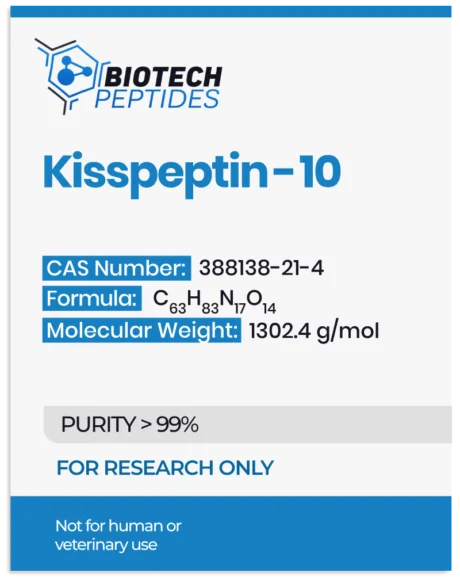
| Molecular Weight | 1302.4 g/mol |
| Molecular Formula | C63H83N17O14 |
| Sequence | YNWNSFGLRF |
| Other Known Titles | KISS-1, Protein KISS-1, Metastin, Kp-10 Peptide |
| Parent Peptide Region | Kisspeptin 45–54 |
| Research Classification | Research Use Only (RUO) |
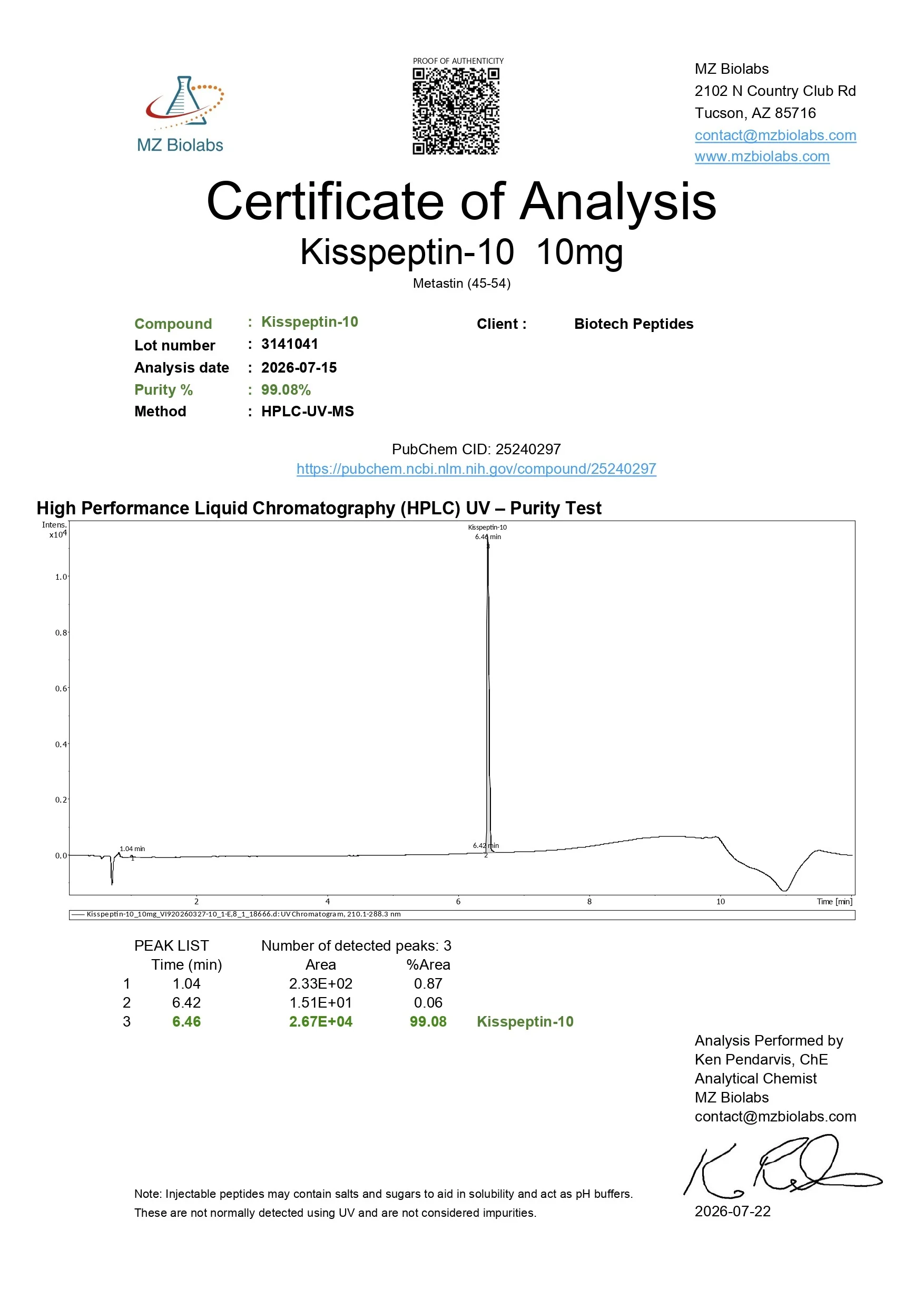
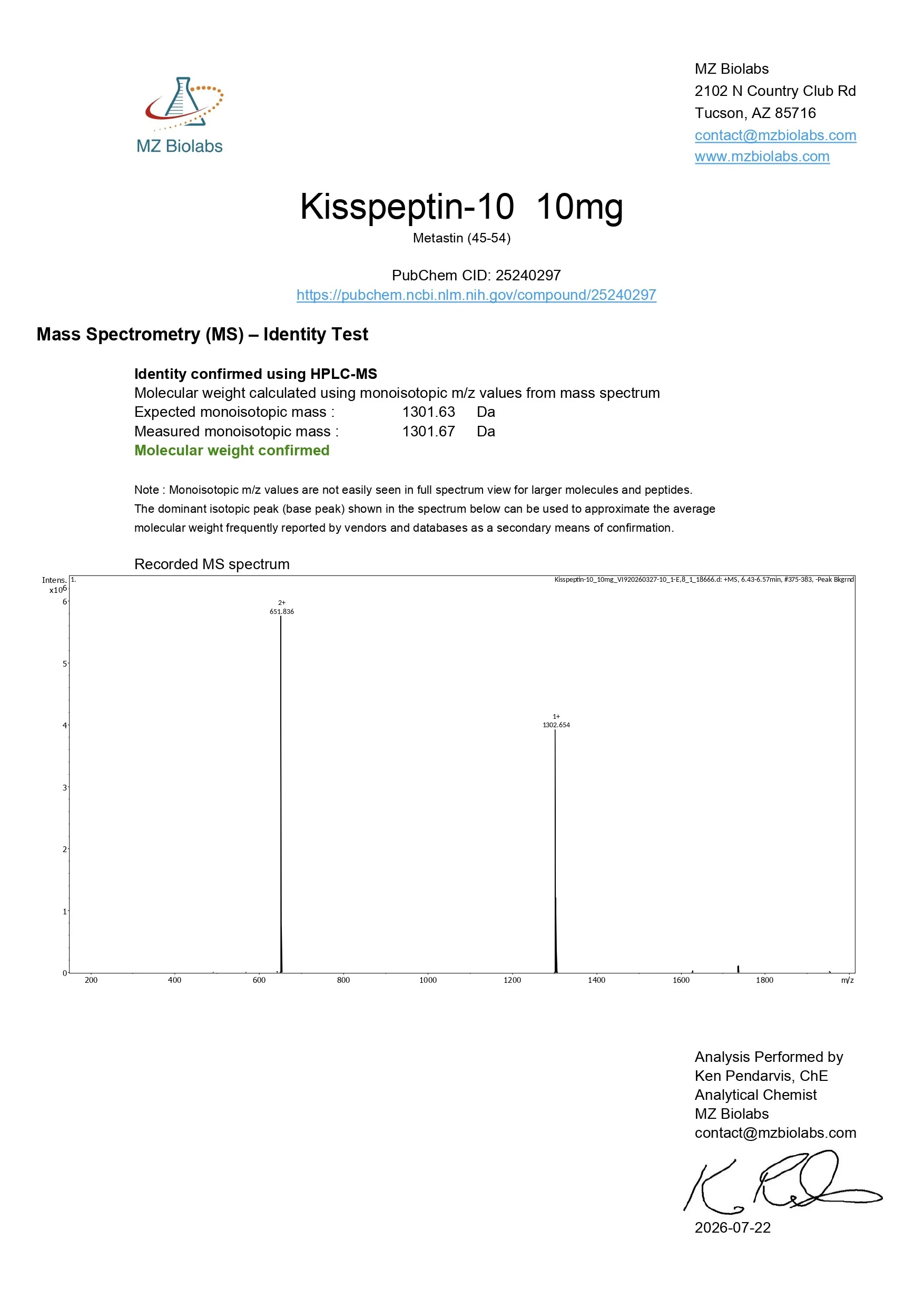
For lot-specific purity, identity, analytical testing, and handling information, researchers should consult the applicable Certificate of Analysis (CoA) and product documentation.
Kisspeptin-10 and KISS1R Signaling Research
One of the primary areas of Kisspeptin-10 research involves the KISS1 receptor, commonly known as KISS1R or GPR54. Kisspeptin receptors are G-protein-coupled receptors that have been investigated in hypothalamic and other cellular models.
Experimental studies have examined whether Kisspeptin-10 interacts with KISS1R and influences downstream intracellular signaling. Reported pathways include:
- Calcium mobilization
- Arachidonic acid signaling
- ERK1/ERK2 phosphorylation
- p38 MAP kinase signaling
- Cellular membrane depolarization
- Neuroendocrine signaling
- Receptor activation and desensitization
These pathways make Kisspeptin-10 a useful research material for investigating how short peptide ligands interact with G-protein-coupled receptors and downstream signaling networks.
Kisspeptin-10 and GnRH Signaling Models
Kisspeptin signaling is particularly relevant to laboratory studies of the hypothalamic-pituitary-gonadal (HPG) axis. Research models have examined interactions between kisspeptin-producing neurons and cells involved in gonadotropin-releasing hormone (GnRH) signaling.
Kisspeptin-10 provides an experimental tool for studying how KISS1R-associated signaling may influence GnRH neuronal activity under controlled laboratory conditions.
Researchers can investigate:
- GnRH-associated signaling
- KISS1/KISS1R receptor biology
- Hypothalamic neuronal activity
- Neuroendocrine communication
- Receptor sensitivity
- Receptor internalization
- Signal-transduction pathways
Studies involving related kisspeptin molecules have also examined receptor desensitization following repeated experimental exposure. This makes receptor trafficking and signal attenuation another relevant area for Kisspeptin-10 research.
Kisspeptin-10 and Energy Metabolism Research
Beyond reproductive neuroendocrine signaling, researchers have investigated kisspeptin neurons in relation to energy balance and hypothalamic signaling.
Experimental work has examined interactions between kisspeptin signaling and neuronal pathways involving neuropeptide Y (NPY) and brain-derived neurotrophic factor (BDNF). These signaling molecules are relevant to studies of hypothalamic neuronal communication, energy regulation, and synaptic biology.
Kisspeptin-10 research in hypothalamic cell models may therefore include analysis of:
- NPY gene expression
- BDNF-related signaling
- Dopamine pathways
- Serotonin signaling
- Norepinephrine pathways
- Neurotransmitter metabolites
- Hypothalamic neuronal signaling
Hypothalamic cell lines such as Hypo-E22 provide experimental systems for investigating how Kisspeptin-10 interacts with cellular pathways associated with neuroendocrine and metabolic signaling.
Kisspeptin-10 and Cancer Cell Research
The KISS1/KISS1R signaling system has also been studied in cellular models involving tumor-cell migration and metastasis-related biology.
Research has investigated kisspeptin expression and KISS1 receptor signaling in different cancer-cell models, including experimental systems derived from breast, bladder, gastrointestinal, prostate, pancreatic, ovarian, thyroid, and melanoma tissues.
Rather than interpreting these findings as clinical effects, Kisspeptin-10 provides a research tool for investigating cellular processes such as:
- Cancer-cell migration
- Cell adhesion
- KISS1 receptor expression
- Intracellular signaling
- Cell-cell interactions
- Metastasis-associated pathways
- Tumor-cell signaling models
These studies can help characterize how peptide-receptor interactions influence cellular migration and signaling in controlled experimental environments.
Kisspeptin-10 and Behavioral Neurobiology Research
Kisspeptin-producing neurons are also being investigated as components of broader neural circuits connecting reproductive signaling, energy balance, and behavioral responses.
Experimental neuroscience studies have examined relationships between kisspeptin signaling and limbic brain activity, reward-associated pathways, neurotransmitter systems, and hypothalamic signaling.
For laboratory researchers, these areas provide opportunities to examine:
- Neuronal signaling
- Limbic-system activity
- Neurotransmitter pathways
- Hypothalamic circuits
- Peptide-receptor interactions
- Neuroendocrine communication
Such research can help characterize the cellular and molecular functions of kisspeptin signaling without assuming a particular physiological outcome.
Kisspeptin-10 in Kidney and Vascular Research
Kisspeptin and KISS1 receptors have also been investigated in renal and vascular tissues. Experimental studies have examined KISS1R expression in renal models and its relationship to signaling involved in kidney development and cellular function.
Additional research has investigated kisspeptin-associated pathways in vascular biology, including vascular smooth-muscle signaling, vasoconstrictive responses, and vascular development.
Potential research applications include:
- KISS1R expression analysis
- Renal-cell signaling
- Kidney development models
- Vascular-cell biology
- Smooth-muscle signaling
- Receptor-mediated vascular responses
These applications make Kisspeptin-10 relevant to researchers studying peptide signaling beyond the central nervous system.
Kisspeptin-10 and Neurobiology Research
Another emerging area of Kisspeptin-10 research involves neuronal stress and protein-aggregation models.
Experimental studies have investigated Kisspeptin-10 in neuronal systems expressing alpha-synuclein (α-syn). Alpha-synuclein is a neuronal protein widely studied in molecular neuroscience, particularly in models of protein aggregation and cellular stress.
Research has examined whether Kisspeptin-10 influences experimental measures including:
- α-synuclein aggregation
- Mitochondrial membrane potential
- Neuronal apoptosis markers
- Choline acetyltransferase (ChAT)
- Neuronal protein expression
- Receptor-dependent and receptor-independent signaling
Computational and experimental studies have also explored potential interactions between Kisspeptin-10 and regions of the α-synuclein protein.
This provides an additional experimental framework for researchers investigating peptide-protein interactions and neuronal stress pathways.
Why Choose Kisspeptin-10 Peptide 10mg?
Kisspeptin-10 Peptide 10mg is a defined research peptide suitable for laboratory studies involving peptide-receptor interactions and neuroendocrine signaling.
Key research areas include:
- KISS1/KISS1R receptor research
- GnRH signaling studies
- Hypothalamic neuronal models
- MAPK and ERK signaling
- Calcium mobilization research
- Energy and metabolic signaling
- NPY and BDNF research
- Cancer-cell migration models
- Renal and vascular biology
- α-synuclein neuronal research
- Peptide-protein interaction studies
Its short sequence and defined molecular characteristics make it suitable for controlled biochemical, cellular, and molecular research applications.
Frequently Asked Questions
What is Kisspeptin-10 Peptide?
Kisspeptin-10 is a short peptide fragment corresponding to residues 45–54 of the larger kisspeptin molecule. It is studied primarily in relation to KISS1R/GPR54 signaling and associated cellular pathways.
What is the sequence of Kisspeptin-10?
The supplied sequence is YNWNSFGLRF, consisting of 10 amino acids.
What is the molecular weight of Kisspeptin-10?
The listed molecular weight is 1302.4 g/mol, with a molecular formula of C63H83N17O14.
What is Kisspeptin-10 used for in research?
Kisspeptin-10 is investigated in laboratory models involving KISS1R signaling, GnRH-associated pathways, hypothalamic neurons, intracellular MAPK signaling, energy metabolism, vascular biology, renal signaling, cancer-cell migration, and neuronal protein-aggregation models.
Is Kisspeptin-10 intended for human use?
No. Kisspeptin-10 Peptide 10mg is supplied strictly for Research Use Only (RUO) and is not intended for human consumption, administration, diagnosis, treatment, or clinical use.
What should researchers verify before using Kisspeptin-10?
Researchers should review the applicable Certificate of Analysis, lot-specific analytical information, storage requirements, and institutional laboratory procedures before conducting experiments.

Reviews
There are no reviews yet.