

Description
Buy GHK-Cu Peptide – Research Grade
GHK-Cu is a copper-associated tripeptide that has been investigated extensively in experimental research involving peptide structure, cellular signaling, extracellular-matrix biology, oxidative stress, inflammatory pathways, and tissue-repair models. The supplied research material describes GHK-Cu as a naturally occurring peptide complex identified in biological fluids and studied in a range of laboratory and animal research systems.
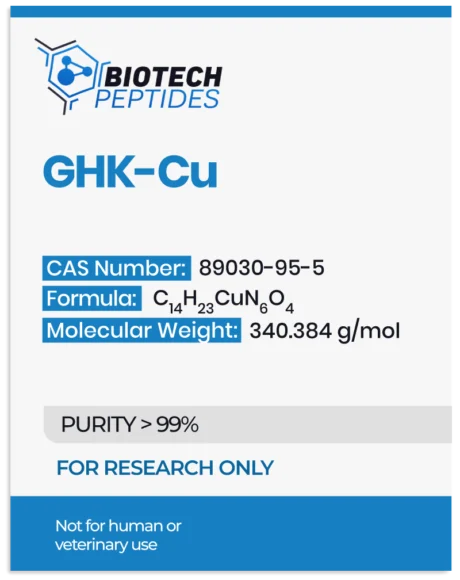
Researchers looking to buy GHK-Cu peptide for qualified laboratory research can use the reported molecular characteristics and peptide sequence as reference information for analytical characterization and experimental studies. The supplied specifications identify GHK-Cu with a molecular formula of C14H23CuN6O4, a molecular weight of 340.38 g/mol, and the sequence designation Gly-His-LysCu.xHAc.
This product is intended strictly for laboratory research, in-vitro testing, analytical studies, and other non-clinical scientific applications. It is not intended for human or veterinary consumption.
Buy GHK-Cu Peptide for Laboratory Research
Buy GHK-Cu peptide for research involving copper-associated peptide chemistry, molecular characterization, cellular pathways, and controlled experimental systems. GHK-Cu is of particular scientific interest because its structure incorporates the tripeptide Gly-His-Lys together with copper, creating a defined peptide-metal complex suitable for laboratory investigation.
The supplied research material describes GHK-Cu as a naturally occurring peptide originally identified in blood plasma, with additional traces reported in saliva and urine. Researchers have subsequently investigated its molecular behavior in cell cultures and experimental models involving extracellular-matrix components, inflammatory signaling, oxidative stress, and other biological pathways.
GHK-Cu Molecular Profile and Scientific Background
GHK-Cu is composed of the amino-acid sequence Gly-His-Lys associated with copper. The supplied specification lists the molecular formula as C14H23CuN6O4 and the molecular weight as 340.38 g/mol. These characteristics provide useful reference points for analytical peptide research and laboratory identification.
The research material supplied for this product describes GHK-Cu as a multifunctional research subject. Experimental studies have investigated its interaction with cellular and extracellular-matrix pathways, including research involving fibroblasts, endothelial cells, immune-cell activity, collagen-related processes, inflammatory signaling, and oxidative stress.
These observations come from experimental research and should be interpreted according to the specific model, methodology, concentration, and experimental conditions used in each study. Findings from cell cultures or animal models should not be represented as evidence of clinical efficacy or human-use safety.
GHK-Cu Chemical Specifications
| Specification | Reported Information |
|---|---|
| Product Name | GHK-Cu Peptide |
| Peptide Type | Copper-associated tripeptide |
| Molecular Formula | C14H23CuN6O4 |
| Molecular Weight | 340.38 g/mol |
| Sequence | Gly-His-LysCu.xHAc |
| Core Peptide | Gly-His-Lys |
| Metal Component | Copper (Cu) |
| Intended Application | Laboratory research and in-vitro scientific studies |
| Purity | Refer to current batch-specific documentation |
The molecular formula, molecular weight, and sequence above are taken directly from the supplied product information. Researchers should verify the identity and analytical characteristics of the specific batch using its applicable documentation before conducting experiments.
GHK-Cu Research Areas
GHK-Cu and Cellular Research
Experimental research has examined GHK-Cu in relation to skin-cell and extracellular-matrix pathways. The supplied material describes studies investigating collagen, glycosaminoglycans, proteoglycans, and chondroitin sulfate, as well as the activity of fibroblasts, endothelial cells, and immune cells.
These investigations make GHK-Cu relevant to laboratory studies examining cell signaling, extracellular-matrix biology, peptide-mediated cellular interactions, and tissue-model systems.
GHK-Cu and Nervous-System Research
The supplied research material also describes experimental investigations involving GHK-Cu and nervous-system models. Researchers have examined pathways involving neuronal signaling, angiogenesis, inflammation, gene-expression profiles, and cellular survival. Some studies cited in the source material used rodent models to investigate molecular pathways associated with neuronal injury.
Such findings represent experimental observations in specific research models and should not be interpreted as evidence that GHK-Cu is suitable for treating neurological conditions.
GHK-Cu and Antimicrobial Research
Research has investigated GHK-Cu in combination with certain fatty acids in experimental systems involving bacteria and fungi. The supplied material describes studies examining wound-related models and inflammatory markers. These investigations provide a basis for further laboratory research into peptide-associated antimicrobial and cellular pathways.
GHK-Cu and Inflammatory Pathways
Experimental research has examined GHK-Cu in murine models involving inflammatory responses. The supplied material discusses research involving TNF-alpha, IL-6, IL-1β, myeloperoxidase, and the NF-κB signaling pathway. These studies have been used to investigate possible molecular interactions between GHK-Cu and pathways involved in cellular stress and inflammation.
GHK-Cu and Oxidative-Stress Research
Another research area concerns the interaction between GHK-related peptides and oxidative-stress pathways. The supplied material describes investigations involving iron release from ferritin, lipid peroxidation, reactive oxygen species, NF-κB, and p38 MAPK signaling. It also discusses experimental research involving Pal-GHK, which is a modified form distinct from the GHK-Cu material described on this product page.
Researchers should distinguish between GHK-Cu and modified derivatives such as Pal-GHK when interpreting experimental literature, because chemical modifications can produce different molecular properties and experimental behavior.
Key Laboratory Research Characteristics
- Defined molecular composition: The supplied specification identifies a molecular formula of C14H23CuN6O4.
- Documented molecular weight: The reported molecular weight is 340.38 g/mol.
- Defined peptide sequence: The supplied sequence designation is Gly-His-LysCu.xHAc.
- Copper-associated structure: GHK-Cu incorporates copper with the Gly-His-Lys peptide sequence.
- Broad research interest: Experimental studies have investigated cellular, extracellular-matrix, inflammatory, oxidative-stress, and signaling pathways.
- Research-only positioning: The material is intended for laboratory and non-clinical scientific research.
Quality Documentation and Analytical Verification
Researchers evaluating GHK-Cu research peptide should review the documentation applicable to the specific batch. Product specifications should be verified against the corresponding analytical records rather than assumed from a general product description.
Where supplied, researchers should review batch-specific documentation for identity, purity, analytical testing, and other quality characteristics. This product description does not claim a particular purity percentage or specific HPLC or mass-spectrometry result because those analytical results were not included in the supplied information.
Handling and Laboratory Storage
GHK-Cu should be handled by appropriately trained laboratory personnel using procedures appropriate for synthetic peptide research and the specific experimental protocol. Researchers should follow the storage and handling conditions provided with the applicable batch documentation.
Because peptide stability can depend on formulation, packaging, moisture exposure, temperature, and storage duration, researchers should use the manufacturer’s current documentation rather than relying on generic storage assumptions. Laboratory personnel should maintain appropriate sample identification and documentation throughout storage and experimental preparation.
Frequently Asked Questions About GHK-Cu
What is GHK-Cu peptide?
GHK-Cu is a copper-associated tripeptide consisting of the Gly-His-Lys peptide sequence associated with copper. It has been investigated in laboratory research involving cellular signaling, extracellular-matrix biology, oxidative stress, and inflammatory pathways.
What is the molecular weight of GHK-Cu?
The supplied product specification lists the molecular weight of GHK-Cu as 340.38 g/mol. The reported molecular formula is C14H23CuN6O4.
What is the GHK-Cu peptide sequence?
The supplied specification identifies the sequence as Gly-His-LysCu.xHAc, with Gly-His-Lys representing the core tripeptide associated with copper.
What is GHK-Cu used for?
This product is supplied for qualified laboratory research, in-vitro testing, analytical characterization, and other non-clinical scientific applications. Research literature has investigated GHK-Cu across several experimental systems, but those findings should not be interpreted as evidence of human or veterinary therapeutic use.
How should GHK-Cu purity be verified?
Purity and identity should be evaluated using the current batch-specific Certificate of Analysis and applicable analytical documentation. Researchers should rely on the actual lot documentation rather than assuming a purity specification from the general product description.

Reviews
There are no reviews yet.