Description
Buy FOXO4-DRI Peptide 10mg – Research Use Only
Buy FOXO4-DRI Peptide 10mg for laboratory research involving cellular senescence, FOXO4-p53 protein interactions, apoptosis signaling, cell-cycle regulation, oxidative-stress pathways, and insulin-related cellular signaling. FOXO4-DRI, also known as FOXO4-D-Retro-Inverso, is a synthetic peptide composed of D-amino acids and designed as a research tool for investigating protein-protein interactions associated with FOXO4 biology.
FOXO4 is a member of the forkhead box O (FOXO) family of transcription factors involved in cellular processes including stress responses, metabolism, differentiation, cell-cycle regulation, and apoptosis. FOXO4-DRI has been investigated particularly in experimental models of cellular senescence because of its proposed ability to interfere with the interaction between FOXO4 and p53.
This makes FOXO4-DRI research relevant to researchers studying senescent-cell biology, programmed cell death, transcriptional regulation, oxidative stress, and age-associated cellular mechanisms in controlled laboratory models.
FOXO4-DRI Peptide Specifications
| Specification | Details |
|---|---|
| Product | FOXO4-DRI Peptide |
| Available Amount | 10mg |
| Other Known Titles | Forkhead box protein O4, Proxofim, FOXO4a, AFX, AFX1, MLLT7 |
| Peptide Type | D-Retro-Inverso synthetic peptide |
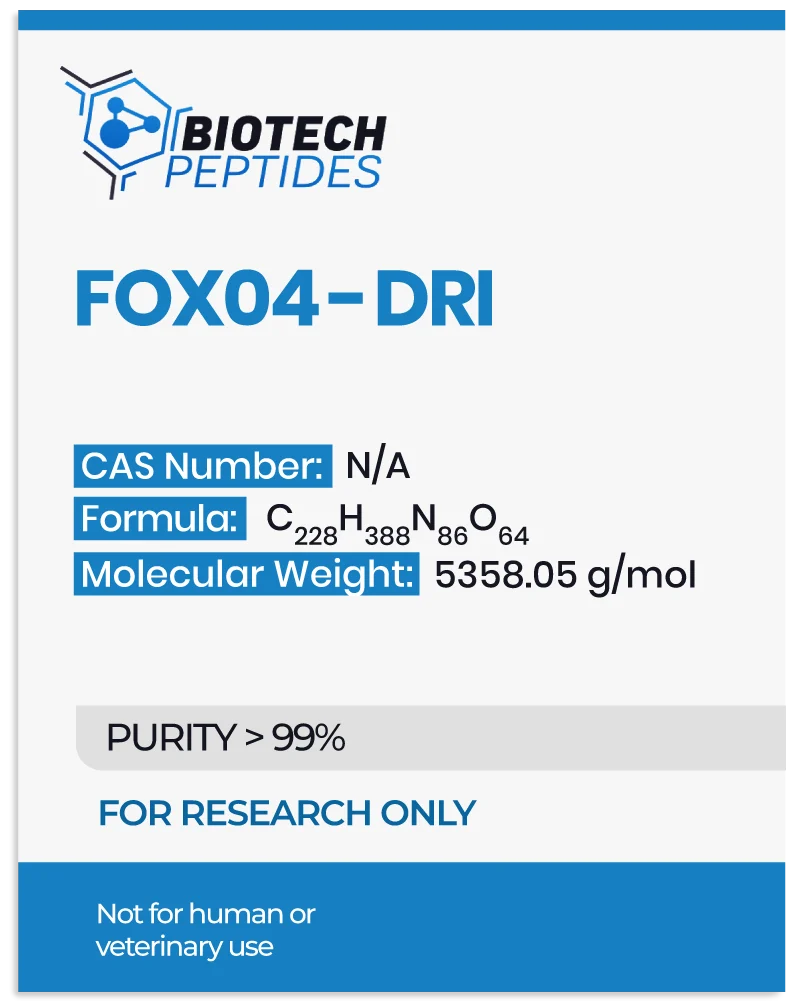
| Molecular Formula | C228H388N86O64 |
| Molecular Weight | 5358.05 g/mol |
| Sequence | H-D-Leu-D-Thr-D-Leu-D-Arg-D-Lys-D-Glu-D-Pro-D-Ala-D-Ser-D-Glu-D-Ile-D-Ala-D-Gln-D-Ser-D-Ile-D-Leu-D-Glu-D-Ala-D-Tyr-D-Ser-D-Gln-D-Asn-D-Gly-D-Trp-D-Ala-D-Asn-D-Arg-D-Arg-D-Ser-D-Gly-D-Gly-D-Lys-D-Arg-D-Pro-D-Pro-D-Pro-D-Arg-D-Arg-D-Arg-D-Gln-D-Arg-D-Arg-D-Lys-D-Lys-D-Arg-D-Gly-OH |
| Research Classification | Research Use Only (RUO) |
FOXO4-DRI Research and Cellular Senescence
One of the principal areas of FOXO4-DRI laboratory research is cellular senescence. Senescent cells are cells that have entered a stable state of cell-cycle arrest while remaining metabolically active. These cells can exhibit changes in gene expression and may release signaling molecules collectively associated with the senescence-associated secretory phenotype (SASP).
FOXO4 has been investigated in connection with the regulation of senescent-cell survival. Experimental research has proposed that FOXO4 can interact with the transcription factor p53, potentially influencing p53 localization and activity. FOXO4-DRI has consequently been studied as a molecular tool for examining whether disruption of this interaction alters apoptotic signaling in senescent-cell models.
FOXO4-DRI and FOXO4-p53 Research
The FOXO4-p53 interaction is central to much of the experimental interest surrounding FOXO4-DRI. p53 is an important regulator of DNA-damage responses, cell-cycle progression, and apoptosis, while FOXO proteins participate in transcriptional responses to cellular stress.
Research has examined whether FOXO4-DRI can interfere with FOXO4-p53 binding and thereby modify downstream p53-associated signaling. Cell-based experiments can evaluate protein-protein interactions, nuclear localization, transcriptional activity, apoptotic markers, and changes in senescent-cell populations.
These experiments provide a molecular framework for studying how specific protein interactions influence cell fate.
FOXO4-DRI and Apoptosis Research
Apoptosis, or programmed cell death, is a tightly regulated cellular process. Experimental research involving FOXO4-DRI has investigated whether disrupting FOXO4-p53 interactions can alter apoptosis-associated signaling in senescent-cell models.
Researchers may measure caspase activity, apoptotic markers, mitochondrial changes, DNA fragmentation, cell viability, and expression of pro-apoptotic genes. These endpoints can help characterize the molecular consequences of FOXO4-p53 pathway modulation.
FOXO4-DRI therefore represents a useful experimental model for studying the relationship between protein-protein interactions, transcriptional regulation, cellular senescence, and apoptosis.
FOXO4-DRI and D-Retro-Inverso Peptide Research
D-Retro-Inverso (DRI) peptides are synthetic peptide structures that incorporate D-amino acids and a reversed sequence orientation relative to the corresponding L-amino-acid peptide framework. This structural strategy is frequently investigated in peptide science because D-amino-acid-containing sequences can exhibit different susceptibility to enzymatic degradation than conventional L-amino-acid peptides.
FOXO4-DRI research provides an opportunity to examine how stereochemistry and sequence orientation influence peptide-protein recognition. Such research can include protein-binding experiments, structural studies, cellular uptake investigations, and peptide stability testing.
These characteristics make DRI peptides valuable experimental subjects for studying protein-peptide and protein-protein interactions.
FOXO4-DRI and Cellular Stress Signaling
FOXO transcription factors participate in cellular responses to oxidative and metabolic stress. FOXO4 has been investigated in pathways associated with oxidative-stress regulation, cellular metabolism, transcriptional control, and survival.
Experimental FOXO4-DRI studies may therefore examine reactive oxygen species, antioxidant enzymes, mitochondrial signaling, transcriptional responses, and stress-associated changes in cellular phenotype.
Potential experimental endpoints include expression of antioxidant enzymes such as manganese superoxide dismutase (MnSOD), catalase, and glutathione peroxidase (GPX), together with measurements of oxidative-stress markers.
FOXO4-DRI and Insulin Signaling Research
The FOXO family is closely connected to insulin and insulin-like growth factor signaling networks. These pathways regulate diverse cellular processes, including metabolism, growth, differentiation, stress responses, and transcription.
FOXO4-DRI can be studied within experimental systems designed to investigate how FOXO-associated signaling interacts with insulin-related pathways. Researchers may examine transcriptional changes, phosphorylation states, glucose-associated signaling pathways, oxidative stress, and cellular metabolism.
Because the precise biological effects of FOXO4-DRI can vary according to the experimental model, results should be interpreted within the context of the specific assay and research system.
FOXO4-DRI and Cell-Cycle Research
Cell-cycle regulation represents another important area of FOXO4 research. FOXO transcription factors interact with pathways controlling cellular proliferation, stress responses, differentiation, and apoptosis.
Researchers can use FOXO4-DRI to investigate changes in cell-cycle-associated proteins and transcriptional pathways in controlled cellular models. Experimental measurements may include cell-cycle distribution, proliferation markers, DNA-damage responses, and apoptosis-associated gene expression.
FOXO4-DRI and Oxidative Stress Research
Oxidative stress occurs when cellular reactive oxygen species exceed the capacity of antioxidant systems to maintain redox balance. FOXO proteins have been investigated as regulators of transcriptional responses associated with oxidative stress.
FOXO4-DRI research can therefore include measurements of reactive oxygen species, antioxidant enzyme expression, mitochondrial activity, and redox-sensitive signaling pathways. These studies may help characterize the relationship between FOXO4-associated protein interactions and cellular stress responses.
FOXO4-DRI in Cardiac Cell Research
FOXO signaling has also been investigated in experimental cardiac-cell models. Cellular aging, proteostasis, autophagy, oxidative stress, and mitochondrial function are interconnected research areas in cardiac biology.
Experimental systems may examine whether modulation of FOXO-associated pathways influences markers of autophagy, proteasomal activity, mitochondrial function, oxidative stress, or cellular survival.
FOXO4-DRI can consequently serve as an experimental tool for investigating molecular relationships between FOXO signaling and cardiac-cell biology.
FOXO4-DRI and Neurobiology Research
FOXO proteins are also studied in neurological research because neuronal cells are highly dependent on regulated protein turnover, mitochondrial activity, oxidative-stress control, and cellular homeostasis.
Experimental research can examine FOXO-associated signaling in neuronal cell models, including pathways involving proteostasis, oxidative stress, autophagy, cell-cycle regulation, and apoptosis. FOXO4-DRI may be incorporated into such models to investigate the consequences of modifying FOXO4-related protein interactions.
FOXO4-DRI Research Applications
- Cellular senescence research
- FOXO4-p53 protein interaction studies
- Apoptosis and programmed-cell-death research
- D-Retro-Inverso peptide studies
- Protein-protein interaction research
- Protein-peptide binding investigations
- Cell-cycle regulation studies
- Oxidative-stress and antioxidant signaling research
- Insulin and IGF-related signaling studies
- Cellular metabolism research
- Autophagy and proteostasis studies
- Cardiac-cell experimental research
- Neuronal and neurobiology research
- Senescence-associated signaling investigations
Key Features of FOXO4-DRI Peptide
- 10mg research quantity.
- D-Retro-Inverso synthetic peptide design.
- Composed of D-amino-acid residues as supplied.
- Molecular weight: 5358.05 g/mol.
- Molecular formula: C228H388N86O64.
- Relevant to FOXO4-p53 interaction research.
- Suitable for cellular senescence and apoptosis studies.
- Applicable to oxidative-stress, insulin-signaling, and cell-cycle research.
- Useful for controlled protein-protein and peptide-protein interaction studies.
- Intended exclusively for qualified laboratory research.
Handling and Storage for Laboratory Research
FOXO4-DRI should be handled according to applicable laboratory procedures and the product’s lot-specific analytical documentation. Researchers should consult the accompanying documentation for verified storage conditions, stability information, preparation requirements, and other material-specific instructions.
Because experimental peptide integrity can be affected by environmental conditions and repeated handling, researchers should use appropriate laboratory controls and procedures to maintain sample quality. Institutional requirements for labeling, storage, handling, and disposal should also be followed.
Frequently Asked Questions About FOXO4-DRI
What is FOXO4-DRI?
FOXO4-DRI is a synthetic D-Retro-Inverso peptide derived from research surrounding the FOXO4 protein. It has been investigated primarily as an experimental tool for studying FOXO4-p53 interactions, cellular senescence, apoptosis, and related signaling pathways.
What does D-Retro-Inverso mean?
D-Retro-Inverso describes a peptide design strategy involving D-amino acids together with reversed sequence orientation. This approach is investigated in peptide science because it can alter peptide stability, molecular recognition, and interactions with biological targets.
What is the molecular weight of FOXO4-DRI?
The molecular weight supplied for this FOXO4-DRI research peptide is 5358.05 g/mol.
What is the molecular formula of FOXO4-DRI?
The supplied molecular formula is C228H388N86O64.
What is the FOXO4-DRI amino acid sequence?
The supplied sequence is H-D-Leu-D-Thr-D-Leu-D-Arg-D-Lys-D-Glu-D-Pro-D-Ala-D-Ser-D-Glu-D-Ile-D-Ala-D-Gln-D-Ser-D-Ile-D-Leu-D-Glu-D-Ala-D-Tyr-D-Ser-D-Gln-D-Asn-D-Gly-D-Trp-D-Ala-D-Asn-D-Arg-D-Arg-D-Ser-D-Gly-D-Gly-D-Lys-D-Arg-D-Pro-D-Pro-D-Pro-D-Arg-D-Arg-D-Arg-D-Gln-D-Arg-D-Arg-D-Lys-D-Lys-D-Arg-D-Gly-OH. Lot-specific analytical documentation should be consulted when definitive structural verification is required.
What is FOXO4-DRI researched for?
Research applications include cellular senescence, FOXO4-p53 interactions, apoptosis, cell-cycle regulation, oxidative stress, insulin-related signaling, protein-protein interactions, and experimental cardiac and neuronal cell biology.
Is FOXO4-DRI intended for human use?
No. This product is supplied strictly as a Research Use Only (RUO) material for qualified laboratory research, in-vitro experimentation, analytical studies, and scientific investigation.
Research Use Only Disclaimer
FOR RESEARCH USE ONLY (RUO). FOXO4-DRI Peptide is supplied exclusively for laboratory research, in-vitro testing, analytical research, and scientific investigation. It is not intended for human consumption, veterinary use, diagnosis, disease management, or use as a food, dietary supplement, cosmetic, or approved drug. This material is intended for qualified laboratory personnel using appropriate safety procedures and following applicable institutional requirements and laws. Findings from cellular or animal research models should not be interpreted as established outcomes in humans. The purchaser is responsible for determining appropriate laboratory use, handling, storage, and regulatory compliance.

Reviews
There are no reviews yet.