
Description
Buy B7-33 Peptide 6mg | Research Use Only
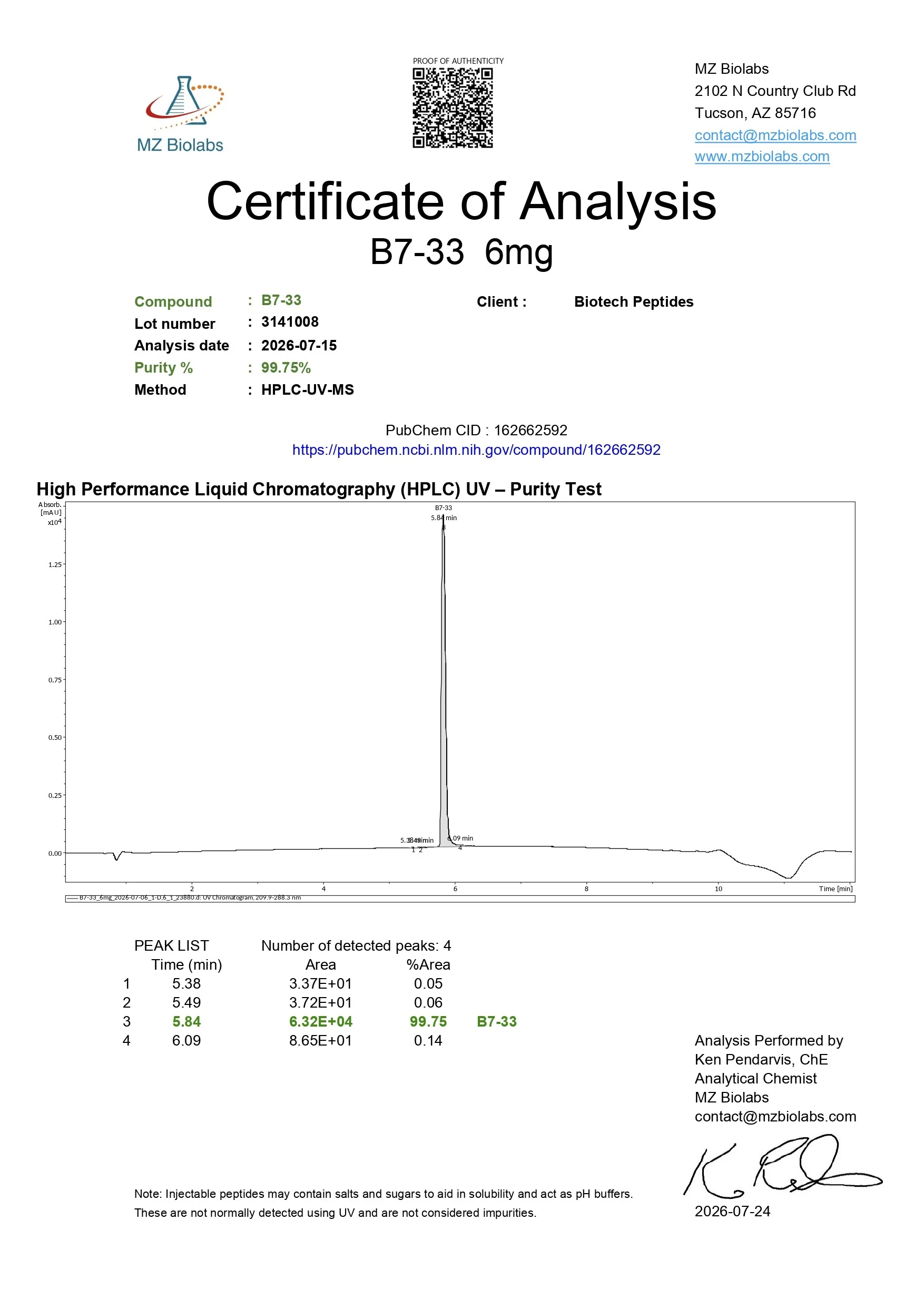
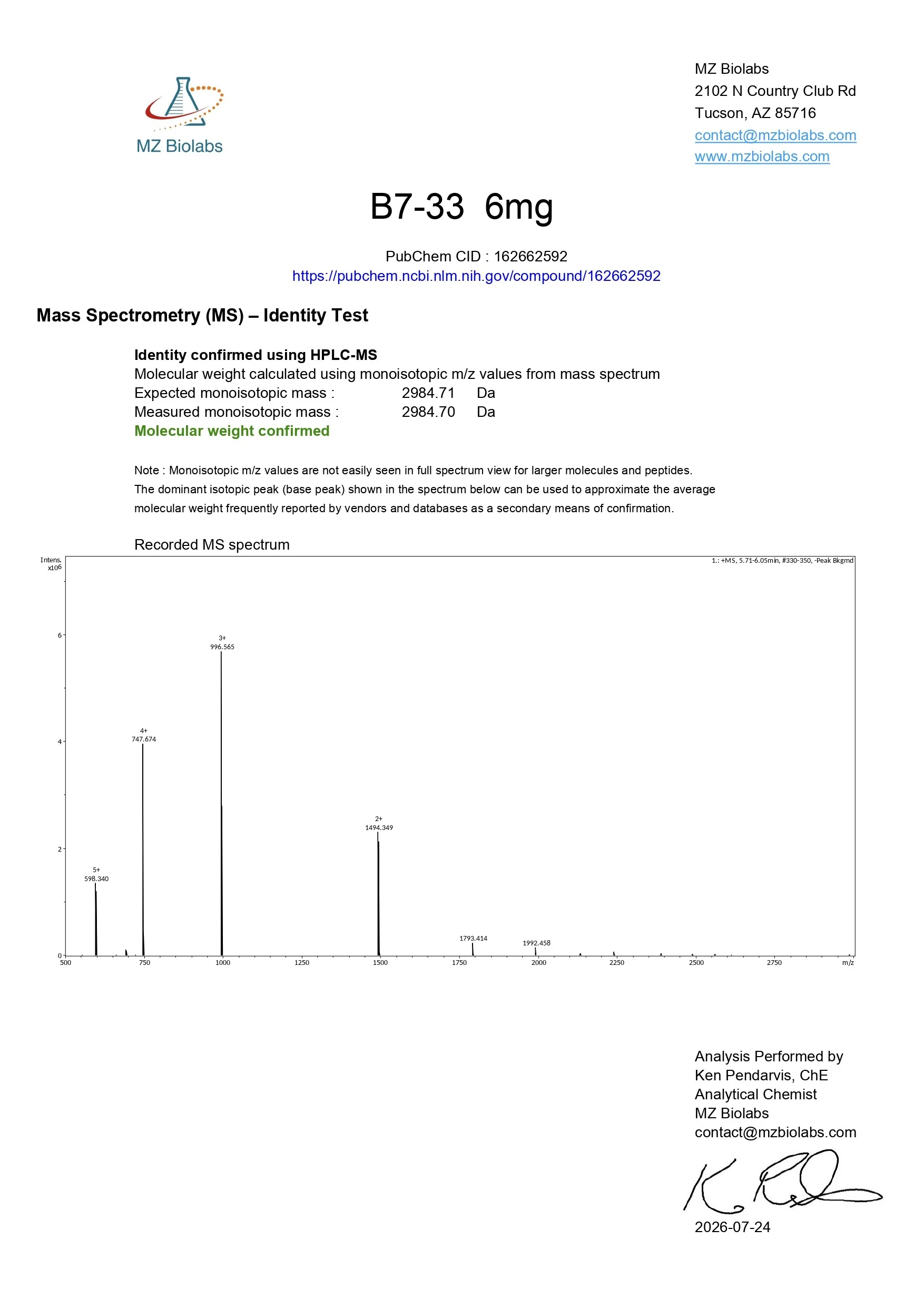
Buy B7-33 Peptide 6mg is a soluble synthetic single-chain peptide derived from the larger naturally occurring H2-relaxin protein. Also known as (B7-33)H2 and GTPL9321, B7-33 has been investigated as a functionally selective agonist associated with the RXFP1 receptor and signaling pathways involving ERK1/2 and matrix metalloproteinase 2 (MMP2).
Research has examined B7-33 in experimental models involving extracellular matrix remodeling, fibrosis, vascular function, cardiac tissue, endothelial signaling, and implant-associated fibrotic responses. Studies have also explored its relationship with RXFP1, pERK1/2 signaling, MMP2 expression, and collagen degradation.
Research surrounding B7-33 remains experimental and includes cell-culture and animal-model studies. Findings described on this page should not be interpreted as established effects in humans. B7-33 Peptide 6mg is intended strictly for Research Use Only (RUO).
B7-33 Peptide Specifications
| Specification | Details |
|---|---|
| Product Name | B7-33 Peptide |
| Quantity | 6mg |
| Other Known Titles | (B7-33)H2, GTPL9321 |
| Sequence | VIKLSGRELVRAQIAISGMSTWSKRSL |
| PubChem | 318164840 |
| Research Classification | Research Use Only (RUO) |
What Is B7-33 Peptide?
B7-33 is a soluble synthetic peptide derived from H2-relaxin, a naturally occurring member of the relaxin peptide family. The source material describes B7-33 as retaining some of the experimental properties associated with relaxin while displaying a different signaling profile.
The relaxin family includes four endogenous receptors organized into two receptor pairs: RXFP1/RXFP2 and RXFP3/RXFP4. B7-33 has been particularly investigated in relation to RXFP1 and downstream ERK1/2 signaling.
One notable feature of B7-33 research is the reported preference for pERK1/2 signaling over cAMP signaling. Researchers have investigated whether this functional selectivity may contribute to the peptide’s observed effects on MMP2 expression and extracellular matrix remodeling.
B7-33 and RXFP1 Research
Research described in the supplied material characterizes B7-33 as a potential functionally selective agonist of RXFP1. Whereas H2-relaxin has been reported to interact with both RXFP1 and RXFP2, the source describes B7-33 as having limited apparent activity through cAMP pathways associated with RXFP2.
Experimental research has investigated B7-33 in cardiac fibroblasts and murine renal myofibroblasts. In these models, B7-33 was associated with increased activity of matrix metalloproteinase 2 (MMP2), an enzyme involved in extracellular matrix and collagen degradation.
The reported MMP2 activity was inhibited by an RXFP1-specific antagonist, providing experimental support for an RXFP1-dependent mechanism. Research has also examined the possibility that B7-33 may signal through RXFP1-AT2R heterodimers.
B7-33 and ERK1/2 Signaling
B7-33 has been investigated for its ability to stimulate phosphorylation of ERK1/2. ERK1/2 forms part of the mitogen-activated protein kinase signaling network and is involved in cellular processes including proliferation, differentiation, and survival.
The supplied research suggests that B7-33 preferentially activates the pERK1/2 pathway rather than stimulating cAMP production. This distinction has been investigated as a possible explanation for differences between B7-33 and the larger H2-relaxin molecule.
Researchers have proposed that RXFP1 activation followed by pERK1/2 signaling may contribute to increased MMP2 production and subsequent extracellular matrix remodeling. These mechanisms remain subjects of experimental investigation.
B7-33 and Anti-Fibrotic Research
Fibrosis involves excessive deposition and remodeling of extracellular matrix components, including collagen. B7-33 has been investigated in experimental models examining fibrotic tissue responses.
Research described in the supplied material has examined B7-33 in cardiac and pulmonary models. In experimental models of myocardial infarction-associated cardiac injury, B7-33 was reported to reduce measures of cardiac fibrosis and was associated with changes in cardiac function.
Additional research has investigated B7-33 in mouse models involving allergic airway responses and lung fibrosis. These experiments have contributed to the hypothesis that selective RXFP1 signaling through pERK1/2 may influence myofibroblast differentiation and extracellular matrix deposition.
The proposed mechanism includes a pathway involving pERK1/2, neuronal nitric oxide synthase (nNOS), nitric oxide (NO), and cGMP. Researchers have investigated whether this signaling network may contribute to changes in myofibroblast behavior and collagen accumulation.
B7-33 and MMP2 Research
Matrix metalloproteinase 2, or MMP2, is an extracellular matrix-degrading enzyme that has been an important focus of B7-33 research. Experimental studies have investigated whether B7-33 can increase MMP2 activity through RXFP1-dependent signaling.
Because MMP2 participates in extracellular matrix remodeling, researchers have explored whether increased MMP2 activity could influence collagen degradation in experimental models of fibrosis.
The source material reports that B7-33 may demonstrate substantial potency in stimulating MMP2 in certain experimental cell systems. However, these findings are model-specific and should not be interpreted as evidence of an established clinical effect.
B7-33 and Vascular Research
Vascular biology represents another area of B7-33 research. Experimental studies have compared B7-33 with H2-relaxin in relation to endothelial function and vascular relaxation.
Research in murine models has investigated whether B7-33 may enhance bradykinin-mediated endothelium-dependent relaxation. The proposed mechanism involves increased endothelium-derived hyperpolarization in particular vascular beds.
The supplied material notes that these effects were not uniformly observed across all vessels examined, including the small renal artery and aorta. Additional experiments involving mesenteric arteries investigated endothelial dysfunction induced by placental trophoblast-conditioned media.
In these experimental models, B7-33 was investigated for its potential to prevent or reduce the development of endothelial dysfunction. Researchers have proposed that B7-33 may reproduce certain acute vascular effects observed with H2-relaxin under controlled experimental conditions.
B7-33 and Endothelial Signaling Research
Endothelial dysfunction is an important subject in vascular research. The supplied studies examined whether B7-33 could influence endothelial responses under experimental stress conditions.
Research involving mesenteric arteries suggested that B7-33 and H2-relaxin may enhance bradykinin-mediated relaxation through mechanisms involving endothelium-derived hyperpolarization. These findings have contributed to further investigation into the relationship between RXFP1 signaling and vascular endothelial function.
Because the observed effects can vary according to tissue, experimental model, and vascular bed, additional research is necessary to characterize the full signaling profile of B7-33.
B7-33 and Cytotrophoblast Research
B7-33 has also been investigated in experimental research involving cytotrophoblast cells. These studies examined signaling pathways associated with vascular endothelial growth factor (VEGF), placental growth factor (PlGF), and soluble fms-like tyrosine kinase-1 (sFlt-1).
The supplied research describes experimental conditions involving marinobufagenin (MBG) and elevated glucose concentrations. Under these conditions, cytotrophoblast cells demonstrated changes in angiogenic signaling markers. B7-33 and a lipidated derivative were subsequently investigated for their effects on these responses.
The reported findings suggested that B7-33 may influence VEGF expression in cytotrophoblasts and that this effect could be reduced by an RXFP1 antagonist. Researchers have therefore investigated RXFP1 signaling as a potential mechanism connecting B7-33 with cytotrophoblast signaling.
The source also reports that lipidation may extend the experimental half-life of B7-33 without substantially altering its observed activity. These findings are relevant to peptide-structure and pharmacokinetic research but do not establish a clinical application.
B7-33 and Implant Research
Fibrotic responses surrounding implanted medical devices are another area in which B7-33 has been experimentally investigated. Excessive fibrotic encapsulation can influence the performance and long-term function of implanted materials.
Research has explored B7-33 as a potential component of experimental biomaterial coatings. The supplied material describes studies in which controlled release of B7-33 from a device coating was associated with reduced fibrotic capsule thickness over an experimental six-week period.
These findings have contributed to research into whether localized peptide release from biomaterials could influence extracellular matrix remodeling and the foreign-body response.
B7-33 Peptide Production and Structure
Compared with the larger H2-relaxin protein, B7-33 is described as having a simpler molecular structure that may make synthetic production less complex. The source material notes that its comparatively less complicated two-dimensional and three-dimensional structure may facilitate production of the peptide.
The supplied sequence for B7-33 is VIKLSGRELVRAQIAISGMSTWSKRSL. Researchers investigating peptide structure-function relationships can use this defined sequence when conducting analytical, biochemical, or receptor-signaling studies.
Potential B7-33 Research Areas
- RXFP1 receptor signaling research
- Relaxin-family peptide research
- ERK1/2 and pERK1/2 signaling studies
- cAMP-independent receptor signaling
- MMP2 and extracellular matrix research
- Collagen remodeling studies
- Fibroblast and myofibroblast research
- Cardiac fibrosis experimental models
- Vascular and endothelial function research
- Bradykinin-mediated vascular signaling
- Cytotrophoblast and angiogenic signaling studies
- Biomaterial and implant-coating research
- Foreign-body response and fibrotic encapsulation research
B7-33 Peptide FAQ
What is B7-33 peptide?
B7-33 is a soluble synthetic single-chain peptide derived from H2-relaxin. It has been investigated primarily in relation to RXFP1 signaling, ERK1/2 activation, MMP2 activity, extracellular matrix remodeling, and experimental fibrosis models.
What is the sequence of B7-33?
The supplied sequence is VIKLSGRELVRAQIAISGMSTWSKRSL.
What is B7-33 also called?
B7-33 is also identified in the supplied material as (B7-33)H2 and GTPL9321. Its PubChem identifier is 318164840.
What is B7-33 researched for?
B7-33 has been investigated in experimental research involving RXFP1 signaling, ERK1/2 phosphorylation, MMP2 expression, extracellular matrix remodeling, cardiac and pulmonary fibrosis models, vascular endothelial function, cytotrophoblast signaling, and biomaterial coatings.
Is B7-33 intended for human use?
No. B7-33 Peptide 6mg is designated Research Use Only (RUO). It is not intended for human or veterinary use, consumption, diagnosis, treatment, prevention, or administration.
Research Use Only Disclaimer
B7-33 Peptide 6mg is intended strictly for research and laboratory use only. This product is not intended for human or veterinary use, consumption, diagnosis, treatment, prevention, or mitigation of any disease or medical condition. It is not a dietary supplement, pharmaceutical product, or therapeutic product.
The information presented on this page is provided for scientific and educational purposes. Research findings described for B7-33 are based on experimental cell and animal models and proposed mechanisms. These findings should not be interpreted as established clinical effects or evidence of safety or efficacy in humans. Researchers are responsible for handling, testing, storage, and use of this material in accordance with applicable laboratory procedures, institutional requirements, and local regulations.




Reviews
There are no reviews yet.